Posted on December 3, 2022 by cprime-admin -

A Train Leaves the City Traveling at 65 Miles Per Hour…
An Argument for Baseline ART-Level Metrics That Actually Prove Success
As a SAFe® Fellow, Agile consultant, and trainer, I love working with clients to establish their first Agile Release Trains (ARTs) and watching them start reaping the benefits of a scaled Agile practice.
But, there’s a challenge that I see consistently in these situations: my clients struggle with determining how well their ART is performing using concrete measurements. This gets in the way of the vital “inspect and adapt” cycle that holds such an important place in the Agile methodology. After all, if there’s really no established definition of success or consistent means of measuring performance against that goal, how will you know what needs to be improved? And, if you can’t prove your first ART is succeeding, how will you get approved to expand the pilot program?
“The problem….is metrics. It is a situation where if you can’t count what is important, you make what you can count important.”—James Willbanks (Army Advisor)
To address this issue, many organizations make the mistake of tracking vanity metrics.
These are simple measurements that look good on paper, but that don’t really say much about the success of the program or track improvements that matter. Some examples include:
- How many ARTs have been launched
- How many people have been trained
- Velocity
These are certainly measurements you can (and probably should) track over the course of establishing and scaling your ARTs. But, they don’t really have any bearing on how successful the ART is. They don’t identify opportunities for improvement in the ART’s effectiveness. They just report how busy the ART has been.
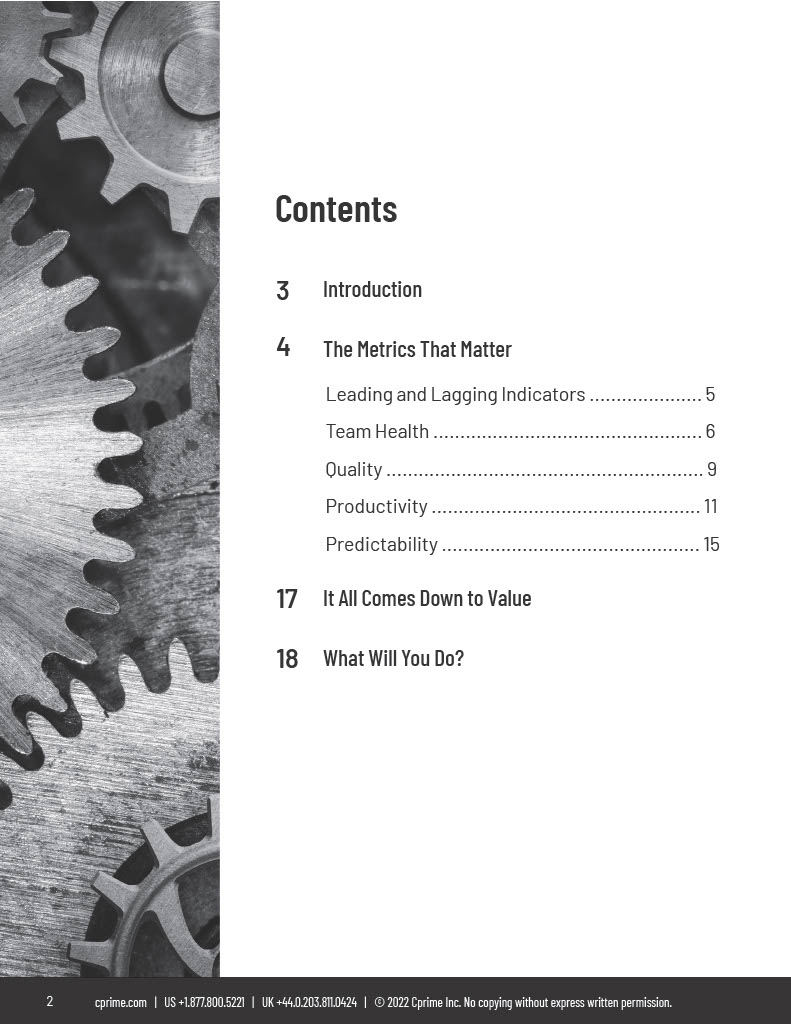
The Metrics That Matter
So, I’ve spent a lot of time thinking about metrics that matter.
How do we demonstrate that we have made improvements? That the new way of working is worth adopting? How do we show that the ART is sustainably improving in its ability to generate value?
The best way to demonstrate success is empirically. But, it’s not enough to look at one value in a vacuum. Rather, it requires a balanced view. In the end, I settled on four domains:
- Team Health
- Quality
- Productivity
- Predictability
Each domain has a set of basic metrics that every organization should be able to collect and analyze without investing too much time and effort.
We will look at each domain in turn but first, we need to understand the difference between leading and lagging Indicators.
Download the white paper now to keep reading! –>
Posted on November 17, 2022 by cprime-admin -
How to embrace the disruption that SAFe® Transformation brings to your teams and create a sustainable enterprise-wide value?
The decision to launch Agile Transformation is usually dictated by a unique combination of organizational goals and challenges that keep you from achieving them. These may include insufficient processes and inappropriate management framework, fragmented collaboration and lack of visibility into the bigger picture, outdated technology, and tools that do not communicate.
Here’s a brief overview of all the services that allow Cprime to take a holistic approach to shape your journey to Enterprise Agility while providing a clear answer if SAFe® is the proper framework for you. Learn what Cprime does to help you design long-term strategic vision, harness technology, enable teams, and improve business continuity through SAFe® adoption.
[cprime_btn link=”https://www.cprime.com/wp-content/uploads/2022/11/SAFe_Transformation_with_Cprime-One-Pager.pdf” label=”VIEW GUIDE” new_tab=”yes”]
Posted on November 10, 2022 by cprime-admin -
Based on research by Bettercloud, organizations with more than 1,000 employees use over 150 different apps, on average, to do business. Smaller organizations use about the same, proportionally speaking. From IT to marketing to sales to finance, every department has its own stack of tools they work with. But do these dozens of valuable solutions talk to each other? Can data be easily and automatically shared across the enterprise?
In many cases, the answer is no.
When collaboration and data sharing are necessary, a hodgepodge combination of spreadsheets and Powerpoint presentations generally suffice. Shared folders, email, and Slack generally make essential documentation hard to find. These high-maintenance, primarily-manual processes are familiar and comfortable despite being rife with inefficiency and errors.
Is it any wonder inertia keeps organizations running in this fashion? But, there IS a better way.
Download this whitepaper today to learn about Enterprise Application Integration (EAI) and how your organization can take advantage of EAI to streamline business processes, increase efficiency and productivity, and achieve greater business success.
Posted on September 21, 2022 by cprime-admin -
As the speed of business increases exponentially, many organizations find themselves in an awkward position: knowing they need to fundamentally change how they do business, but unsure of how to approach such a monumental undertaking. The pandemic and all its effects have greatly accelerated what was already a dizzying situation.
Without a doubt, organizational transformation is nothing to be taken lightly. Handled poorly, it can upset years of hard-won success. Even if handled well, there are bound to be growing pains. But, approaching change with the correct principles in mind and focusing on comprehensive change management can mitigate risks and make the entire process far smoother.
In this white paper, we will be outlining portions of a tried and true framework for organizational change. We will discuss how the steps outlined in this framework can be applied using Lean-Agile methods, and examples of how organizations we’ve worked with have done just that.
Posted on August 29, 2022 by cprime-admin -
The modern IT department manages a host of complex challenges on any given day; from routine ad hoc hardware problems (“turn it off and turn it back on again, Daryl”), to the maintenance of mission critical hardware and software systems. IT is central to the ongoing success of most organizations today, so it only makes sense that IT teams are always on the lookout for ways to improve.
In this whitepaper, we will break down Information Technology Service Management (ITSM): what it is, why it’s important, and how it can be improved. We’ll do this by following some of the day-to-day challenges experienced by IT teams. Along the way, we’ll discuss:
- The Information Technology Infrastructure Library (ITIL) framework
- The role tooling plays in achieving ITSM success
- A solution offered by Cprime to help put these pieces together
Download this whitepaper today!
Posted on April 5, 2022 by cprime-admin -
Organizational culture can be defined as a set of values, behaviors, and beliefs that contribute to the unique social and psychological environment of an organization. Agile frameworks can have a powerful and productive influence on organizational culture when aligned.
Can Company Culture and Agile Frameworks Align?
This paper offers guidance on how to choose the best-suited Agile framework based on existing culture, and how to maximize that alignment between your organizational culture and the Agile framework you choose to adopt.
Download this whitepaper to learn more.
Posted on January 4, 2022 by cprime-admin -
One of the most critical aspects of enterprise agility is alignment. If an organization is not strategically aligned at all levels, it can’t achieve true agility. And, the first step toward alignment is establishing strategic goals for the company that can be effectively mapped down through all levels, resulting in the individual tasks employees carry out daily.
The creation and communication of Objectives and Key Results (OKRs) form the foundation of ongoing strategic alignment. It is the single most critical piece of the puzzle because effective OKRs can cut through politics, smooth change management, reduce friction between teams, and dramatically improve engagement across the enterprise.
Download this whitepaper to learn more about OKRs and how they help businesses seeking practical tools for goal setting and strategic alignment.