Revolutionizing PayPal: The Largest Atlassian Cloud Migration in History
PayPal, a global leader in online payments, faced significant challenges with their existing infrastructure, which…
AI adoption scales when people and AI learn to work together.
Turn AI access into real operational value through human‑centered workflow redesign and embedded coaching.
Cprime’s AI Adoption and Change Coaching helps organizations redesign workflows around high-value human-to-AI handoffs so employees collaborate with AI consistently in daily execution.
The result? Organizations build sustained adoption, recover operational capacity, and embed AI into the systems where work and decisions actually happen.
Schedule an AI adoption readiness assessment.

Organizations are investing heavily into AI and copilots, yet many still struggle to see consistent measurable returns. The reason is simple: AI transformation is no longer a technology challenge. It’s a human one.
To unlock the value of your AI investment, enterprises must shift from “tool deployment” to behavior, workflow, and operating model transformation.

Even with strong AI platforms in place, organizations fall short because of persistent human‑factor barriers. Across industries, several patterns consistently slow AI adoption. When these gaps persist, organizations accumulate AI capability without realizing measurable value.

Teams experiment with AI tools only for ad‑hoc tasks or search, not embedded, repeatable workflows. Instead of becoming a steady part of the workflow, it stays on the sidelines.

Employees fear obsolescence, distrust AI outputs, or cling to manual processes. That hesitation keeps them anchored to manual work.
AI pilots remain as isolated experiments rather than becoming standard operating practice across teams, stalling before enterprise‑wide integration.

When official guidelines or guardrails are unclear, employees adopt unapproved tools, creating security, compliance, and data risks.
Without clear verification practices, employees hesitate to rely on AI for meaningful decisions. These gaps form the human bottleneck, the biggest obstacle to realizing human and AI ROI.
Executives increasingly view AI as a strategic capability. Yet scaling AI adoption across an enterprise introduces new challenges.
When AI is woven into day‑to‑day work:
• Teams get more done by shifting from ‘doers’ to ‘orchestrators’
• Decision‐making becomes faster and more precise
• Innovation becomes less risky with governed, compliant tools and behaviors
When AI is woven into day‑to‑day work:
• It can lift the repetitive work that contributes to burnout
• give employees more space for strategic thinking
• help them build new skills faster
• Employees feel more capable and less bogged down, which supports both performance and retention.

Organizations evolve through five maturity stages as AI becomes woven into daily work:
• Usage – Occasional, exploratory usage for research or small tasks.
• Literacy – Understanding AI behavior, limitations, and verification of outputs.
• Outcome Orientation – Employees define work by results, not manual tasks.
• AI‑Core Workflows – AI integrated into key workflows and decisions processes.
• AI Co‑Worker – Teams orchestrate AI capabilities as collaborators within the workflow.
Our goal: move your organization toward AI‑Core Workflows and AI Co‑Worker maturity.


You cannot mandate mindset. You must diagnose it.
Our AI in the Workplace Assessment evaluates how your workforce thinks, feels, and behaves with AI today across four critical vectors:
• Literacy – Do employees understand how to orchestrate AI, not just prompt it?
• Attitudes & Culture – Is AI viewed as an enabler, or a threat?
• Aptitude – Can teams adapt deeply ingrained workflows?
• Compliance – Are behaviors safe, governed, and consistent?
The result: a data‑driven Human Bottleneck Heat Map and a prioritized 90‑day execution roadmap.
Turning AI access into real capability through AI change management
Cprime’s AI Adoption and Change Coaching helps organizations equip their people to work with AI so it becomes a trusted part of everyday execution.
Our coaches embed with teams, redesign workflows, and guide employees through the shift from occasional AI usage to consistent human‑AI collaboration.
Our coaches work directly within your delivery teams to:
• Redesign workflows for AI‑First execution.
• Build role‑specific AI skills for leaders, practitioners, and teams.
• Increase verification confidence and human‑in‑the‑loop safety.
• Reinforce daily behaviors through simulation, feedback, and shadowing.

AI‑augmented knowledge workers can complete tasks roughly 25% faster while producing up to 40% higher quality outputs. Improved decision velocity allows teams to move from intuition‑driven decisions toward data‑informed execution. As AI-augmented workflows mature, organizations recover capacity that can be reinvested into innovation, customer value, and strategic initiatives.
As organizations enable new ways of working, employees shift away from repetitive work and focus more on problem solving, creativity, and strategic thinking. Access to AI assistance accelerates skill development and time‑to‑proficiency for new capabilities. Teams begin to view AI as a collaborator they orchestrate rather than a tool they occasionally use.
Schedule a focused assessment to understand where adoption friction exists and where AI can deliver measurable operational value.
• Where AI can accelerate high-value workflows
• Workforce capability and AI literacy across roles
• Cultural and behavioral barriers to adoption
• Governance and trust risks that may slow scaling
• Early opportunities to demonstrate measurable outcomes

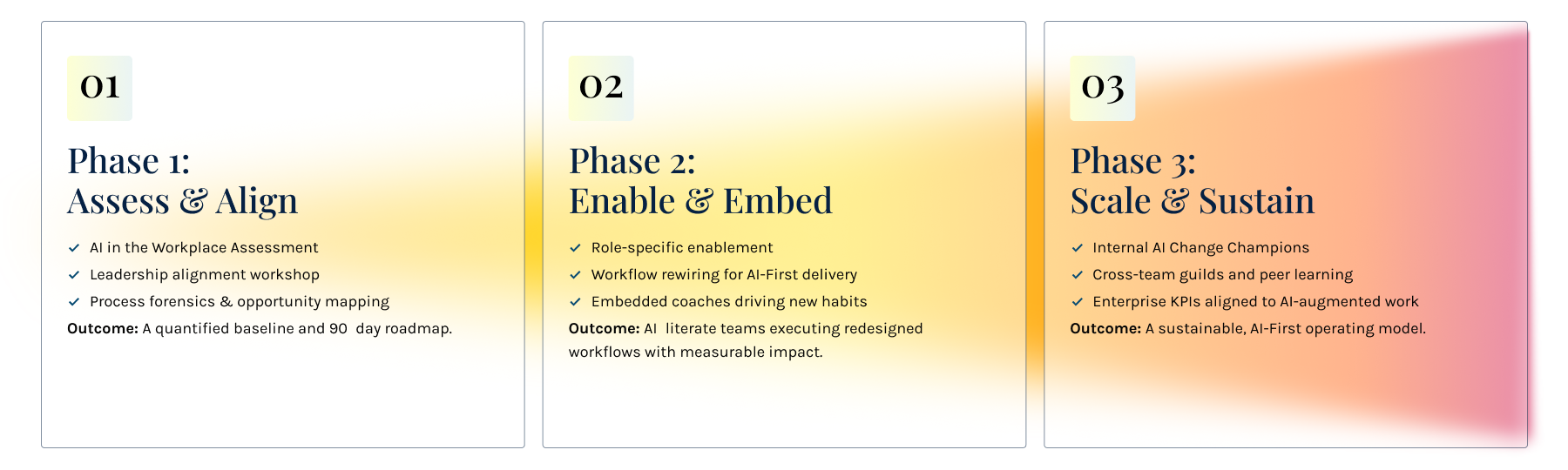
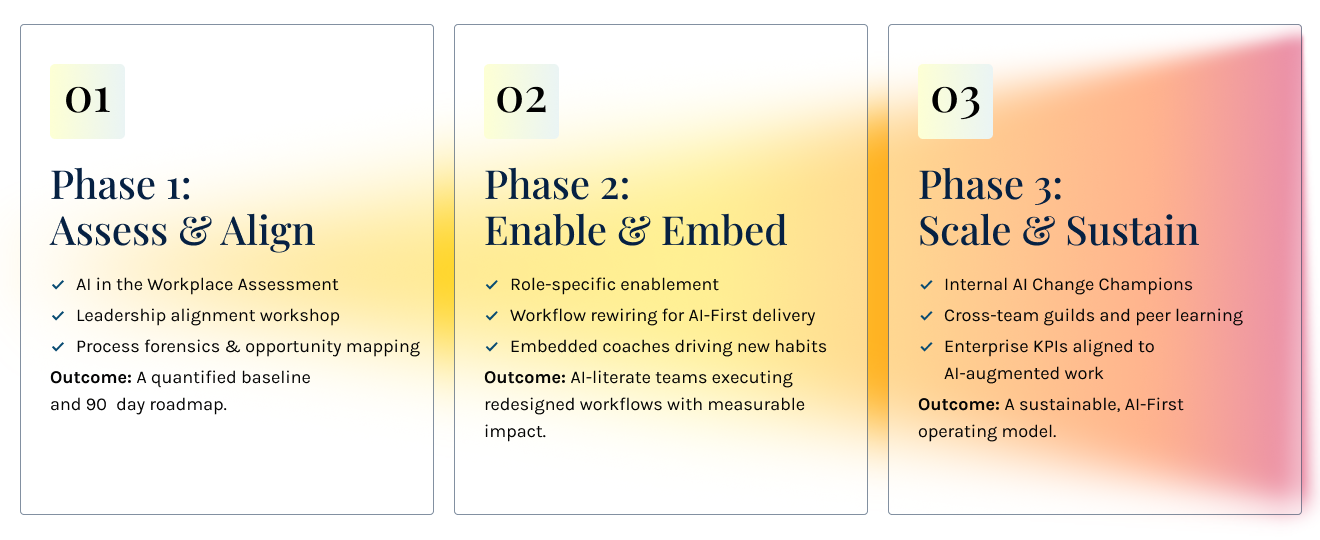
Successful AI adoption requires a structured approach that combines workflow redesign, behavioral change, and operational learning.
Prepare
Understand the current state through an AI readiness and friction assessment
Roadmap
Define role-specific integration paths that show where AI should augment work.
Iterate
Embed coaching within delivery teams to refine workflows and sustain improvement.
Measure
Track operational improvements such as cycle-time reduction and capacity recovery.
Enable
Develop internal capability so teams expand successful AI practices across the organization.
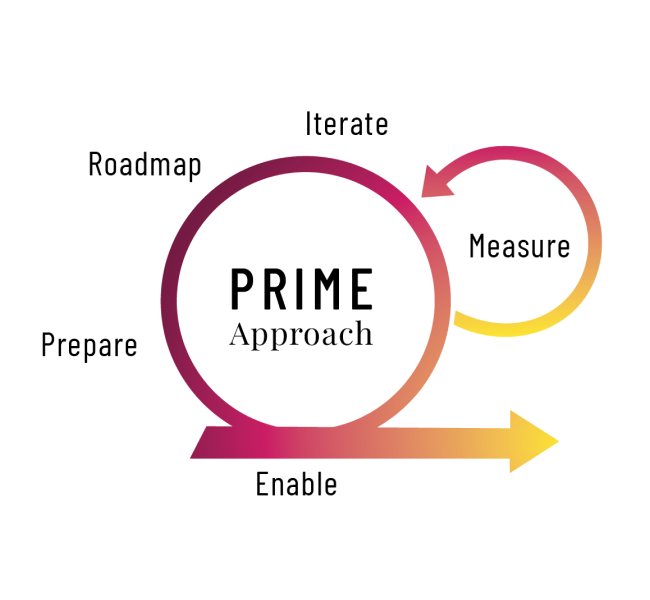
Cprime combines decades of enterprise transformation experience with practical coaching that embeds AI into real work. Our approach focuses on redesigning workflows, enabling teams, and scaling new behaviors across the organization.

Organizations exploring AI transformation often search for guidance on AI change management, workforce readiness, and how to scale adoption beyond early pilots.
AI change management focuses on helping employees adapt how they work so AI becomes part of daily execution. It includes workflow redesign, role-based enablement, governance practices, and hands-on coaching that guide teams through the shift to human-AI collaboration.
Many organizations deploy AI tools successfully but struggle to translate that access into measurable operational change. AI transformation change management addresses the workforce, workflow, and leadership alignment required to turn AI capabilities into consistent business outcomes.
An AI readiness assessment evaluates how prepared an organization is to adopt AI in real workflows. It examines operating models, workforce skills, governance practices, and workflow design to identify where AI can deliver value and what changes are required to scale adoption.
An AI readiness assessment framework typically evaluates several dimensions of readiness, including workforce capability, workflow maturity, governance and risk controls, and leadership alignment. These areas help determine where AI can be embedded safely and where change management efforts should focus first.
AI organizational change management helps employees shift from manual execution toward orchestrating AI-assisted work. Through coaching, workflow redesign, and capability development, organizations enable employees to work effectively with AI while maintaining human judgment and oversight.
Organizations realize AI value when they equip their people to experiment, adapt, and redesign work around human-AI collaboration. Schedule your AI adoption readiness assessment and start turning AI capability into measurable operational outcomes.