Revolutionizing PayPal: The Largest Atlassian Cloud Migration in History
PayPal, a global leader in online payments, faced significant challenges with their existing infrastructure, which…
Work is shifting faster than most organizations can adapt. Teams are blending human expertise with AI at every stage of execution, but legacy lifecycle models were built for predictable roles and linear careers.
The result is friction: skills fall behind, employee expectations evolve, and organizations struggle to coordinate performance across hybrid environments.
Our approach: AI-First Employee Lifecycle Management helps organizations redesign the employee journey so people and intelligent systems can grow, adapt, and deliver value together. The result is a workforce that stays capable, engaged, and aligned to changing business needs.
Take the Employee Lifecycle Management Maturity Assessment.

The workforce environment has fundamentally changed. Technical skill half-life continues to shrink, hybrid work reshapes expectations, and career paths evolve in real time. Traditional lifecycle systems cannot keep pace with this level of change.
Organizations that modernize the lifecycle now gain a lasting advantage: stronger capability, higher engagement, and a workforce that can adapt as fast as the business.
Skills aging faster than organizations can reskill
Fragmented tools and inconsistent hybrid experiences
Limited visibility into workforce capability and future needs
AI initiatives added to outdated workflows that weren’t designed to support them

An AI-first employee lifecycle replaces fragmented HR processes with a coordinated workforce system where intelligence, automation, and human judgment operate together.
Employees receive personalized guidance and development in the flow of work, while leaders gain insight into the skills and capabilities that matter most.
An AI-first lifecycle includes:
• Dynamic, skill-based career journeys that evolve as roles change
• Continuous learning and feedback embedded directly into daily work
• AI-enabled workflows that guide decisions and remove friction
• Workforce intelligence that improves capability planning and mobility
• Performance systems focused on contribution, capability, and enterprise impact
This creates a more adaptive workforce model where employees feel supported, leaders see what’s coming, and the organization moves faster.

Lifecycle experiences are redesigned around onboarding, capability development, mobility, and leadership growth to support long-term engagement and productivity.
AI supports tasks such as onboarding guidance, skills development, knowledge discovery, and performance insight while people retain responsibility for judgment and decision-making.
Unified workforce data enables leaders to understand skill gaps, anticipate workforce needs, and guide talent investment with clearer insight.
Performance insight focuses on capability growth, contribution to enterprise priorities, and collaboration across teams.
Modernizing the employee lifecycle doesn’t only strengthen HR operations. It affects revenue, performance, and long-term workforce value. Organizations that shift to AI-first lifecycle practices often see:

Faster time-to-productivity
Through AI-guided onboarding and role activation
Higher workforce output
As employees build relevant skills continuously
Longer productive tenure
Driven by better development and mobility options
Reduced avoidable attrition
Through clearer pathways and more consistent support
Improved customer impact
As engaged employees deliver better experiences and drive revenue growth
Take the Employee Lifecycle Management Maturity Assessment to see how prepared your workforce systems are for AI-enabled work.
Even with strong intentions, many organizations struggle to redesign lifecycle systems. Solving these issues requires redesigning how employee journeys, workforce data, and AI capabilities operate together.
Lifecycle ownership is often distributed across HR, L&D, managers, and IT, which makes it difficult to maintain consistency or accountability. Much of the work still relies on manual steps and episodic processes that aren’t designed to support continuous development.
This manifests itself in:


Without integrated data foundations, predictive insight becomes limited, making it harder to plan or respond to shifting workforce needs. Many enterprises layer AI tools on top of legacy workflows, creating friction on legacy systems not designed to support intelligent automation.
This leads to:
Even when technology is in place, employees often hesitate to trust or adopt AI-enabled tools unless expectations are clear and the experience feels supportive. Without intentional design, these gaps erode confidence and make it harder for people to embrace new ways of working.
That’s why you’re probably seeing:

Cprime helps organizations modernize the employee lifecycle by blending human-centered experience design with AI-enabled workflows and workforce intelligence. We redesign workforce systems so AI becomes embedded in how people work, grow, and contribute.
We design lifecycle journeys around the moments that matter most: onboarding, learning, mobility, advancement, and leadership development. Employees receive consistent, personalized support across hybrid environments.
• Persona‑based employee journey design
• AI‑enabled onboarding and career development
• Consistent experiences across hybrid and distributed environments
We modernize lifecycle workflows across HR platforms, embedding automation and AI where they can reduce friction, improve clarity, and support continuous development.
• Lifecycle workflow orchestration across HR platforms
• Continuous learning and skills development systems
• AI‑enabled performance and feedback models
We unify workforce data and build insight layers that help leaders anticipate skills gaps, understand capability needs, and make more informed talent decisions.
• Unified workforce data foundations
• Predictive insights into skills, mobility, and workforce planning
• Decision support for workforce strategy
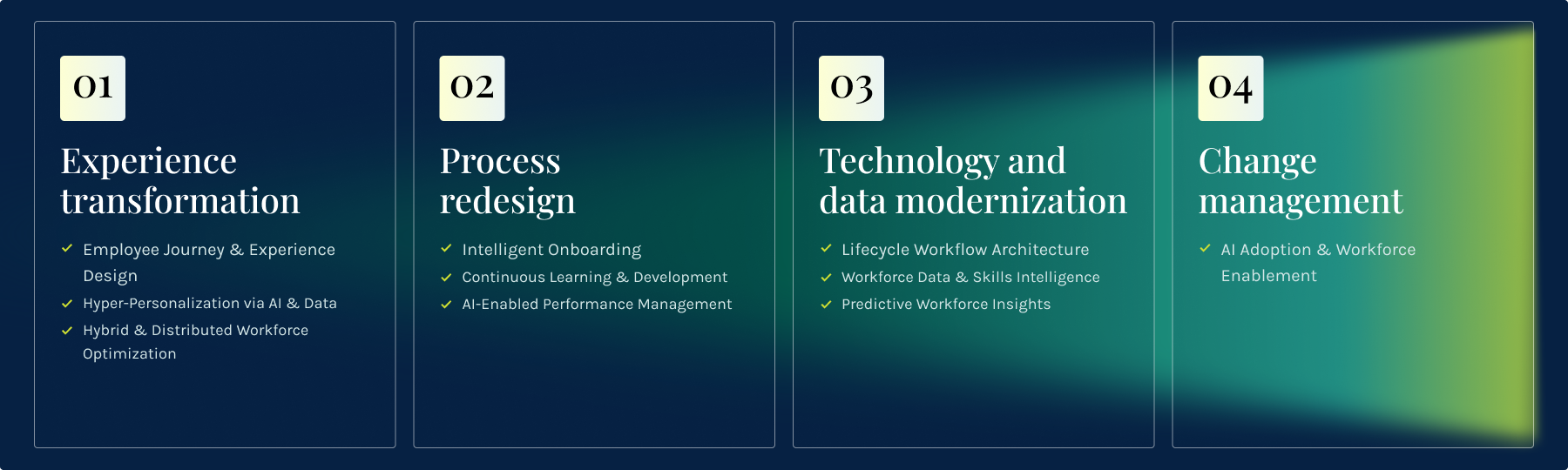
AI‑first lifecycle transformation succeeds when employee experience redesign, AI enablement, and organizational adoption move forward together. Cprime brings the integrated capabilities needed to support all three, backed by proven expertise modernizing enterprise workforce systems at scale.
With more than twenty years of experience modernizing operating models and workforce systems, our teams combine strategic insight with practical engineering and human-centered change leadership to ensure AI becomes a trusted and valuable part of how people work.

Understanding how employee journeys, workforce data, and AI capabilities interact is the first step toward lifecycle transformation. The Employee Lifecycle Management Maturity Assessment evaluates how your current workforce systems support AI‑enabled work and identifies the highest‑value opportunities for improvement.
Assessment outcomes typically include:
• Lifecycle maturity baseline
• Workforce capability gaps
• AI opportunity areas across the employee journey
• Prioritized transformation roadmap

Employee lifecycle management refers to the structured way organizations manage the stages of an employee’s journey—from recruitment and onboarding through development, performance, and eventual transition. Effective lifecycle management aligns workforce experience, skills development, and operational needs to improve productivity, engagement, and long-term organizational performance.
AI-first employee lifecycle management redesigns workforce systems so AI supports employees across onboarding, learning, performance, and career development. Instead of simply automating HR tasks, organizations embed AI into workforce workflows and decision processes to help employees work more effectively while maintaining human judgment and oversight.
No. Most organizations modernize employee lifecycle management by integrating AI capabilities into existing HR platforms while redesigning workflows, data foundations, and workforce processes. The goal is to improve how lifecycle systems operate across the enterprise without requiring wholesale replacement of core HR technology.
Organizations often begin with an employee lifecycle maturity assessment. This evaluation reviews employee journeys, workforce data, lifecycle workflows, and governance structures to identify capability gaps and opportunities. The result is typically a prioritized roadmap for improving employee lifecycle management and enabling AI-supported workforce systems.
Take the Employee Lifecycle Management Maturity Assessment to understand how prepared your workforce systems are for AI‑enabled work.