
Revolutionizing PayPal: The Largest Atlassian Cloud Migration in History
PayPal, a global leader in online payments, faced significant challenges with their existing infrastructure, which…
AI is advancing quickly. Operating models are not.
Many organizations are increasing their investment in AI, yet meaningful results often remain inconsistent. The obstacle usually comes from how work, decisions, and governance function inside the enterprise rather than from the AI technology itself.
Cprime’s AI‑first operating model design helps leaders redesign workflows, decision rights, governance and performance systems, so human judgment and AI agents work together inside real business processes.
Is your enterprise ready?

Enterprise AI spending is accelerating rapidly, yet many organizations struggle to demonstrate measurable ROI. The reason is structural.
Operating models built around manual handoffs, siloed ownership, and static governance can’t support AI at scale. The result? When AI is introduced without redesigning those systems it amplifies existing friction, not performance.
Common patterns we see:
• AI pilots never transition into operational workflows
• Decision rights remain fragmented across teams
• Governance systems operating outside of daily execution
• AI improves individuals, but workflows stay the same
• Metrics track usage, not operational outcomes
Without operating model redesign, AI becomes a disconnected tool layer rather than a performance system.

Our approach supports leaders who are ready to incorporate AI into core execution systems.
AI-first operating model design helps enterprises redesign how work operates so human judgment and AI agents collaborate inside real business execution.
The objective is not deploying more AI tools. The objective is establishing an execution system where people and AI operate together with clear ownership, embedded governance, and measurable performance outcomes.
Organizations typically achieve:
• Faster decision and execution cycles
• Reduced coordination overhead across teams
• Increased operational capacity through AI‑assisted execution
• Improved quality through standardized workflows and monitoring
• Governance embedded directly into operational workflows

Most organizations begin with early experimentation. As those efforts grow, structural issues become more visible. This is where operating model redesign becomes necessary.
AI capability typically develops through several stages before operating model change becomes necessary.
This engagement represents a later-stage transformation initiative. Organizations typically pursue it after they have begun experimenting with AI and are ready to redesign enterprise operating systems to scale value.
In most cases, leaders begin with an AI Readiness Assessment to evaluate operating model constraints, adoption risks, governance maturity, and workflow opportunities before initiating a full operating model transformation.
Cprime’s change management, coaching, and learning portfolio supports this progression by addressing the barriers that prevent AI from scaling across the enterprise.
The journey typically includes:
• Understanding readiness and friction points
• Addressing specific operational barriers
• Redesigning the operating system of the enterprise


Together, we identify behavioral, workflow, and governance constraints slowing AI adoption. These diagnostics help leaders understand where AI value is blocked.
Examples include:
• AI Readiness Assessment
• Workforce AI adoption and behavior assessment
• Workflow and delivery intelligence diagnostics
• Operating model maturity reviews
These assessments provide a baseline for understanding how AI interacts with current workflows, governance structures, and workforce readiness.
Such as workforce adoption, workflow augmentation, or employee lifecycle transformation.
These engagements establish foundational capabilities for human–AI collaboration across teams and functions.
Examples include:
• AI Adoption and Change Coaching
• AI-Augmented Product Development
• AI-First Employee Lifecycle Management
These initiatives begin embedding AI into real workflows while building the adoption discipline required for scale.


As AI expands across the organization, leaders often discover that structural constraints limit consistent performance improvement.
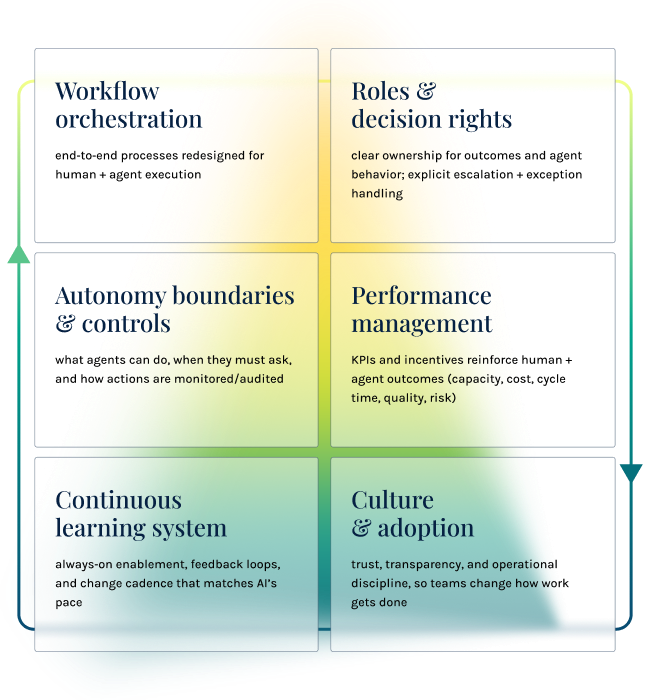
The transformation establishes the governance structures, workflow orchestration patterns, decision rights, and performance systems required for AI-enabled execution at enterprise scale.
This model brings clarity, structure, and coordination to the way humans and AI contribute to work.
Workflow orchestration
End‑to‑end workflows redesigned so humans and AI agents execute work together with clear task boundaries and escalation paths.
Decision rights and accountability
Explicit ownership for outcomes, agent behavior, and exceptions so decision flow is visible and accountable.
Embedded governance
Controls, monitoring, and auditability built directly into execution workflows rather than layered on afterwards.
Performance management
Operational KPIs that measure cycle time, capacity, cost‑to‑serve, quality, and risk across AI‑augmented workflows.
Continuous learning system
Feedback loops that allow workflows, policies, and agents to improve based on real operating signals.
We then design a Minimum Viable Operating Model (MVOM) that demonstrates how human judgment and AI agents collaborate within real workflows.
This initial design phase is typically informed by findings from the AI Readiness Assessment, which evaluates the organization’s operating structure, governance maturity, workflow architecture, and adoption readiness.
In parallel, we design a Target Operating Model (TOM) that allows the organization to scale successful patterns across teams, functions, and business units.

A working version of human and AI execution created inside a priority workflow. It includes role design, autonomy levels, workflow maps, governance, and runbooks. This approach lets organizations validate and refine new operating patterns before expanding them.
• Human and AI role design
• Decision rights and autonomy boundaries
• Workflow redesign for AI‑enabled execution
• Governance controls embedded in execution
• Runbooks for incidents, exceptions, and improvement
A design for scaling those patterns across teams and business units. It includes a KPI spine, orchestration patterns, portfolio governance, and enablement programs. In parallel, we design a target operating model (TOM) that allows the organization to scale successful patterns across teams, functions, and business units.
• Enterprise KPI spine and benefits realization model
• Standard workflow orchestration patterns
• Operating cadence aligned to AI improvement cycles
• Portfolio governance and prioritization model
• Enterprise enablement and adoption programs

Engagements typically produce a set of concrete operating artifacts that enable leaders to run AI‑enabled execution systems.
Deliverables may include:
• Human and AI operating model blueprint
• Workflow orchestration design pack
• AI portfolio operating model
• KPI spine and benefits realization framework
• Governance and monitoring model
• Runbooks for operating cadence and incident response
• Enterprise scaling playbook
These assets create the operational discipline required to convert AI investment into measurable enterprise performance.
When AI is embedded directly into the workflows that matter most, and when governance functions inside daily execution rather than around it, organizations begin to see clear improvements in how work flows and how outcomes are achieved.
When AI is embedded into mission‑critical workflows and governed in daily execution, organizations see measurable gains in:
Capacity
Teams can manage a higher volume of work because coordination becomes smoother and more automation takes place inside the workflow.
Cost‑to‑Serve
Fewer errors and less rework reduce operational friction.
Cycle Time
Shorter loops, fewer handoffs, and more connected steps create faster movement from intent to action.
Quality
Standardized workflows and real‑time monitoring reduce variation and help identify issues earlier.
Risk
Governance becomes part of the execution environment. With controls, auditability, and visibility built into the workflow, organizations can move quickly while maintaining confidence in how decisions and actions take place.

Organizations are reaching a turning point in AI adoption. Many have begun experimenting with AI across teams, yet value remains uneven because operating systems have not evolved to support AI‑enabled execution.
Operating model redesign addresses the structural barriers that prevent AI from delivering enterprise performance improvement.
Leaders pursue this transformation to:
• Move from isolated AI pilots to operational workflows
• Align strategy, funding, and execution around AI‑enabled work
• Establish governance that supports safe and scalable AI usage
• Create measurable performance improvements across workflows
AI becomes a repeatable execution capability embedded within enterprise operations.
Understanding where your operating system enables or constrains AI is the first step in moving toward an AI‑first enterprise.
For more than 20 years, Cprime has helped global enterprises redesign operating models and embed new ways of working at scale. That operating model transformation heritage now informs how we guide organizations through enterprise AI adoption.
Rather than treating AI as a standalone technology initiative, we apply proven operating model design disciplines to ensure AI capabilities integrate into real workflows, decision systems, and governance structures.
Our teams combine:
• Operating model transformation expertise built across two decades of enterprise engagements
• Organizational change and adoption leadership
• Product and delivery operating model design
• AI transformation strategy and enablement
This foundation allows organizations to move beyond experimentation and establish reliable human‑AI execution systems.

An AI‑first operating model redesigns workflows, roles, governance, and performance systems so human judgment and AI agents operate together inside daily execution. Instead of AI functioning as a tool layer, it becomes embedded in mission‑critical workflows where decisions, actions, and monitoring occur.
Many initiatives focus on deploying AI tools without redesigning workflows, governance systems, and decision rights. When operating models remain unchanged, AI assists individuals but does not change how work flows across the enterprise, which limits measurable business impact.
Typical outputs include operating model blueprints, workflow redesign frameworks, governance structures, performance metrics, and operating runbooks. These assets help organizations embed AI into real workflows and scale adoption across teams.
Initial design phases typically focus on a minimum viable operating model across priority workflows. This foundation can be developed in several weeks, with enterprise scaling and enablement occurring over longer transformation programs.
The AI Readiness Assessment evaluates governance structures, workflow design, adoption readiness, and operating model constraints that influence how AI performs inside the organization.