Resource Topic: Service Management

ESM Webinar Series Part 2 | The Keys to Optimal ESM are Automation and Integration

Enterprise Service Management (ESM) is an optimized combination of the right software solution, well-thought-out processes and workflows, and customized automation that effectively supports a customer-centric approach to each service an internal business unit undertakes.

In this three-part webinar series, we focus on those building blocks to provide a well-rounded understanding of ESM and how it can effectively uplevel your internal and external customer service processes.

In Part Two, The Keys to Optimal ESM are Automation and Integration, you will learn:

  • The power of automation to streamline and optimize your ESM practice
  • Examples of apps, workflows, and integrations that have proven successful
  • How to map out your own workflows to optimize your unique ESM experience

 
Speakers:

Sneha Crews
Managing Director for Solutions Engineering, Cprime
Eric Rodstein
Senior Solutions Engineer, Cprime

Perfecting Customer Management Using Jira Service Management

An optimized ITSM practice using Atlassian Jira Service Management (JSM) has brought tremendous benefits to organizations seeking to cement a customer-centric approach to their service management processes.

In the first two parts of this webinar series, we discussed an introduction to change management, service catalogs, and CMDB, and how they can all be applied and optimized using JSM. In this third installment, we cover the vital topic of customer management. You will learn:

– The importance of understanding the customer’s perspective and requirements
– How to best use JSM for customer management—from portal design to automation and beyond
– How to use JSM to empower your Shift Left—an integrated knowledge base, dynamic forms, intelligent queues, and more
– How to measure customer management for reporting and data-driven decision making

Speaker:

Clayton Chancey
Senior Solutions Architect, Cprime

Using a Service Catalog and CMDB to Standardize Change Management in Jira Service Management

A streamlined and optimized ITSM practice offers tremendous benefits to your IT teams and your entire organization. But, the vital ITSM practice of change management can still be challenging for many.

In our previous webinar in this series, we discussed how to best enable change management in adherence to the ITIL framework and using Jira Service Management (JSM). In this webinar, we take those ideas a step further by incorporating a service catalog and configuration management database as tools to help standardize the change management process and further minimize disruptions.

After watching this webinar, you’ll understand:

-The role of a Service Catalog in ITSM
-How to create and curate an effective Service Catalog
-How to build and manage a Configuration Management Database (CMDB)
-How to best leverage CMDB for service improvement

Speaker:

Clayton Chancey
Senior Solutions Architect, Cprime

The Future of IT Service Management

Stay ahead of the curve in IT automation, security, and ITSM processes.

As technology evolves, the demands placed on IT service management processes are constantly changing.

In this unique research report conducted by enterprise software provider Appfire and global consulting firm Cprime, in partnership with the market research experts at Adience, we’ll dive into pressing ITSM topics like:

  • Automation for ITSM processes
  • SLA management and improvement of KPIs
  • Why aren’t more organizations automating?
  • The benefits and challenges of distributed teams, and security in an increasingly remote world
  • Migrations from self-hosted servers to the cloud and other options
  • Unlocking business opportunities for growth with ITSM


Enterprise Service Management Webinar Series Part 1 | ESM Foundations: Do You Understand Your Customer Journey?

Enterprise Service Management (ESM) is an optimized combination of the right software solution, well-thought-out processes and workflows, and customized automation that effectively supports a customer-centric approach to each service an internal business unit undertakes.

In this three-part webinar series, we focus on those building blocks to provide a well-rounded understanding of ESM and how it can effectively uplevel your internal and external customer service processes.

In Part One of this webinar series you will learn:

  • The vital importance of cultivating a customer-first mindset
  • How to adjust your mindset to view your services as products
  • The power of a product/service roadmap

Speakers:

Devin Anderson
Strategic Product Coach, Cprime
Eric Rodstein
Senior Solutions Engineer, Cprime

A Pre-flight Checklist for Moving Your CMDB onto Jira Service Management Cloud

With the current market emphasis on Atlassian Cloud migrations and Jira Service Management (JSM), we get you ready for take off as we delve into the complexities of successfully migrating an existing CMDB (or implementing a new one) in the Atlassian Cloud.

In this webinar, we provide concrete examples and best practices to help guide your successful migration of Configuration Management Database (CMDB) from an on-prem architecture to a cloud architecture while highlighting the importance of design considerations for discovering and categorizing assets, various IT configurations, and integrating with JSM for effective Incident, Change, Request, and Problem Management.

Learn:
– Challenges and considerations of migrating an existing CMDB (or implementing a new one) in Atlassian Cloud
– Examples and best practices for a successful migration of your CMDB to a cloud architecture
– Benefits of a JSM integration

Speakers:

Clayton Chancey
Senior Solutions Architect, Cprime
Bob Hart
Senior Solutions Architect – Ecosystems, Device 42

Your Practical Guide to Enterprise Service Management

The speed and complexity of modern businesses are always growing and change is the only constant. To keep pace with ongoing acceleration, organizations undergo continual digital transformation. They adopt various software solutions to eliminate waste, create efficiencies, and streamline processes so they can keep pace with what their customers have come to expect, and many times, they work — to an extent.

Often, though, the very tools and processes that were expected to simplify and streamline the company’s internal workflow become a source of complexity in themselves. As a result, one department or line of business can become a silo, separated from others and struggling to collaborate effectively. More often than not, it’s the customer (the consumer of the service) who suffers in the long run, since the company is still trying to move fast, but those movements remain chaotic and unpredictable. 

There is not one “silver bullet” solution to this modern business challenge. But, a relatively new concept — Enterprise Service Management (ESM) — has proven highly effective in smoothing out the internal roadblocks standard processes often create.

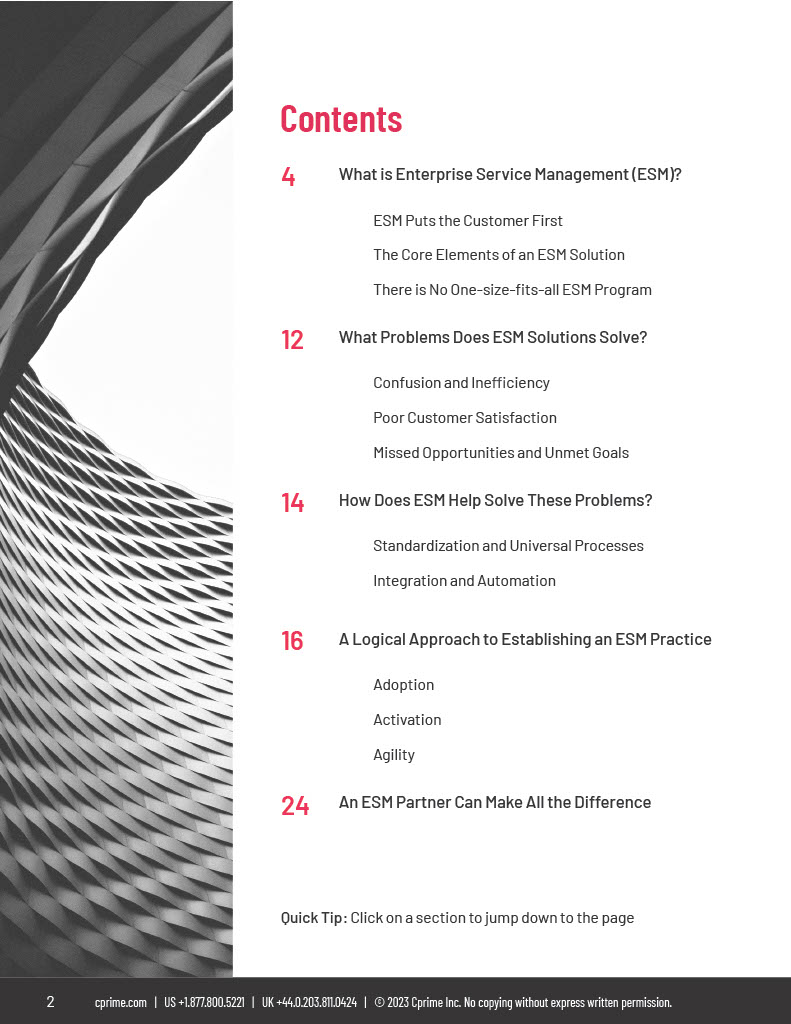
In this paper, we will cover 

  • A high-level overview of what ESM is (and is not) 
  • Why it can be beneficial for modern organizations 
  • A simple three-step implementation process that’s proven successful
  • And a few hypothetical use cases that exemplify how a successful implementation improves the flow of work and information throughout the organization

What is Enterprise Service Management (ESM)?

ESM Facts to Consider:

According to the Service Desk Institute:

  • As of Q2 in 2021, 68% of organizations have ESM strategies in flight. This is up from 43% just two years before.
  • Of those same organizations, more than half consider their ESM strategies to be “well advanced”, up from just 7% in 2019.
  • Just 11% of organizations have no plans to implement ESM, down from 20% in 2019.
  • ESM is known by other names in various companies. Some call it just “service management”, while others label it a “digital transformation”. (We believe the latter is too broad to be limited to just ESM.)
  • The top three business units to successfully adopt ESM are customer support, business operations, and HR.

Enterprise Service Management is defined as “the use of ITSM principles to support all business functions across the enterprise.” While that’s accurate, it’s important to note that it’s not as simple as copying and pasting the ITSM playbook into Marketing, Finance, HR, and so on.

It is common for IT organizations to have established ITSM processes in place that may serve as a launching point for ESM in the broader organization. But, by applying the relatively complex processes, tool components, and governance requirements required in the IT department to all business units, the organization risks overwhelming team members in Marketing, HR, Finance, and other groups and, in the end, lowering adoption rates and setting up the ESM initiative for failure.

Perhaps a better definition of ESM is:

An optimized combination of the right software solution, well-thought-out processes and workflows, and customized automation that effectively supports a customer-centric, data-driven approach to each service an internal business unit undertakes. 

In some cases, certain aspects of an existing ITSM solution may carry over to the larger ESM program, but only to the extent that it fully supports the business unit’s goals and limitations. We support collaboration across the organization but recognize that IT tooling and processes do not translate to all business units. It is beneficial for an organization to consult a partner with experience in successfully delivering ESM to analyze and develop solutions. 

Download the white paper now to keep reading! –>

Cprime and ITIL: The Key to Unlock Optimized ITSM

The modern IT department manages a host of complex challenges on any given day; from routine ad hoc hardware problems (“turn it off and turn it back on again, Daryl”), to the maintenance of mission critical hardware and software systems. IT is central to the ongoing success of most organizations today, so it only makes sense that IT teams are always on the lookout for ways to improve.

In this whitepaper, we will break down Information Technology Service Management (ITSM): what it is, why it’s important, and how it can be improved. We’ll do this by following some of the day-to-day challenges experienced by IT teams. Along the way, we’ll discuss:

  • The Information Technology Infrastructure Library (ITIL) framework
  • The role tooling plays in achieving ITSM success
  • A solution offered by Cprime to help put these pieces together

Download this whitepaper today!