Resource Topic: Agile & DevOps

The Non-Technical Product Manager’s Guide to Technical Product Management

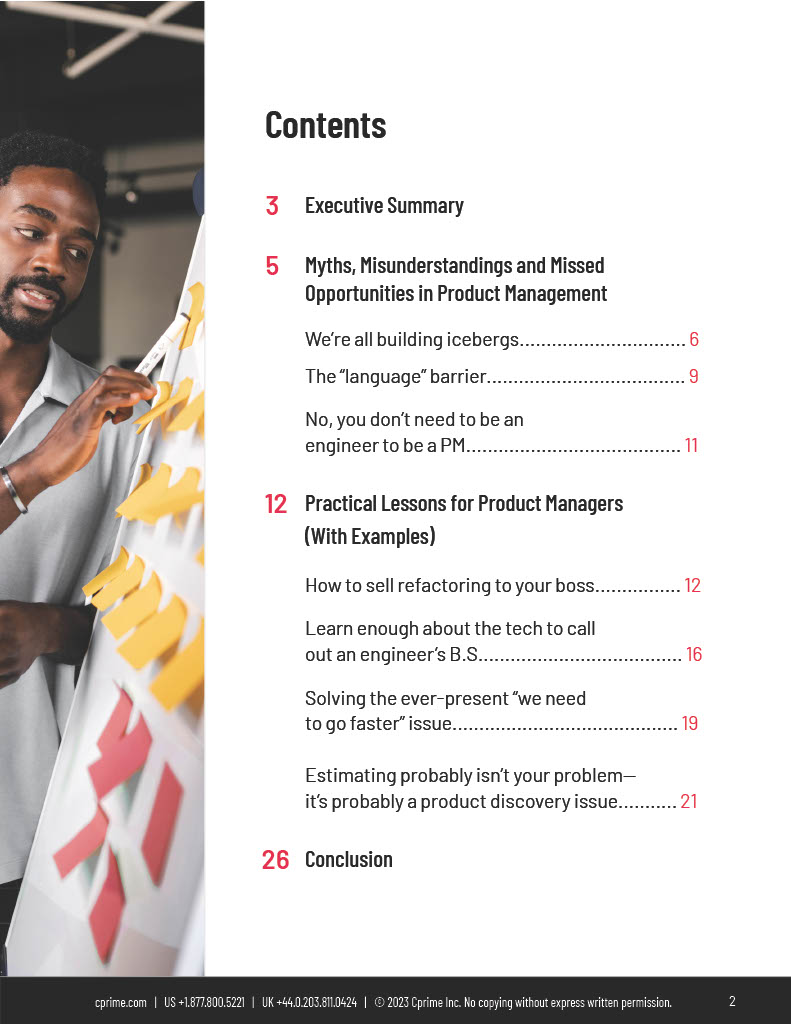
Technical Product Management Table of Contents

Executive Summary

  • Why is everything moving so slow?
  • Why are the engineers not finishing the work that’s planned? (Only five stories in a week? Really?!)
  • Why can’t they answer these questions without resorting to a bunch of technical mumbo jumbo?

This paper is geared toward Product Managers (PMs) in the software space who want to maximize the value their teams are delivering across the whole product. That’s you, right? That’s all of us, really. It seems simplistic and obvious, but if you’re like me, you routinely run into roadblocks keeping you from achieving this basic and necessary goal. 

The issue is especially difficult when the product isn’t a sexy mobile app with a gorgeous UI. In fact, your product may not have a UI at all. How do you go about effectively managing a product when you’re changing spark plugs (refactoring, for example) instead of applying a shiny new coat of paint (exciting new features)?

It took some time and some tough learning experiences (aka failing hard), but I’ve compiled some practical tips that I think will help you face and overcome these challenges so you can really bring your product management practice to the next level. I’ll be covering some myths, misunderstandings, and missed opportunities that are probably plaguing you daily. Then, I’ll drill down to some specific lessons and examples from my experience as a product manager and product agility consultant.

When you finish this paper, I hope you’ll:

  1. Understand why PMs must own the entire product—we need to understand how the tech affects the product and impacts the customer experience
  2. Learn how to converse with engineers intelligently and collaboratively about the technology (even if you’re not a former coder), and with executives about the business strategy 
  3. Have a better grasp on product discovery, creating optimal backlogs for technical work, and organizing the full product development workflow around customer value

It should take you about 20 minutes to read the whole thing. But, I know you’re busy. Feel free to take it in chunks. So, let’s get started!

Download the white paper to keep reading! –>

From Project to Product: The Need for Speed

As we look to enhance our ways of working and shift from project-based methodologies to product thinking, it’s easy to overlook the technical aspects of this change. Let’s not make that mistake.

In this webinar, Ken Robinson, Technical Coach, and Anne Steiner, Chief Product Coach, delve into the technical aspects of switching from project to product. What does this mean for our engineers, testers, and product teams? Equally important, what does this mean to the health, resilience, and maneuverability of our codebases and environments?

We approach these topics across the following dimensions:

  • Development – new product development as well as maintenance and enhancements
  • Testing
  • Delivery Lifecycle

Lastly, we bring it all together to illustrate how engineering for speed + quality and the concept of “total product ownership” reduces time to market, enhances product quality, and fuels maneuverability.

Speakers:

Ken Robinson
Senior Technical Coach, Cprime
Anne Steiner
Chief Product Coach, Cprime

We Need a Hero — How to Find and Support Your Next Superstar Product Owner

A Product Owner serves as the bridge between the development team and stakeholders, steering the product’s vision and driving its success. An excellent product owner can elevate the entire product team. But how do you find the right person to take on this vital role?

Hiring external candidates with Product Owner expertise is an option, but many organizations overlook an often easier and more effective opportunity: to train or develop their internal employees for these crucial roles.

Upskilling your existing product professionals can be the most time- and cost-effective option. Plus, they offer in-depth domain knowledge—specific to your unique organization—no outside hire can match.

By the end of the webinar you will know:

  • How to identify existing employees that have the mindset and institutional knowledge to successfully fill the Product Owner role
  • How to determine what skills the new Product Owner needs to learn through a focused gap analysis
  • How to create an environment that encourages continuous learning so that they can grow into the role and help you and your team deliver great products over time

Speakers:


duane-kenney-headshot-email1.png Duane Kenney
Product Coach
Cprime
Devin Anderson
Product Strategy Coach
Cprime
jerry-odenwelder.png Jerry Odenwelder
Product Coach
Cprime

Let’s Talk About How the Finance Department Fits Into a SAFe Enterprise with the Cprime SAFe Fellows

Let’s Talk About _____ with the Cprime SAFe Fellows is an ongoing global webinar panel series with Cprime’s SAFe Fellows and SPCTs that will cover a variety of advanced SAFe topics.

It’s impossible to remain competitive in today’s market without every business unit in your organization fully embracing the tools and ways of working that support speed to market, rapid innovation, and resilience to market conditions that are constantly changing.

That’s why so many organizations have embraced scaled agility using the Scaled Agile Framework® (SAFe®): its logical, scalable approach to complete business agility has proven exceptionally effective—even in the tricky realm of enterprise finance.

In this roundtable discussion, SAFe Fellows, Ken France, Darren Wilmshurst, and Isaac Montgomery, discuss how Finance fits into and supports a SAFe enterprise, and how change agents can partner with Finance to support business agility. You will learn:

  • How they have helped organizations move from traditional, project-based funding to lean, value stream funding
  • Tips for navigating a scaled Agile transition and pitfalls to avoid
  • How financial governance and control is enhanced through lean budgeting
  • The importance of partnering with Finance early-on and continuously during a transformation


Speakers:

Ken France
VP, Enterprise Agility, SAFe Fellow & SPCT
Cprime
Isaac Montgomery
SAFe Fellow & SPCT
Cprime
Darren Wilmshurst
Director, SAFe Fellow & SPCT
Cprime
Glenn Smith
SAFe Business Agility Consultant and Trainer, SPCT
Cprime

Creating Organizational Momentum for the Adoption of Agile in a Large Government Agency

Overview

The agency’s digital division shoulders tremendous responsibility, delivering and operating the digital solutions that support vital transportation, communication, and strategic defense systems.

However, they struggled with delivery challenges—projects regularly running significantly over budget and over time, poor solutions being delivered, and being unable to react to new requirements being driven by a changing global environment.

The Challenge: Creating Organizational Momentum

For over twenty years, this government agency has been trying to transform themselves for the digital world, including moving to a more Agile way of working. Many complications stood in the way of success:

  •     The inherent bureaucratic scaffolding underpinning the agency’s mission and activities
  •     Decades of regulated processes presenting a formidable “how we’ve always done it” mentality
  •     The glacial speed of change inherent to all government procedures
  •     Team members suffering from transformation fatigue after such a long period of effort

Cprime was brought in by the Deputy Director of a delivery area that had been successfully delivering using an Agile methodology to the extent they could. They were running into friction as they tried to operate within an organization who’s reporting and governance model expected all delivery to follow a traditional waterfall model, and where there was no organizational support for the use of Agile, and no organizational consensus that Agile should be used.

Matt White, a Cprime consultant, explains, “We faced the challenge of influencing the thinking around Agile within the organization, to demonstrate the art of the possible and the potential benefits, to remove any perceived blockers and impediments, and to create some organizational consensus and momentum around the adoption of Agile.”

The Solution: Harnessing Enthusiastic Volunteers Under a Guiding Coalition

The first step was a Discovery period and summary report that established the current state of agility within the organization. This was handled by consultants Peter Gardiner and Matt White.

Peter recalls, “This discovery period resulted in a formal assessment and a backlog of problems to be solved. Perhaps most importantly, it allowed us to network within the organization so that we could build our change strategy in concert with those leaders and subject matter experts in the best positions to support the process.”

As Cprime experts got a handle on what was required, they realized that organizational consensus and momentum around Agile would require the entire organization to be involved in understanding what the introduction of Agile might mean, what the potential benefits could be, and to test and remove perceived blockers and impediments. 

Matt states, “We knew immediately that there were too many stakeholders higher up the chain of command for us to simply identify root problems and expect solutions to be implemented. Instead, our focus was on creating a viral change movement within the organization.” The strategy was built around Dr. John Kotter’s Accelerate.

Early on, Peter and Matt helped establish a Guiding Coalition of internal leaders and executives championing the project. This group met weekly to agree on a vision for Agile within the organization and to oversee a portfolio of transformation Epics, prioritizing, reviewing progress, and removing impediments using Lean Portfolio Management (LPM) techniques.

A series of Agile briefings supported this effort. These talks by representatives from Cprime, other government agencies, and the wider industry, aimed to build knowledge and inspire people on the art of the possible. They were supplemented by a series of formal “Introduction to Agile” lunchtime training courses run for hundreds of people across the organization. This created a pool of enthusiastic volunteers that came together as a series of virtual teams around the Epics being overseen by the Guiding Coalition.

Cprime coaches Jon Malcolm and Alan Jennings then worked closely with the teams to help them deliver their Epics.

Jon notes, “Our approach was novel in that we never established a long-term two- or five-year strategy, which is common in government agencies. Rather, we took an experimental approach in which every aspect of the work gets broken down into very small tests. We coached the teams through establishing a hypothesis and testing it against real-world results. They learned from each test and moved forward in the right direction, performing bigger and better tests.”

Alan adds, “This approach allows us to deliver transformational change in a broader, bottom-up, iterative way that is far more sustainable than top-down, design-and-launch transformation efforts that we see regularly failing. We empowered small teams to make slight changes that eventually changed systems, processes, and ultimately the organization’s culture.”

Results:

The most notable result of Cprime’s involvement over the first fourteen months of the program was that the attitude of the organization towards Agile changed.

“We saw a fundamental shift,” says Peter, “to the point where the organization no longer felt the need to make a formal decision around the adoption of Agile because it had reached a broad consensus that it should be done. All the perceived blockers and reasons for not adopting it had been debunked, and senior leadership now shared a new vision of how the organization could operate in an Agile way.”

“We also saw a real change in attitude from the people on the ground who were previously so transformation fatigued,” adds Jon, “to where they were excited about what’s being accomplished and there was a huge appetite for working in an Agile way.”

Hundreds of team members have directly been trained, but the program’s impact has reached thousands.

“To me,” says Matt, “the most exciting part of this story is that other teams and leaders within the organization that had not been directly involved in the program took a keen interest in what we’re doing. They could see it was working, and it’s proven the effectiveness of Agile methods, so they wanted a chance to be involved.”

Alan concludes, “I think we successfully showed an alternative way of delivering organizational change. As a result, the agency adopted the same methods on a much larger scale to formally introduce a new operating model built on Agile, and to engage Cprime in supporting them through this process.”

A Lean-Agile Practice Accelerates Progress in this Luxury Auto Maker’s EV Production Facility

The Challenge: The Need for Speed (to Market)

Many markets, representing millions of potential customers, have committed to banning the sale of gas-powered vehicles by 2035. Others have made voluntary arrangements to support the adoption of electric vehicles soon. This trend underscores the value and need for quick, efficient, and sustainable EV manufacturing—a challenge this company has proudly embraced.

Leadership committed to the electric vehicle project with a goal of opening production facilities in Shanghai, China. Seeing the need to get up and running quickly and ensure optimal collaboration between the Shanghai manufacturing teams and existing UK vehicle teams, establishing a solid Lean-Agile practice became a priority. 

But there were some formidable challenges to overcome:

  • Most members of the engineering and manufacturing teams in Shanghai were totally new to Agile, although familiar with Lean Manufacturing methods and concepts. So, they are learning a new way of working while simultaneously setting up new facilities, melding as a team, and taking on a new, high-priority project.
  • Multinational distributed teams can face barriers because of language and cultural differences, as well as the logistical issues caused by widely spaced time zones—there is only a three-hour window when teams in the UK and China are both working.

The company originally brought in an Agile Transformation vendor that failed to mesh effectively with the teams and didn’t make genuine progress. To reset the initiative, they brought in Cprime… and we have guided the Shanghai teams to perform “Above and Beyond” expectations.

The Solution: Expert Training and Coaching that Guides New Agile Teams to Scaled Success

Cprime Agile Coaches began working with the Shanghai teams in coordination with the company’s Lead Agile Coach in London. Success was a multi-step process.

Initial Planning

Training_Medium_black_coralDonald Ng, the Lead Agile Coach heading up the engagement for Cprime, worked directly with the UK team and all the Cprime coaches working onsite and remotely to set up both synchronous and asynchronous opportunities for collaboration on a cadence that fit everyone’s schedules and supported steady progress. 

Rather than attempting to take on everything at once, the plan was to start with a team of seven coaches working with about 60 team members. As the engagement progressed beyond the fundamentals, Cprime brought in two additional coaches to meet the program’s needs over the next three months. The teams were further organized into nineteen “squads” across three coaching groups as internal roles matured. 

Filling Necessary Agile Roles

At the start, the Cprime Agile Coaches took on the responsibilities of Scrum Master for the teams, besides coaching and training. Donald has worked closely with the client team to facilitate the hiring and training processes so internal associates could fill those roles as quickly as possible. 

Now, all the teams’ Scrum Masters and Product Owners are well-qualified internal team members and the Cprime coaches can focus wholly on coaching and training the teams for success. The three coaching groups now comprise two or three Cprime coaches, six internal Product Owners, and three Scrum Masters from six different squads.

Agile Training

To ground the Shanghai teams in the fundamentals of Agile and how to apply them in the manufacturing environment, the coaches facilitated several training courses over four months. These included:

  • Twelve core module courses covering three topics (Agile Mindset, Introduction to Scrum, and the client’s unique framework for scaling Agility)
  • Fifteen bite-size learning sessions on various topics developed to fill specific gaps, including Jira and Confluence fundamentals, Innovations Stories Sharing, and Kanban fundamentals.
  • Seven role-based sessions to train and support new Scrum Masters and Product Owners. 

Additionally, a Leadership Training program is slated to begin to broaden organizational support for the growing Agile practice.

Ongoing Stabilization and Scaling

As the Agile practice develops and scales, stabilization is required to ensure the organization maintains continuous improvement and reaps all the benefits of Agility. The core stabilizing factor is the Agile Community of Practice (CoP).

CoPs are groups of people organized around a specific technical or business domain. A healthy CoP actively focuses on professional networking, personal relationships, shared knowledge, and common skills, forming a strong and welcoming culture within the represented teams. As a result, knowledge workers enjoy autonomy, mastery, and purpose beyond their daily tasks.

In collaboration with the Scrum Masters, Cprime coaches have organized a strong and growing Agile Community of Practice supporting the Shanghai and UK teams’ ongoing stabilization.

The Results: Burgeoning Agile Maturity, Continuous Improvement, and Delighted Teams

By the end of November, the teams had worked together through eight sprints, each an improvement over the last. This trend of continuous improvement will continue and even accelerate as the new Agile leaders mature and the Cprime coaches are now free to focus only on coaching and development.

Excellent Net Promoter Scores (NPS) Following Training

Prior to Cprime’s involvement, the client had no formal process in place for measuring the efficacy and value of training and development. By introducing the NPS process, the coaches could measure the value of the Agile training programs they facilitated so that these, too, could continuously improve.

An NPS can range from -100 (very poor) to 100 (essentially perfect). The average NPSs for Cprime-led training courses in Shanghai were:

  • 72.7 on the twelve core module courses
  • 70.9 on the 15 bite-size sessions
  • 74.3 on the seven role-based course

Delighted Team Members

Another measurement tool introduced by the coaches is a Coaching Assessment that allows the team members to rate the value of the coaching they are receiving. The following comments from team members reflect their sentiments:

  • “The coaches encourage the teams and organize our meetings very well.”
  • “They work very hard to help the teams.”
  • “The Agile coaches are very good to new employees. They guide us through the projects, helping us understand the detailed background, and solving any problems or questions that come up along the way.”
  • “Team meetings are held efficiently within a timebox, and we are avoiding unnecessary meetings.” 
  • “The coaches have strong professional knowledge and are proactive in communicating with other groups, and escalating issues when necessary.”

The Shanghai teams are poised for continued growth and acceleration. With continued support from Cprime Agile Coaches and In collaboration with the Agile teams at the group level in the UK, we foresee ongoing success.

Ready to start your Agile transformation? Contact Cprime today!

Decentralizing Authority for Successful Digital Transformations

One of the most fundamental but overlooked aspects of effective digital transformation is the extent to which decision-making authority is decentralized. Decentralization of decision-making authority involves the greater distribution of power and accountability to teams, enabling faster and more effective decision-making, increased innovation, better engagement, and improved organizational agility.

Can your teams make the necessary decisions to pivot to maximize value when they have enough data that tells them to do so?

In the first half of this paper, we will cover why decentralization of decision making is vital in today’s business environment, and some fundamentals around how to prepare for and execute decentralization. Then, in the second half of this paper, we will explore key concepts about how organizations can effectively test, implement, and scale a decentralized structure while tracking and evaluating its success to maximize potential impact and mitigate risks early and often.

To learn more, download this whitepaper today!

Automation and Emulation Software Leader Streamlines Development Processes With Cprime’s Expert-Led GitLab Solutions and DevOps Services

The Client

In an era of online shopping and next-day delivery, this US-based Cprime client facilitates business continuity for thousands of brands worldwide. Their complex automated storage, retrieval, warehousing, and logistics solutions improve the flow of goods, materials, and information, allowing companies to meet the ever-growing expectations of global consumers.

Industry expertise, robotics, artificial intelligence, and machine learning have made the company a global leader in materials handling and logistics. Its diverse clientele come from industries that include ecommerce, retail, food and beverage, manufacturing, and third-party logistics providers.

Challenge: Streamlining Modern Warehouse Design Pipelines to Enhance Pre-Sales Efficiency

Designing a modern automated warehousing solution is astonishingly complex. In an unoptimized environment, the sheer number of factors and volume of calculations required to create a design prototype for a new logistics facility can take weeks.

“A modern warehouse is essentially a collection of robots. It’s all spectacularly complicated,” explains Kevin Ryan, Cprime Head of DevOps, EMEA. “The scope, size, and throughput of modern warehouses, and the number of unique products in any given warehouse have grown beyond our human ability to calculate. Even machines struggle to crunch the numbers efficiently.”

While lengthy design calculation times were the company’s primary pain point, system complexity also resulted in an inability to react rapidly to change. Any updates to a customer’s operating parameters or facility specification would further delay pre-sales project modeling; the company had to recalculate each time-consuming potential design from scratch. The delays ranged from hours to weeks.

“If customers can’t get answers from us quickly, the dialogue stalls and the entire process can grind to a halt. We wanted to change that,” says one of the project’s executive sponsors.

“They were seeing new projects and revenues delayed by up to a quarter as they waited for a mathematical model. There was a potential cost of millions for each delay,” says Ryan. “The company needed a development framework that would allow them to put a pre-sales mathematical model of a warehouse in front of a customer faster, which meant boosting efficiency.”

To complicate matters, any development framework the company adopted had to be a good fit with Azure Batch, the cloud platform providing the computing power to manage the calculations. The company also needed an implementation partner that could work closely with the cloud specialists on-site to modernize, scale, and streamline its infrastructure to meet the growing demand of the world’s largest retailers and manufacturers. 

Solution: Leveraging the GitLab Toolchain with Cprime Expert DevOps Services

Evaluating its options, the automated warehouse designer selected GitLab to provide the backbone for its new continuous integration and continuous development (CI/CD) initiative. Recognized for being robust, reliable, and secure, GitLab was the ideal CI/CD, collaboration, issue tracking, quality automation analysis, and code review tool. The GitLab toolchain contained everything the company needed to speed up development and enhance their predictive modeling sales tools and in-production logistics engines.

To implement the solution, GitLab recommended the Expert-Led GitLab Solutions and DevOps Services of Cprime, their Certified Training Partner.

“The Cprime DevOps team has invested heavily in GitLab professional services engineer certifications covering everything from CI/CD, project management, DevOps, and inner sourcing, to security and system admin,” explains Ryan. “But the requirements for this engagement went beyond professional GitLab implementation services. The company hired Cprime to show them how to take the GitLab toolchain and achieve elite DevOps CI/CD performance.” 

“The requirements for this engagement went beyond professional GitLab implementation services. The company hired Cprime to show them how to take the GitLab toolchain and achieve elite DevOps CI/CD performance.” — Kevin Ryan, Cprime Head of DevOps, EMEA

Discovering Context and Objectives Using Spikes

The two-person Cprime team began Discovery to define the company’s context and objectives clearly. They started by creating research tasks to identify and resolve questions and explore potential solutions.

“By creating technical spikes, we formed an understanding of their codebase and what they needed to achieve,” says Ryan. “Using those prototypes, we rapidly gathered feedback and verified we were on the right track.”

Tailoring Toolsets and Processes for the Azure Environment

After achieving consensus with the company’s management and DevOps teams, the Cprime team tailored the new GitLab instance to work specifically within the customer’s Microsoft Azure environment and security context.

“We created secure containers, CI/CD pipelines, and process templates,” says Ryan. “The result was a universal base implementation they could reuse across multiple projects to speed up development long term.”

Infrastructure as Code With Helm and Terraform

To ensure a consistent, easily deployed development environment, the Cprime team also worked with the company to leverage GitLab CI/CD’s native Terraform integration. Using the Terraform Helm provider allowed the company to begin centrally deploying Helm charts. This allowed it to manage high- and low-level Azure Kubernetes components, easily implement and modify Infrastructure-as-Code (IaC) workflows, and simplify the creation of common and complex infrastructure patterns.

Throughout the process, Cprime worked to bridge the gaps, coordinating and driving innovation between company stakeholders, DevOps teams, and third-party Azure infrastructure architects.

“As implementation specialists, Cprime took the work of all the teams, rationalized it, and worked as the engine that put it into production,” says Ryan. “It was all about streamlining collaboration and automating the processes to speed up development.”

“As implementation specialists, Cprime took the output of all the teams, rationalized it, and put it into production using GitLab. It was all about streamlining collaboration and automating processes to accelerate development.” — Kevin Ryan, Cprime Head of DevOps, EMEA

Results: Increased Deployment Frequency and Reduced Error Rates 

Because of the combined efforts of Cprime and the project teams, the warehouse design company established high levels of process maturity based on DevOps Research and Assessment (DORA) core metrics. Across the board, the company’s deployment frequency increased while it slashed its change lead times, change failure rates, and mean error recovery times.

Cumulative Change Dramatically Reduces Turnaround Times

As an indicator of the efficacy of the cumulative changes, the company reduced simulation times from over 11 hours to as few as 24 minutes. Turnarounds on proposal submissions showed similarly dramatic improvements.

“We’ve reduced the time to solution—from receiving customer data to running designs and calculations and ultimately giving out a warehouse proposal—from eight weeks down to one day,” the executive sponsor states. “The productivity increase has scaled our capacity to answer RFQs and engage with new and existing customers.”

Likewise, by using GitLab project templates, Terraform, and Helm scripts to automate their CI/CD pipeline, the company’s development team recently set a new turnaround record—they received a new specification and deployed the corrected warehouse design in only 90 minutes.

“We’ve reduced the time to solution—from having customer data to running designs and calculations and ultimately giving out a warehouse proposal—from eight weeks down to one day. The productivity increase has scaled our capacity to answer RFQs and engage with new and existing customers.” — Executive Sponsor

Getting There With Cprime

During the engagement, Cprime exceeded the client’s expectations for GitLab professional engineering services. Based on Cprime’s performance and the clear successes of phase one, the company has extended the relationship indefinitely.

“We started with a very short engagement and, based on our performance, over a year later we support all their GitLab and Azure-related activities,” says Ryan. “The company learned what I want all potential Cprime customers to understand: if you want to become a high-performing, elite development organization, Cprime will get you there.”

If you’d like to see similar results in your own organization, explore our flexible GitLab and DevOps solutions.

Exploring New Horizons with Cprime—Creating a Continuous Integration Testing Pipeline for Lunar Vehicle Development

The Client

When a prestigious European technical university set out to build a moon robot, one of its goals was to highlight the potential of its new generation of engineers. Using a fresh student perspective, the institution sought to create a semi-autonomous rover that could move freely about the moon’s surface while collecting important information about radiation levels.

Unlike previous remote moon exploration vehicles, however, the university’s initiative focused on creating a smaller, more lightweight system. The new rover would have a form factor that scientists could easily convey into space and deploy as a swarm to gather data across a vast surface area. The rover’s affordability, autonomy, and improved mobility would allow exploration teams to undertake missions across terrain impractical for larger, heavier, and more expensive self-driving vehicles.

Challenge: Breaking New Ground — Creating a Modern CI/CD Testing Platform for the Aerospace Industry

Software development is often a process of trial and error, and developing hardware, software, and firmware systems for off-planet exploration exponentially increases the potential risk of something going wrong. Due to the narrow margins for error in space, the rover project team of 50 student engineers and support staff wanted a modern, proactive testing and development process to increase their chances of developing a robust, reliable lunar vehicle.

“Having your code break on the moon is obviously a massive problem. It’s not something that you can fix by hitting a button and rebooting the system,” says Kevin Ryan, Agile and DevOps Coach for Cprime EMEA. “The problem was that embedded system workflows, especially in the aerospace and space industries, are decades behind the processes used to develop modern cloud-based industrial infrastructures. Not that the students lacked skills—there was a lack of precedent in the entire industry. Cprime’s role was to help them establish that precedent and significantly reduce marginal risks.”

“Having your code break on the moon is obviously a massive problem. It’s not something that you can fix by hitting a button and rebooting the system.” — Kevin Ryan, Agile and DevOps Coach for Cprime EMEA

Aligning processes with modern cloud methodologies

To improve their quality control protocols, the university team needed to align their processes with contemporary cloud methodologies and software development best practices. That meant implementing the tooling and ways of working for a CI/CD (continuous integration, continuous deployment) pipeline. The testing pipeline would allow them to rapidly iterate upon their code and design while maintaining quality and continuity across the project.

“As a team, they focused on writing complex, embedded machine learning and AI code. Coming directly from academia, they weren’t up to speed on code development automation infrastructures,” says Ryan. “Industrialized development just wasn’t a part of their scope.”

Solution: Partnering with Cprime to Evaluate Tools and Create New Development Opportunities

Based on a recommendation from one of their commercial partners, the university team turned to Cprime, GitLab Certified Training Partners. The initial brief was simple, but left room for expansion.

“They had chosen GitLab—a complete DevOps platform—but they wanted Cprime to show them what using it should look like,” says Ryan. “They needed to understand the fundamental building blocks. We began by implementing the development environment and went from there as they learned the tool’s potential applications and use cases.”

The Cprime trainers experienced a learning curve nearly as steep as the student engineers themselves. The project was more than a simple tooling upgrade or transformation. The Cprime team needed to dive deep to define the project’s practical requirements and apply their newfound knowledge to a viable solution.

“Due to the unfamiliar environment, it has been a little like a research project—an incremental process to figure out how their DevOps journey should work,” says Ryan. “There was no Googling for a quick solution. As trainers, we needed to understand what they do before we could even hope to make reasonable and intelligent proposals to move them forward.”

A single repository of distinct projects with clear relationships

After clarifying the engineering team’s requirements, Cprime began putting together the components for a successful CI/CD pipeline. The team adapted course materials and explored key principles—from classes like GitLab with Git Basics and GitLab for CI/CD Pipelines—with the engineers to help them create an elite DevOps toolchain to solve their testing issues.

“We began by advocating for a mono repo rather than a poly repo approach to mitigate complexity and aid communication. Then we developed systems for quality assurance, build, and testing automation. We also automated dependency management and documentation generation,” says Ryan. “Once they were comfortable with the basic processes, we moved into more hardcore QA tools like Google Test, the C++ testing and mocking framework. Now, they are doing some groundbreaking stuff and actually deploying machine-level firmware to their space robot.”

“Together we have put together a toolchain that ensures they check, double check, and triple check every one and zero in their code base. It has pushed the project forward and allowed them to increase their benchmarks while simplifying each subsequent success.” — Kevin Ryan, Agile and DevOps Coach for Cprime EMEA

The right tools for success

To reduce context switching and promote a more familiar, consistent development and testing environment, Cprime also introduced the GitLab Workflow extension for Visual Studio (VS).

“Using modern technologies like Docker and VS development containers has made a huge difference,” says Ryan. “Because each machine you compile code on can yield a different result, just having an identical environment for everyone with all the dependencies, tooling, and  build infrastructure in place has improved auditability and repeatability.”

Results: Increased Quality and Reduced Margins for Error

After 18 months of working with Cprime, the university teams have a unique CI/CD pipeline suitable for the aerospace industry and low-level firmware and embedded systems development. It is a development and testing framework that rivals any cutting-edge development and testing automation infrastructure for the cloud.

By guiding them toward a uniform development ecosystem with repeatable processes, Cprime helped the engineering team eliminate nearly 75% of the trial and error caused by compiling and testing code on inconsistent systems.

“That translates directly into higher quality firmware and software, and a reduced margin for error,” says Ryan. “We have put together a toolchain that ensures they check, double check, and triple check every one and zero in their code base. It has pushed the project forward and allowed them to increase their benchmarks while simplifying each subsequent success.”

If you’d like to see similar results in your organization, explore our flexible
GitLab training and GitLab implementation solutions.

From Project to Product: Leaders, Here’s What It Means to You

Project to product is all the rage these days. You, your boss, or your company are already talking about this. Heck, your group has been “agile” for years now, but this next phase seems to just be a repackaging of that.

In this webinar, Anne Steiner, Chief Product Coach at Cprime, gets into Project to Product from the leader’s perspective. We explore “why we should care” and “what this really means”. Then, we deep dive into the following keys to leadership success in driving this change:

  1. Your help, involvement, and willingness to influence change is critical. Team-level change isn’t enough and will yield limited benefits.
  2. You need more than just engineering/IT buy-in to be successful. It takes the whole enterprise.
  3. Product management is a thing. We’ll learn what it is, how it is different from project management, and why it is critical to market domination and product success.

Lastly, we’ll leave you with some tips for success that will guide you in driving change whether you sit at the manager, director, VP, or C-level.

Speaker:

Anne Steiner
Chief Product Coach, Cprime