



Resource Topic: Agile & DevOps

6 Common Challenges RTEs Face and How to Solve Them

Release Train Engineers (RTEs) have tremendous responsibility in a scaled Agile environment. After all Agile Release Trains (ARTs) can’t steer themselves.

But, RTEs also face significant challenges along the way. In this webinar, Cprime’s Ali Huda, Senior Enterprise Agility Consultant, discusses common challenges RTEs face and how they can be overcome using  SAFe® and Agile best practices, best-in-class tooling like Jira Align, and focused effort. We will also demo how Jira Align can help solve these challenges.

Learn how to solve these problems in your own organization:

  • Lack of visibility into the full book of work
  • Lack of visibility into how work being done by teams is contributing to strategic goals
  • Lack of understanding of how much an ART can deliver over the course of a planning increment
  • Visibility into the Risks and Dependencies affecting an ART
  • Constant need to create and update roadmaps
  • Limited availability and customizability of progress report

Speakers:

Ali Huda
Senior Enterprise Agility Consultant
Cprime

A Leading Pharmaceutical Company Works With Cprime to Nearly Double Speed and Efficiency, Saving Billions

The Challenge: Attempting a Transformation Within a Transformation 

A digital or Agile transformation is always going to be a long and challenging effort, especially at the enterprise level. This company has been pursuing a large-scale digital transformation for years now, which causes change at all levels. Amidst this change, they tasked the development team with undertaking a huge tooling project and, to accomplish that, an Agile transformation of their own. 

Migrating to a new SaaS platform

The coordination and management of clinical drug trials involves a lot of moving parts, and the cost of mismanagement can be very high. The team had relied on custom applications for many years to support this process. But, considering the advancements made in the tools available, and the cost of keeping up an aging infrastructure, the organization decided in 2018 to invest in a new cloud-based SaaS solution for the PMD functions. 

The development team’s Director and Product Owner explains, “While it sounds logical to think moving to a SaaS solution would mean everything is simplified and made easier, the reality is quite different. There’s a tremendous amount of data involved and several key integrations that need to be duplicated, migrated, or reconfigured.”

And, of course, work can’t be put on hold for the duration of this process, so all of that work needs to be done while both tools and all integrations are live and the data is constantly changing. 

“I equate it to jumping onto a moving bus,” he says.

Pursuing scaled Agility

After joining the team as Product Owner in 2019, the Director became responsible for delivery, engineering, and product management, in addition to the tooling migration. With the resources available, the only practical way to get a handle on the workload was to double down on the scaled Agile transformation the team had already begun.

“We were technically ‘doing Agile’,” he says, “but there was a lot of room for improvement. Specifically, we needed to get better organized and consistent around processes, roles, and expectations.” 

He took an important step by working to get Agile Facilitators (Scrum Masters) installed in the four existing Agile teams to add that layer of oversight and coordination. He continues, “I think bringing in the Agile Facilitators gave us better insight into where we were struggling. For example, we were moving people to the work rather than work to the people. We were heading into sprint planning without having fully refined our backlog, and then refining as the sprint progressed.”

By surfacing these gaps in their Agile practice, the team could start formulating a plan to fill them. 

Overcoming inertia

Of course, change rarely comes easily. Especially in very large organizations, inertia can be a formidable obstacle. 

Moving to new ways of working comes with a cost—financially and psychologically. “The way we’ve always done it” is not just an excuse. It’s a security blanket that protects the organization from new ideas that can sometimes be scary.

And the larger organization was already experiencing a lot of change as part of their ongoing multi-year digital transformation. So, additional change was an even harder sell. After all, the changes weren’t just tool- or process-related. They involved changes in mindset and culture. 

The Director says, “I realized quickly that we would need to create a solid plan of attack that would garner support from others in the organization if we had any hope of making changes that would stick.”

The COVID-19 pandemic  

On top of everything else, in early 2020, the global pandemic hit with its accompanying upheaval and uncertainty. The teams had to quickly learn how to work and collaborate remotely, which is not the standard for Agile teams. Over the next two years, significant staff turnover also took its toll on the team’s efforts.

Despite all this, they made progress. In June 2021, they launched the planning module on the new platform. 

“Over the eighteen months it took to achieve that goal, we learned a lot about where we were and where we needed to be,” he says. “The key takeaway to me was that if we wanted to continue to progress, we needed help.”

That’s when Scott Seivwright, Executive Agile Coach with Cprime, began consulting with the team.

The Solution: A More Formalized Approach to Scaled Agility and Expert Guidance

Scott recalls, “When the Director and I first spoke, I could see that a lot of the pieces were there, but that they were missing structure and consistency.”

To address this issue, Scott recommended the Scaled Agile Framework® (SAFe®) as a template from which the team could build a structured combination of roles, ceremonies, artifacts, and processes to formalize and systematize their Agile practice.

(SAFe and Scaled Agile Framework are registered trademarks of Scaled Agile, Inc.)

To test the validity of this plan, they pursued a pilot program in the UK. The Cprime team resourced Agile professionals who could take on vital roles in the SAFe transformation. They also liaised with external suppliers and internal teams to coordinate the software delivery, data systems, and integrations that would link the existing stack with new APIs and platform solutions.

Then, in March 2021, the teams headed into the core SAFe ceremony, the quarterly PI planning session.

Big-room PI planning

Optimally, PI planning is an opportunity for all stakeholders connected to the Agile Release Train (ART)—the SAFe designation for a “team of Agile teams”—to meet together, in person, to discuss the next six sprints’ worth of work. Of course, with the pandemic still affecting many areas, getting everyone together wasn’t possible.

The Director recalls, “Although we had to make do with a mostly virtual PI planning event, I think it was a huge step forward for us. It was the first time we could get the right people together all at once from both the business and tech sides to discuss what we needed to do, what stood in our way, and how to address those issues. It fostered communication and collaboration that we vitally needed.”

The event spotlighted more areas for improvement as well, which informed future planning events and the Cprime team’s strategies.

“At the time,” Scott says, “the clinical trial program was running at an overall efficiency rate of about 48 percent. In other words, a little less than half of the drugs being sent out in support of various clinical trials were actually reaching the right person at the right time to produce valid, timely results. So, in order to avoid invalidating the tests, the company was spending about twice what they should have been to cover for inefficiencies and waste in the process. This was our starting point.”

Bringing in an Agile Coach to serve as RTE

The next step in the process was for Scott to bring in Brandon Hill-Jowett, Cprime Agile Coach and Release Train Engineer (RTE). The Release Train is the SAFe designation for the coordinated effort required for a team of Agile teams to accomplish the work planned for each planning increment. It’s the RTE’s job to lead that train, remove any impediments standing in its way, and keep it speeding down the track.

“Bringing Brandon on made an immediate impact,” the Director says. “He’s given us a huge amount of energy and drive, and a clear vision of what we need to achieve. He’s a fantastic coach, and I’ve seen the increase in Agile and SAFe knowledge—both my own and in the team—and how much that’s leveled up our work.”

Brandon says, “After that initial PI event, we came away with a clearer understanding of the blockers holding the team back from taking the next step. For example, we found that estimates for the work required to accomplish a given goal were as much as 265 percent low for a variety of reasons: internal dependencies, unreliable systems, scope variance, delays from outside vendors, and erroneous testing cycle times. Now that we’d set up a dialogue with the business side, those explanations went a long way toward justifying the need for change.”

Brandon worked with the Director and other stakeholders to identify systemic problems that could be rectified through incremental change and a focus on continuous improvement. They set up SAFe ceremonies on a regular cadence to support collaboration and fuel regular progress. They also created an Executive Action Committee (EAC) that meets regularly to discuss and rectify dependencies and blockers on the business side, make decisions to guide the team’s strategy, and keep the rest of the organization informed.

“We created cross-functional teams during the final PI of 2022,” Brandon says, “and we’re now working on optimizing the ART so we can keep this momentum going.”

The Results: The Team Sees Both Measurable and Unmeasurable Affects in Short Order

The results of these efforts have been nothing short of fantastic.

Massive improvements in productivity

Brandon reports, “We’ve seen predictability rise from 45 percent to 80 percent, which means our planning is becoming far more accurate and work is getting done consistently. Since establishing cross-functional teams, we’ve seen velocity double, meaning twice as much is getting accomplished each sprint.”

The Director agrees, “Our technical capabilities and engineering function have gotten much stronger. By improving our ability to quickly and efficiently update and develop our systems, we’re able to get working software in the hands of the user faster. Then, we get feedback faster and can turn that into further improvements. So, we’re delivering more value to our customers, faster than ever.”

Brandon continues, “Mapping out the previous processes, we calculated an average release time of 548 days (about 18 months). We forecast that the efficiencies we’ve proposed will reduce that release cycle by 73 percent to just 149 days (about five months). Overall, we forecast we will increase that 48 percent efficiency up to 80 percent, saving the company billions of pounds annually.”

A better culture to support a better way of working

Some of the benefits are less tangible, but no less important.

“I’m seeing marked changes in the culture and attitudes of those in and around this team,” the Director says. “There’s greater psychological safety and trust. We’re working together more effectively, both within the tech department and with the business side. In this kind of environment, it’s becoming easier to ask the right questions, entertain innovative ideas, and collaborate freely because we’re working toward common goals.”

He concludes, “In the end, our goal is to help more people with the life-saving and life-changing drugs the company develops. Every step we take to improve our piece of that puzzle means we’re achieving that goal.”


Interested in similar results for your organization? Explore our flexible Agile Scaling solutions.


About Cprime

Cprime is an industry-leading, full-service global consulting firm with a focus on providing integrated and innovative solutions around digital transformation, product, cloud, and technology. With over 20 years’ experience, we provide strategic and technical expertise to businesses across more than 50 industries. Our team of advisors and technical experts have the know-how to meet organizations where they are to develop actionable solutions and solve business challenges. We also collaborate with our expansive network of partners to design, deploy, and harmonize technology stacks across organizations. Our mission is to empower visionary business leaders and teams to reimagine the future of work to achieve better outcomes.

The Five Phases of Agile Maturity (Part 3): Phase 5

The journey to agile maturity is neither fast nor straightforward. What do you need to know? What challenges might you face? Which tools will best meet your organization where it’s at?

Join our experts to explore what you should expect to see across the five phases of Agile maturity. In the third and final part of this series, we focus on Phase 5. Cprime’s Sneha Crews (Managing Director, Solutions Engineering), Rod Morrison (Partnerships Director, EMEA) and Sarah Sego (Agile Transformation Consultant), will share valuable advice about negotiating the turns, avoiding roadblocks, and enjoying the ride in your agile maturity journey. Plus, we’ll talk about the optimal tools to support you—enterprise product management software, like Atlassian Jira Align.

Learn:

  • Common maturity elements of Phase 5 of agile maturity (The Scaling Agile Enterprise)
  • Challenges you may face in the last phase of your agile maturity journey and how to overcome them
  • How Jira Align’s features and functionality can support your Agile enterprise
  • How to utilize custom-tailored solutions to meet your specific needs


Speakers:

Sneha Crews
Managing Director, Solutions Engineering
Cprime
Rod Morrison
Partnerships Director, EMEA
Cprime
Sarah Sego
Agile Transformation Consultant
Cprime

SAFe® Organizational Change — Achieving 70% Predictability at an International Lifestyle and Beauty Pioneer

The Client

This Cprime client is an internationally recognized global cosmetics and beauty manufacturer. Founded over 70 years ago, the company is notable for its transformation of the industry, especially in how they market accessible cosmetics with luxury appeal.

Today, the beauty product manufacturer is globally ubiquitous—it is currently the home of over 30 instantly recognizable brands synonymous with quality and affordable extravagance.

The company’s success has translated into a public valuation of over 90 billion USD with annual sales revenues of nearly $18 billion from business operations in over 150 countries.

Challenge: Aligning International E-commerce Websites Across Multiple Brands, Regions, and Cultures

Known for its traditional brick-and-mortar sales success, the company has also seen significant results because of its increased focus on online retail and e-commerce channels. But, despite doubling online revenue during the COVID-19 pandemic, the beauty brand was leaving money on the table, especially during the critical holiday season that represents most of the cosmetics and lifestyle industry’s annual sales.

Complexity of Scale

The manufacturer’s key issue was maintaining consistency and functionality across a vast number of corporate and international websites. Each of the company’s over 30 brands operated multiple semi-autonomous regional websites, each with localized content and requirements. Everything from brand messaging to site performance, content delivery, payment collection, and product fulfillment across the sites was difficult to maintain, inconsistent, and underperforming.
“It is the most complicated company I’ve come across,” explains Jennifer Vasi, Cprime Agile Coach and Certified Scaled Agile Framework® Program Consultant (SPC), and Release Train Engineer. “Its online, brand, and global and regional aspects all have to come together. From a scaling perspective, that is incredibly advanced. The company has over 300 different websites—think 30+ brands, each with 10+ regions. Each website has a different brand experience and each checkout section follows specific regional requirements.”

The Costs of Inconsistency

Poor user experience was causing shopping cart abandonments and driving customers to competitors with more stable, streamlined, user-friendly ecommerce portals.

“They were behind the curve,” says Denise Joseph, Agile Coach and Certified Scaled Agile Framework® Program Consultant (SPCT). “When site performance dipped, consumers would simply head over to another online vendor for a better shopping experience.”

Another pain point was that the levels of technical maturity in the organization varied widely—while some sites were updated with modern development technologies, others ran slow and deeply complex legacy code.

“The sites for newer brands were usually very advanced and on the most current development platforms. Other, more established brands were running code up to a decade old,” says Bridget O’Brien, Cprime Agile Coach and SPC.

A Global Disconnect

The next issue was the disconnect between the regional and corporate teams with product placement, promotional efforts, and site feature development. They often failed to leverage valuable regional knowledge. In terms of feature development, the different localities and international teams were working at cross purposes, duplicating costly development efforts instead of coordinating to develop new components the company could reuse across all locations. Despite local advice, management was also investing in initiatives unsuitable to specific regions.

“The company needed to eliminate its autonomous websites, build a modern, universal ecommerce platform, and establish processes for effective inter-regional communications,” says Liza Ridgway, Cprime’s Head of North America Sales. “They needed to eliminate redundancy, errors, and duplicated effort.”

“The client’s primary goal was prioritization—they wanted to create a very focused roadmap that included modernizing the platform,” adds O’Brien. “They wanted to get the entire organization moving in the same direction.”

Solution: Partnering with Cprime for Incremental Change

Aware of the changes required and the complexity of all its moving parts around the globe, the manufacturer’s ecommerce arm reached out to Cprime. The request for help was based on the two companies’ successes working together on a previous transformation.
“Rather than trying to boil the ocean, they recognized they needed somebody to guide them incrementally through this complex transformation,” says Vasi. “Cprime had helped them before and we were familiar with the organization’s people and culture.”

Improving Portfolios, Empowering Teams, and Aligning Objectives

Operating at the portfolio and team levels, the Cprime consultants approached the manufacturers’ requirements using the same methodologies they were engaged to promote.

“At the portfolio level we began with a basic transformation to empower management to recognize value streams and select and group project teams,” says Joseph. “We led the transformation using the Scaled Agile Framework (SAFe®), eventually adopting a more supportive role and offering coaching to support the company’s new ways of working and help management align around its objectives and the key results it sought.”

As a part of this process, the Cprime coaches helped the company visualize the data they had in Jira, establish their development programs, and effectively plan using the Atlassian toolset to achieve their goal of becoming more predictable. Throughout the engagement, the Cprime team adapted its approach to meet the manufacturer’s requirements.

“Our team size fluctuated. Our coaching team numbered around five people, but we often took on player-coaches in specific roles to fill in the gaps,” says O’Brien. “When they needed release train engineers, for example, someone from Cprime would take on those responsibilities and advise and help until their teams had the knowledge for independent success.”


“The company needed to eliminate its autonomous websites, build a modern, universal ecommerce platform, and establish processes for effective inter-regional communications.” – Liza Ridgway, Cprime’s Head of North America Sales


Prioritizing Communication to Achieve Desired Business Results

At the team level, Cprime followed a similar path, prioritizing removing the communication silos between the brand and its regional partners to develop a standardized ecommerce platform based on mutually established goals. Just as significantly, Cprime set out to open up a dialogue between the head office and the regional teams to ensure their local expertise would start being considered.

“We spent a lot of time in goals coaching and story writing with the brand and regional teams, working with them to stop their goal posts from shifting,” recalls Vasi. “It wasn’t about affecting what they were delivering. It was about streamlining how they worked and collaborated so they could become effective product teams with a view of the big picture. We focused on teaching them how to deliver value rather than simply checking off unrelated and potentially conflicting boxes in their internal ticket system.”

Results: 70% Predictability with Structured PI Planning and Improved Information Flow for All

Over the course of the engagement, the manufacturer’s ecommerce section went from almost no structured quarterly planning to running regular release trains and regional program increment (PI) planning sessions.
“With release trains and PI planning sessions in full swing, the teams aligned. Each knew what the others were working on and how their own deliverables affected the work product of their colleagues,” says Nicole Bruno, Cprime Agile Coach, Release Train Engineer, and SPC. “They had a better, more collaborative working relationship—they were no longer just throwing requests over the fence.”

Change at the Organizational Level

In a year and a half, Cprime trained hundreds of people throughout the organization, in the US, Europe, Hong Kong, APAC, and the rest of Asia. Overall, the Cprime team facilitated 13 independently held release trains, each with a minimum of 50 team members.

“As a result of the training, for three days every quarter, across the company and the world, 650 people would sit down and establish a roadmap,” says Joseph. “The entire company—management, and everyone down the line—knew exactly what to deliver for the next three months.”

Enhanced Planning and Efficiency

Besides providing the regional teams with a voice and averting expensive culturally unsuccessful initiatives, the roadmap eliminated costly duplicate work by providing the teams with the information they needed to create shared services the company could reuse in every locale. As a result of the planning, predictability rose to 70% despite turbulent pre- and post-COVID-19 market conditions.

While no transformation is ever complete, Cprime has helped place the beauty and cosmetics manufacturer on the path to future success by empowering its management and teams with the information required to plan more effectively.

“We got them to a place where they understood their deliverables, and could measure how their teams were doing. Management had clear metrics to base decisions on,” concludes Joseph. “Leadership gained confidence in what the teams were planning. The teams themselves justified that confidence by learning how to establish realistic workloads they could take on without over-committing and under-delivering.”


Want to see the same results for your organization? Explore our flexible Scaled Agility solutions.


SAFe and Scaled Agile Framework are registered trademarks of Scaled Agile, Inc.

Let’s Talk About SAFe® 6.0 with the Cprime SAFe Fellows

Let’s Talk About _____ with the Cprime SAFe Fellows is an ongoing global webinar panel series with Cprime’s SAFe Fellows and SPCTs that will cover a variety of advanced SAFe topics.

How can you continue to adapt and grow with the pace of change? One of the key aspects of the Scaled Agile Framework® is its dedication to continuous learning and relentless improvement. The newest evolution of the framework will continue to ensure your organization has the tools it needs to stay ahead of the competition. Join our Cprime SAFe Fellows, Ken France, Darren Wilmshurst, and Isaac Montgomery, for the second episode of this panel series to learn all about the what’s to come in SAFe from an advanced viewpoint.

  • Explore where the SAFe framework is going next
  • Review the major updates experienced practitioners need to know about
  • Understand the advantages and challenges of the next evolution SAFe and its impact to your organization

(SAFe and Scaled Agile Framework are registered trademarks of Scaled Agile, Inc.)

Speakers:

Ken France
VP, Enterprise Agility, SAFe Fellow & SPCT
Cprime
Isaac Montgomery
SAFe Fellow & SPCT
Cprime
Darren Wilmshurst
Director, SAFe Fellow & SPCT
Cprime
Glenn Smith
SAFe Business Agility Consultant and Trainer, SPCT
Cprime

The Five Phases of Agile Maturity (Part 2): Phase 3 and 4

The journey to agile maturity is neither fast nor straightforward. What do you need to know? What challenges might you face? Which tools will best meet your organization where it’s at?

Join our experts to explore what you should expect to see across the five phases of Agile maturity. In part 2 of this series, we focus on Phases 3 and 4. Cprime’s Sneha Crews (Managing Director, Solutions Engineering), Rod Morrison (Partnerships Director, EMEA), and Ali Huda (Enterprise Agility Consultant), will share valuable advice about negotiating the turns, avoiding roadblocks, and enjoying the ride in your agile maturity journey. Plus, we’ll talk about the optimal tools to support you—enterprise product management software, like Atlassian Jira Align.

Learn:

  • Common maturity elements of Phase 3 of agile maturity (The Scaling Agile Organization) and Phase 4 of agile maturity (The Agile Enterprise)
  • Challenges you may face in your agile maturity journey and how to overcome them
  • How Jira Align’s features and functionality can support scaling

Speakers:

Sneha Crews
Managing Director, Solutions Engineering
Cprime
Rod Morrison
Partnerships Director, EMEA
Cprime
Ali Huda
Senior Enterprise Agility Consultant
Cprime

How to Get Started with Lean Portfolio Management

In partnership with:

Properly functioning Lean Portfolio Management will position your enterprise for profitable growth by delivering maximum customer value. You can get started with a few simple steps! Join Cprime and Apptio experts to learn how to:

  • Structure your lean portfolio
  • Put the right decision-makers in plac
  • Establish basic Lean Portfolio Management practice
  • Clearly measure the health of the Lean Portfolio using Apptio


Speakers:

Dan Weikart Dan Weikart
Director & Enterprise Agility Coach, Cprime
Andrey Mihailenko
Co-Founder of Targetprocess and the VP, Product & Engineering, Apptio

Getting Started with Lean Portfolio Management (LPM)

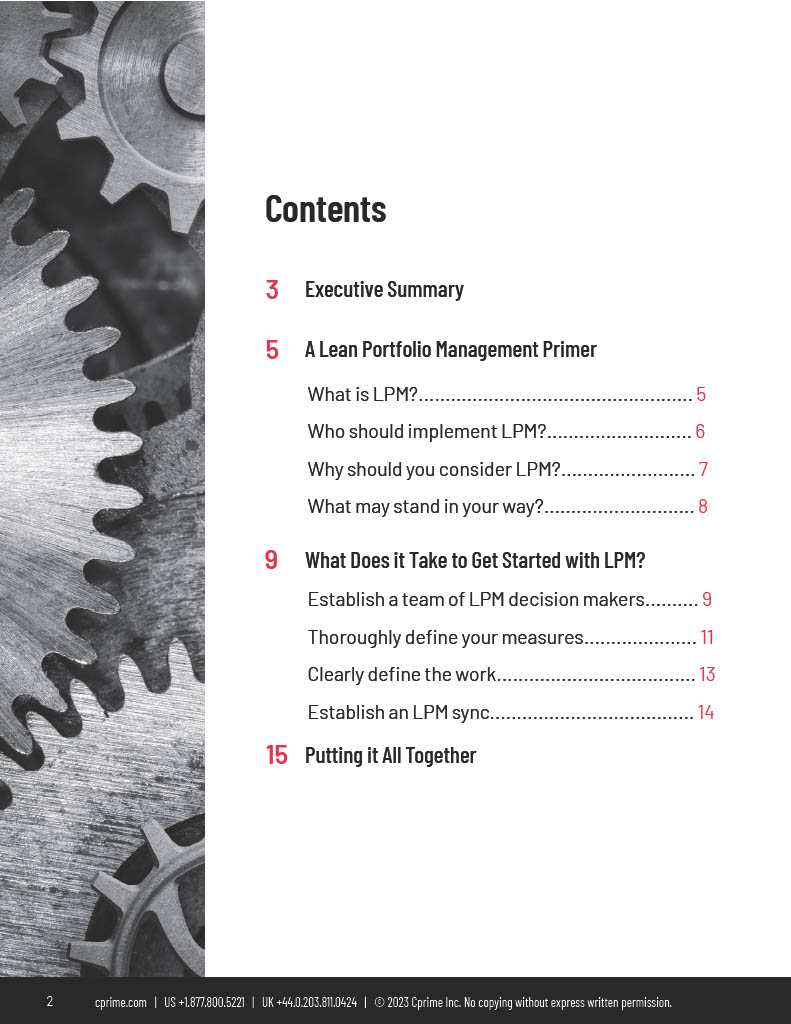
Executive Summary

Every organization’s goal is (or at least should be) to streamline their execution so they can get their products or services in the hands of their customers quickly and efficiently. The market simply moves too quickly to justify any other strategy.

It’s simple to get started 

When your business focuses on one product, and the process to get your product in the customer’s hands is short and simple, applying the basics of well-known Agile concepts like Scrum usually suffices to accomplish that purpose. 

But, if you’re trying to streamline and optimize multiple products, services, and lines of business—large, complex initiatives that may span months or even years—the goal becomes much more challenging.

It’s like turning around an enormous ship on the open ocean—slow, takes a lot of energy, and can be risky.

Business leaders who develop broad strategies and want to see them executed at all levels of the organization—or who are responsible for more concentrated bundled solutions or product categories—rightfully ask: 

  • How do we most effectively execute our strategy across business units and product lines? 
  • If we succeed in doing so, what benefits can we expect to see?
  • And, perhaps most importantly, how do we get started?

By ‌reorganizing work to focus on value and clear solutions, organizations can streamline and optimize outdated and inefficient portfolio management processes. This method dovetails perfectly with other scaled agile processes and supports agility at the enterprise level. 

Although this is a complex set of challenges, getting started on a viable solution is actually relatively simple. 

What you’ll learn in this paper

For many organizations, the answer they’ve discovered is Lean Portfolio Management (LPM).

In this paper, we will briefly cover: 

  • An introduction to LPM—what it is and how it works
  • A guide to getting started with an LPM practice
  • The benefits you can expect from implementing LPM
  • How your organization can take the next step
  • Additional resources that will help you dive deeper into this topic

NOTE: Although LPM is a proven method for aligning large scale initiatives in any industry delivering any kind of product or service, we’ll be using software for our examples. Nearly every organization today is a software organization to some extent, so the examples should resonate universally.

Download the white paper now to keep reading! –>

A Leading Pharmaceutical Company Pursues Scaled Agile Excellence with the Help of Cprime

The Challenge: Lack of Alignment and Planning Struggles Slowed the Agile Scaling Journey

As they progressed in their efforts to scale their Agile practice, they identified opportunities for improvement across the board, both in processes and in the underlying cultural and strategic approach they were taking to scaled agility.

Interdependent teams working in silos

“We had four delivery teams working with two products,” says the R&D department’s Product Director, “and the products are highly interdependent. The data coming out of each feed the other in a cycle. So the delivery teams worked hard on their own product backlog items (PBIs) but there really wasn’t a mechanism for keeping all four teams aligned at all times.”

Additionally, the effectiveness of planning was limited because different teams were planning independently in parallel, which often left risks and dependencies undetected until they became blockers.

Project instead of product mindset

This leading pharmaceutical manufacturer had already engaged Cprime a year earlier to provide extensive training courses around various Agile disciplines and Lean Portfolio Management (LPM). As a result of her own experience in these training classes, the Product Director recognized that the delivery teams were approaching their workflow from a project perspective rather than focusing on value streams, which is a core foundation of SAFe and LPM. To progress with their scaling journey, this would need to change. This core adjustment in what was guiding the work would require tremendous change involving many people. It was no small task.


“We had four delivery teams working with two products and the products are highly interdependent. The data coming out of each feed the other in a cycle. So the delivery teams worked hard on their own product backlog items (PBIs) but there really wasn’t a mechanism for keeping all four teams aligned at all times.” – R&D department’s Product Director


Limited understanding of the big picture

Finally, a general lack of alignment between the business and technical teams resulted in priorities and tasks being set down without the teams really understanding the bigger picture of what they were building and why. This is a situation that we see affecting nearly every organization in one form or another. While it can be a formidable challenge, the delivery teams were eager to overcome it.

The Solution: Bringing in a Release Train Engineer (RTE) to Solidify SAFe

Heading into 2022, they reached out to Cprime to source a coach and SAFe expert who could help guide the teams through the coming changes. Ryan Evans, RTE and Agile Coach, took on this challenging and exciting engagement.

An initial assessment and gap analysis

“Although I am an RTE,” Ryan says, “running the Agile Release Train (ART) wasn’t my first task. I needed to thoroughly understand where the teams were in terms of Agile maturity and workflow so I could give the ART the best chance at success.”

Ryan worked closely with the Product Director to perform a large-scale assessment of the delivery teams and processes. In the end, the assessment functioned as a gap analysis.

“I’ll never forget opening Ryan’s report,” she says, “to see forty-six items listed as opportunities for improvement. But it was great to see everything out on the table. Then, Ryan and I discussed each item and decided which were most important and would have the most impact. Then we could focus our efforts accordingly.”

Ryan adds, “While the gap analysis turned up many necessary improvements, we could boil nearly all down to a few main themes: getting all the teams unified into one ART and working on one cadence so they could plan and execute the work as a cohesive unit, and applying foundational SAFe concepts pragmatically to better organize and prioritize the work being done. So, that’s what we did.”

Changes to enhance PI Planning

Ryan began working with the teams in February 2022, five weeks before the end of the first quarter. With an eye on optimizing the Q2 PI Planning session, he focused on making changes that would get meaningful results without causing undue disruption.

“We had about five weeks to prepare for the new PI Planning,” Ryan recalls, “so it was a blur of activity. We needed to coordinate a much larger and longer session than they’d done before, and we wanted to do some preliminary training so the teams and leadership could get the most out of the event. But we completed it and ran an enhanced planning session involving all four teams, as well as subject matter experts and other stakeholders from several other business units—about one hundred attendees on three continents.”

The primary goals of these changes were:

  • Getting on the same page — Bringing all four teams together for a single, all-encompassing planning session
  • Getting on the same schedule — Establishing a unified cadence so everyone could effectively plan, deliver, and continually improve in concert
  • Understanding our dependencies — With the use of Mural, the teams could visualize all their dependencies and when they needed to be delivered
  • Determining the priority of work — Using the concept of Weighted Shortest Job First (WSJF), the teams could determine the order in which they should tackle work
  • Formalizing the I&P — Establishing a consistent Innovation & Planning (I&P) sprint at the end of each PI to support continuous improvement
  • Laying a solid foundation — This first enhanced PI planning event would set a baseline on which to measure improvement, and a blueprint for future engagements

During the event, Ryan served as RTE, the facilitator who kept the process on track and moving forward. With his coaching, the Product Owners and Agile Facilitators (Scrum Masters) helped facilitate and took the lead in their areas of responsibility.

The Product Director recalls, “Going into that Q2 planning event, I think we were all far better prepared than we’d been in the past to have meaningful conversations and make appropriate decisions. Understanding what we needed to accomplish, how to best do so, and especially why, was vital to the event’s success.”

Working the SAFe framework

Another objective Ryan and the team focused on, both before and after the enhanced Q2 PI planning event, was formalizing the teams’ use of the SAFe framework to better support their scaled Agile practice as an ART. This was another byproduct of ongoing training and slow-but-steady adjustments to existing roles and processes to better align with best practices that have proved successful in thousands of previous engagements.

“To me,” the Product Director says, “one of the greatest benefits of working with Ryan on this was his supporting our use of SAFe as a framework, not a rigid checklist of requirements. There were several concepts we agreed were necessary and beneficial changes we needed to implement, but others that we discussed and decided just weren’t right for the company at this time. And that’s ok. We could pick what would work best for our unique situation.”

The primary goals of these adjustments were:

  • Formalizing roles and responsibilities — Team members and leaders were trained to take on or better carry out their respective roles in a SAFe environment.
  • Formalizing Agile concepts — This included the definition of ready, definition of done, acceptance criteria, capacity planning, feature refinement, and prioritization via WSJF. These concepts were already in play, but teams weren’t applying them consistently, so they needed a common understanding and commitment.
  • Formalizing Agile ceremonies — Establishing a consistent schedule of daily, weekly, and per-sprint meetings provided stability and unity while eliminating a lot of unnecessary ad hoc meetings.
  • Supporting ongoing improvement — Providing necessary SAFe training to get buy-in and help everyone understand the how AND the why behind the changes, as well as ongoing assessments to first establish a baseline and then track increased maturity.

Ryan says, “There was a notable rise in the teams’ confidence level as these principles sunk in and they started seeing the real world value of adhering to a more unified and consistent way of working. Even those who were hesitant at first have really embraced the process.”

The Results: An unprecedented 96% predictability rate on top of greater transparency and trust

Two PIs further along since that first enhanced session in Q2, the team has experienced an unprecedented improvement in predictability based on committed PI Objectives completed.

“In all my years running ARTs, I’ve never seen a percentage this high,” Ryan says, referring to the 95.7 percent predictability rate of committed PI Objectives the teams achieved in the last quarter. “It’s a testament to the strides they’ve made in understanding capacity and velocity, as well as what they can legitimately commit to versus what work is less predictable because of dependencies or blockers outside their control.”

The Product Director concurs, “While that number is phenomenal, we know there’s still work we can do to increase the number of stories we’re able to commit to as we work to smooth out dependencies internally and with outside teams. But, the progress so far has been excellent.”


“While the gap analysis turned up many necessary improvements, we could boil nearly all down to a few main themes: getting all the teams unified into one ART and working on one cadence so they could plan and execute the work as a cohesive unit, and applying foundational SAFe concepts pragmatically to better organize and prioritize the work being done. So, that’s what we did.” -Ryan Evans, STE, Cprime RTE and Agile Coach


Qualitative improvements

Besides quantitative results showing dramatic improvement from baselines set in March, the teams have reported several qualitative improvements as well, including:

  • Greater confidence planning, committing to, and delivering work, but more importantly, greater confidence in stating when the teams cannot commit to deliver work
  • More transparency and visibility into the work within and outside the teams
  • Stronger engagement with and understanding of the big picture strategy
  • New-found stability to withstand inevitable change within and outside the teams
  • Enhanced collaboration within the development teams and with stakeholders in other departments
  • Greater trust that the teams will finish the work that is ready and in the queue

Additionally, in November, a fifth delivery team joined to do a Large Solution PI planning session. This showed a new level of coordination and collaboration between the teams as both continue to mature in their scaled Agile practice. As a result, the company has renewed the engagement so the progress can continue.

The Product Director concludes, “Working with Ryan has been great. We got on well from the get go, and I know that every new decision or experiment is going to be a give and take where we will do what’s best for my teams and the company as a whole.”

Want to see similar results for your organization? Explore our flexible Scaled Agility and Learning solutions.

SAFe and Scaled Agile Framework are registered trademarks of Scaled Agile, Inc.

The Five Phases of Agile Maturity (Part 1): Phase 1 and 2

The journey to agile maturity is neither fast nor straightforward. What do you need to know? What challenges might you face? Which tools will best meet your organization where it’s at?

Join our experts to explore what you should expect to see across the five phases of Agile maturity. In part 1 of this series, we will focus on Phases 1 and 2. Cprime’s Sneha Crews (Managing Director, Solutions Engineering), Rod Morrison (Partnerships Director, EMEA), and Drew Garvey (Enterprise Solutions Architect), will share valuable advice about negotiating the turns, avoiding roadblocks, and enjoying the ride in your agile maturity journey. Plus, we’ll talk about the optimal tools to support you—enterprise product management software, like Atlassian Jira and Jira Align.

Learn:

  • Common maturity elements of Phase 1 of agile maturity (The Agile Team) and Phase 2 of agile maturity (The Team of Agile Teams)
  • Challenges you may face in the beginning of your agile maturity journey and how to overcome them
  • Software tools, features, and functionality that can support scaling


Speakers:

Sneha Crews
Managing Director, Solutions Engineering
Cprime
Rod Morrison
Partnerships Director, EMEA
Cprime
Drew Garvey
Enterprise Solutions Architect
Cprime