Revolutionizing PayPal: The Largest Atlassian Cloud Migration in History
PayPal, a global leader in online payments, faced significant challenges with their existing infrastructure, which…
Rovo is installed. Delivery intelligence still has to be built.
Most teams are using Rovo for search. That alone does not change delivery performance. The AI is there, but the insights teams need are not.
Cprime designs and implements Rovo-powered delivery intelligence inside sprint, release, and dependency workflows so AI supports real delivery decisions.
The result: Teams spend less time assembling status updates, risks surface earlier in the sprint cycle, and delivery commitments become easier to meet. Schedule a Rovo delivery workflow assessment.

Why Rovo alone does not create delivery advantage
Organizations are rapidly enabling Atlassian Rovo after moving to Cloud. Leadership expects AI to improve delivery visibility and team productivity.
Without intentional design, integration, and validation, Rovo remains an underutilized search feature rather than an intelligence system that supports real execution decisions.
Many teams face similar challenges:


Rovo can retrieve information across tools, but delivery insights rarely exist in a usable form.
Sprint summaries, dependency insights, release readiness signals, and delivery risks must be designed and generated intentionally. Without that design work, teams still rely on manual reporting and fragmented dashboards.
Delivery insights depend on signals from multiple systems including Jira, Bitbucket, CI/CD pipelines, and testing platforms.
When these signals are not integrated into Rovo workflows, AI cannot generate meaningful operational insights.


AI‑generated insights must be validated against real delivery data and team workflows.
Without a validation framework, teams often distrust outputs or ignore them entirely.
Organizations that realize value from Rovo move beyond search and embed AI into delivery workflows. A Rovo augmented environment connects your delivery data, DevOps activity, and daily workflows into one intelligent layer that teams can rely on.
Reduced reporting effort
Automated sprint summaries and release documentation reduce manual reporting work, allowing engineers and product leaders to focus on delivery work instead of assembling updates.
Earlier delivery risk visibility
Integrated DevOps signals allow teams to identify delivery risks earlier within the sprint cycle.
Leaders gain delivery visibility without increasing reporting overhead.
Faster release coordination
AI‑generated delivery insights simplify cross‑team coordination and improve release readiness visibility.
Release documentation no longer delays deployment cycles.

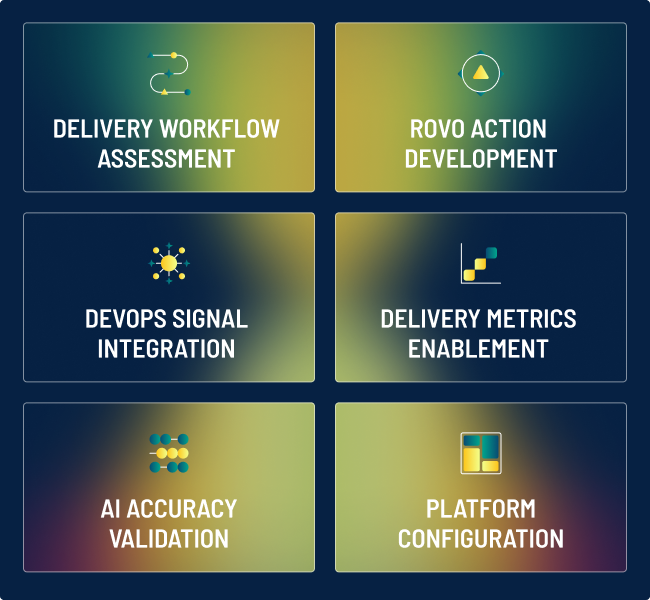
Schedule a focused Rovo delivery workflow assessment to identify:
• Delivery workflows where Rovo agents can generate actionable insights
• Gaps in DevOps signal integration across Jira, Bitbucket, and CI/CD pipelines
• Data and validation risks affecting AI output accuracy
• Initial agents that can demonstrate measurable delivery impact

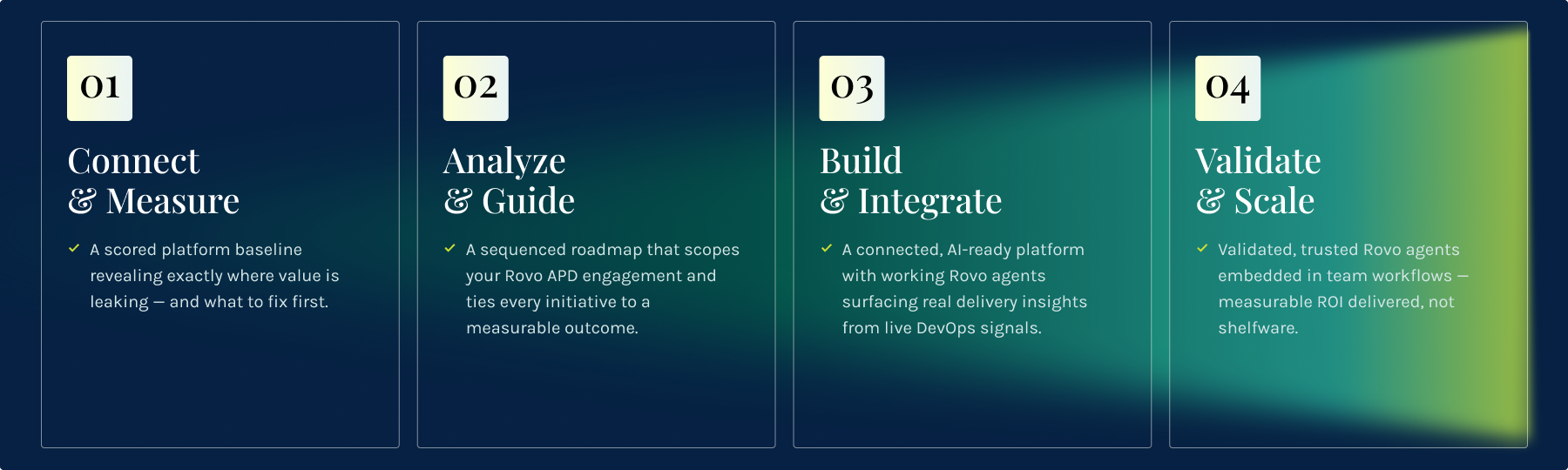
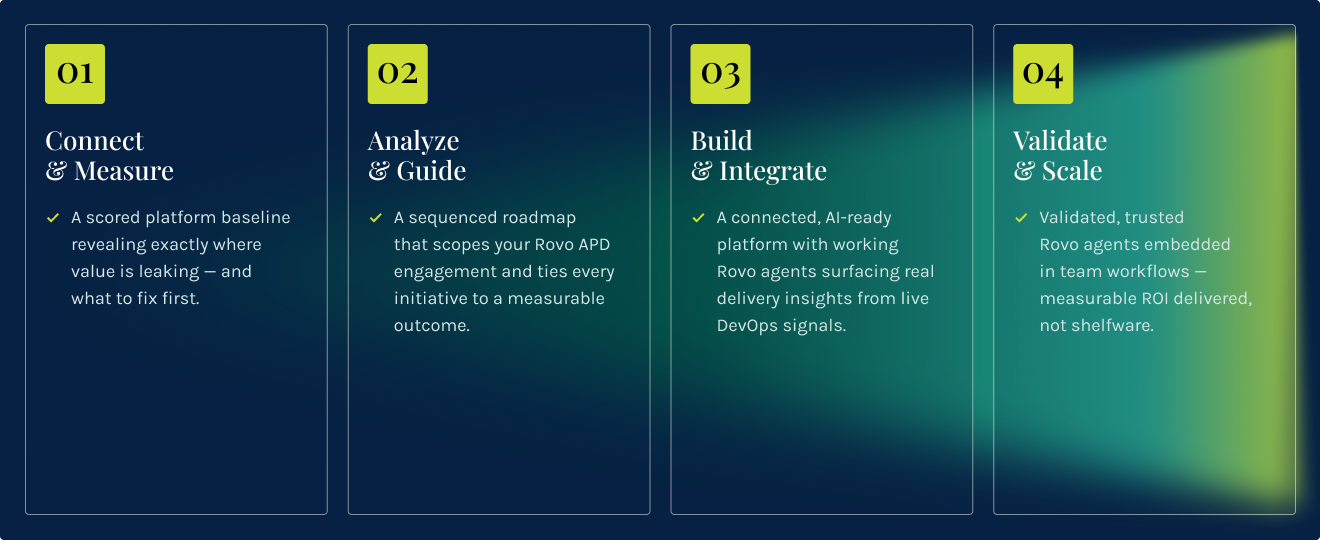
We design and implement a working delivery intelligence layer on Atlassian so AI supports real execution decisions inside the flow of work. Using Rovo agents connected to live DevOps signals, we embed intelligence directly into sprint, release, and portfolio workflows so teams act on signal rather than assemble reports.
The result is measurable operational impact.

Automated sprint summaries generated from live delivery data reduce reporting effort by 70 percent and free more than five hours per sprint per team, allowing engineers and product leaders to spend more time delivering work rather than assembling status updates. At scale, 20 teams can recover approximately $300K or more in annual capacity. Leaders gain visibility without adding overhead, and teams reinvest time in delivery.

Release notes are auto-produced from merged pull requests and completed work, accelerating documentation cycles by 90 percent. Releases ship on schedule, and compliance requirements are met without manual bottlenecks.

Cross-team dependencies are surfaced before they derail commitments. Clients typically see 40 to 60 percent fewer delivery delays and more reliable sprint and release outcomes.

Delivery risk is visible in real time. Status response accelerates by up to 95 percent, meetings shorten, and leadership time shifts from reactive updates to strategic decisions.
Cprime combines Atlassian expertise, Agile delivery knowledge, and AI implementation capabilities to operationalize Rovo inside real product development environments.
Technology alone does not change delivery outcomes. We embed Rovo capabilities into existing Agile and DevOps workflows so teams adopt them as part of normal execution.
Our approach focuses on three areas:
• Designing high‑value delivery insights for sprint and release workflows
• Integrating DevOps signals across Jira, Bitbucket, and CI/CD pipelines
• Building and validating Rovo agents that generate reliable delivery insights
Additional capabilities include:
• Forge development expertise required to build production‑grade Rovo Actions
• Validation frameworks to ensure AI outputs remain trustworthy
• Adoption design that embeds AI insights into daily team routines
Execution leaders often ask how this engagement differs from out-of-the-box Rovo usage, how value is proven, and what operational changes are required.
Atlassian Rovo is an AI capability built into the Atlassian platform that helps teams search, understand, and act on information across their work environment. It connects knowledge, work items, and DevOps signals across tools like Jira, Confluence, and Bitbucket so teams can ask questions, generate insights, and automate actions directly inside their delivery workflows.
Out-of-the-box Rovo provides search and basic assistance. Delivery intelligence requires custom agents, DevOps integration, validation frameworks, and workflow redesign aligned to execution KPIs.
Most engagements begin with a focused assessment and pilot build. Working agents are typically delivered within weeks, followed by validation and expansion across additional workflows.
We define measurable delivery KPIs upfront, baseline current performance, and track changes in reporting effort, cycle time, delay frequency, and management overhead. Value is demonstrated through execution metrics, not usage statistics alone.
Many organizations already have Rovo available. Delivery advantage comes from how AI is configured, validated, and adopted inside daily engineering workflows. Schedule your Rovo delivery workflow assessment and move from feature access to measurable execution impact.