

When disconnected systems begin to slow the business
The client is a global healthcare company with approximately 1,500 employees. Its Enterprise Technology organization supports critical functions across enterprise applications, cybersecurity, infrastructure, SAP, and business process engineering.
As the organization grew, teams worked across separate systems for software delivery and IT support. Development teams operated in Azure DevOps, while IT support relied on ServiceNow. Consequently, visibility fragmented, ways of working diverged, and operational friction spread across the department.
Within ServiceNow, teams treated nearly every request as an incident, regardless of the actual need. Routing lacked clarity, workflows were missing or poorly designed, and alignment to ITIL practices stayed limited. End users had little visibility into ticket status. Meanwhile, support agents struggled with awkward interfaces, limited customization, and inefficient processes.
At the same time, product and development teams lacked standardized workflows and governance in Azure DevOps. This made consistency across delivery teams hard to achieve.
The client set a clear goal: one unified operating model for delivery and support. This model needed to improve visibility, standardize execution, and support future growth.
Turning fragmented delivery into a connected operating model
Cprime partnered with the client to design and configure a connected Atlassian environment. This environment supports both software delivery and enterprise IT service management.
To support software development and product delivery, Cprime implemented:
- Atlassian Guard
- Jira Software
- Confluence
- Big Picture for portfolio management
- Jira Product Discovery for future work pipeline management
The implementation introduced a standardized work hierarchy across teams. It spans Themes, Initiatives, Epics, Features, Stories, Tasks, and Test Cases. In addition, dedicated product and team spaces now support consistent planning, prioritization, sprint execution, and collaboration.
On the service management side, Cprime configured Jira Service Management (JSM) to align with ITIL practices. This work modernized the support experience through several changes:
- Separate workflows for incidents, service requests, and change requests
- Defined SLAs and routing processes
- Workflow automations
- Tailored customer portals for Business Application Support, Enterprise Technology Support, and Global Technical Support
- A bespoke deployment management solution to support CAB approvals and transport movement across environments
Throughout the engagement, Cprime ran collaborative working sessions with Enterprise Technology leaders across IT, cybersecurity, and business process engineering.
Standardizing work across teams without disrupting delivery
One outcome stood out: the client consolidated disconnected delivery and support functions into a single Atlassian environment.
Following the implementation:
- Product and development teams now operate with standardized workflows and consistent delivery structures
- Enterprise Technology teams gained improved visibility into work, priorities, and dependencies
- IT support operations align to ITIL best practices, with clearer categorization, routing, and SLA management
- End users have greater visibility into ticket status and support progress
- Support agents benefit from improved, customizable views within JSM
- The team removed licensing limitations that had restricted broader departmental participation
In addition, Jira Product Discovery gave the client a structured approach for evaluating and managing future work.
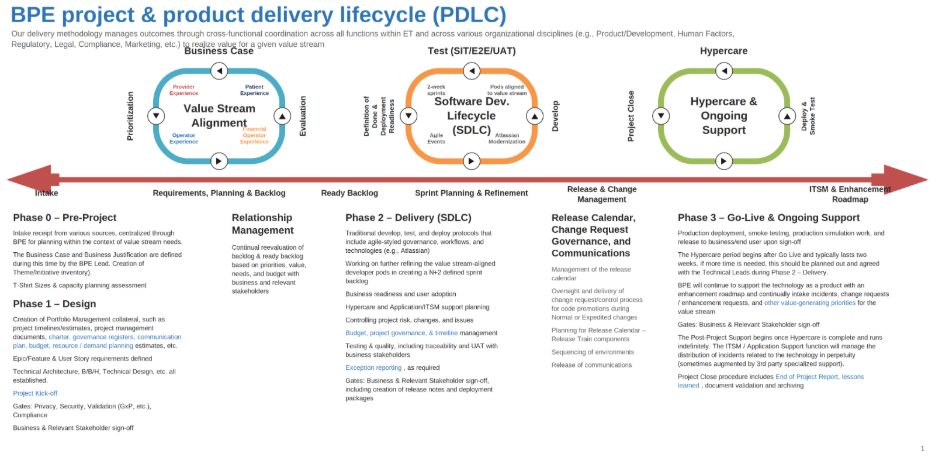
The connected delivery and change lifecycle established in the Atlassian environment.
Building a foundation for long-term operational maturity
For the client, the engagement established a connected, standardized foundation for software delivery, IT support, and operational governance.
By aligning teams within one environment, the client improved consistency across delivery and support. As a result, leaders gained clearer visibility into how work moves across the organization.
As the organization continues to evolve, this foundation now supports scaling collaboration, governance, and enterprise delivery practices. Because the model is built to grow with the business, adoption continues well beyond the initial rollout.
Frequently asked questions (FAQs)
What is Atlassian consolidation?
Atlassian consolidation brings software delivery and IT support onto one connected Atlassian environment. Teams replace disconnected tools with shared workflows, clearer governance, and consistent visibility across delivery and service management.
How does Jira Service Management support ITIL practices?
Jira Service Management aligns with ITIL through separate workflows for incidents, service requests, and changes. Defined SLAs, routing rules, and change approvals help IT support operate with clearer categorization and accountability.
Can teams move from Azure DevOps and ServiceNow to Atlassian?
Yes. Development work can move into Jira Software and Confluence, while IT support moves into Jira Service Management. A partner-led implementation standardizes workflows and governance, so the shift improves consistency rather than adding disruption.
What are the benefits of unifying software delivery and IT support?
Unified delivery and support give leaders shared visibility into work, priorities, and dependencies. Standardized workflows reduce friction, while end users and support agents gain clearer status and more usable service experiences.
How does Cprime approach an Atlassian implementation?
Cprime works through collaborative sessions with technology leaders to design the operating model first. Configuration of Jira Software, Confluence, and Jira Service Management then reflects how work and decisions actually flow, which supports adoption over time.
Ready to modernize delivery and service management?
Disconnected systems and inconsistent processes make it hard to scale delivery and maintain visibility. Cprime helps organizations unify workflows, modernize service management, and build operating models that sustain execution.
Through Atlassian consolidation, your teams can replace fragmented tooling with one connected way of working. If fragmented tools or limited visibility are slowing your teams, now is the time to act.