
Resource Topic: Strategic Portfolio Management (SPM)

Ebook – Your Path to Execution Excellence with ServiceNow SPM

How ServiceNow SPM powers enterprise agility and strategy execution

Disruption is now the norm. The enterprises thriving in this environment aren’t reacting faster—they’re orchestrating smarter. Strategic Portfolio Management (SPM) has become the new operating system for aligning strategy, funding, and execution in real time.

This exclusive ebook reveals how leading organizations use ServiceNow SPM—guided by INRY, a Cprime Company—to turn strategic intent into measurable outcomes.

You’ll learn how to:

  • Reconnect siloed investments to enterprise priorities for visible, measurable value.
  • Build adaptive systems that evolve with shifting business demands.
  • Integrate financial planning, resource management, and agile delivery in one flow.
  • Apply proven practices from healthcare, government, and retail to accelerate ROI.
  • Use post-implementation adoption strategies that sustain transformation.

Download the ebook to see how modern enterprises are using ServiceNow SPM to transform disruption into a competitive advantage.

Unlock the Power of Strategic Portfolio Management (SPM)

Discover how Strategic Portfolio Management can transform your organization, enabling agility, innovation, and sustained growth.

In our white paper, “Strategic Portfolio Management: A Catalyst for Business Evolution in the Age of Disruption”, you’ll learn:

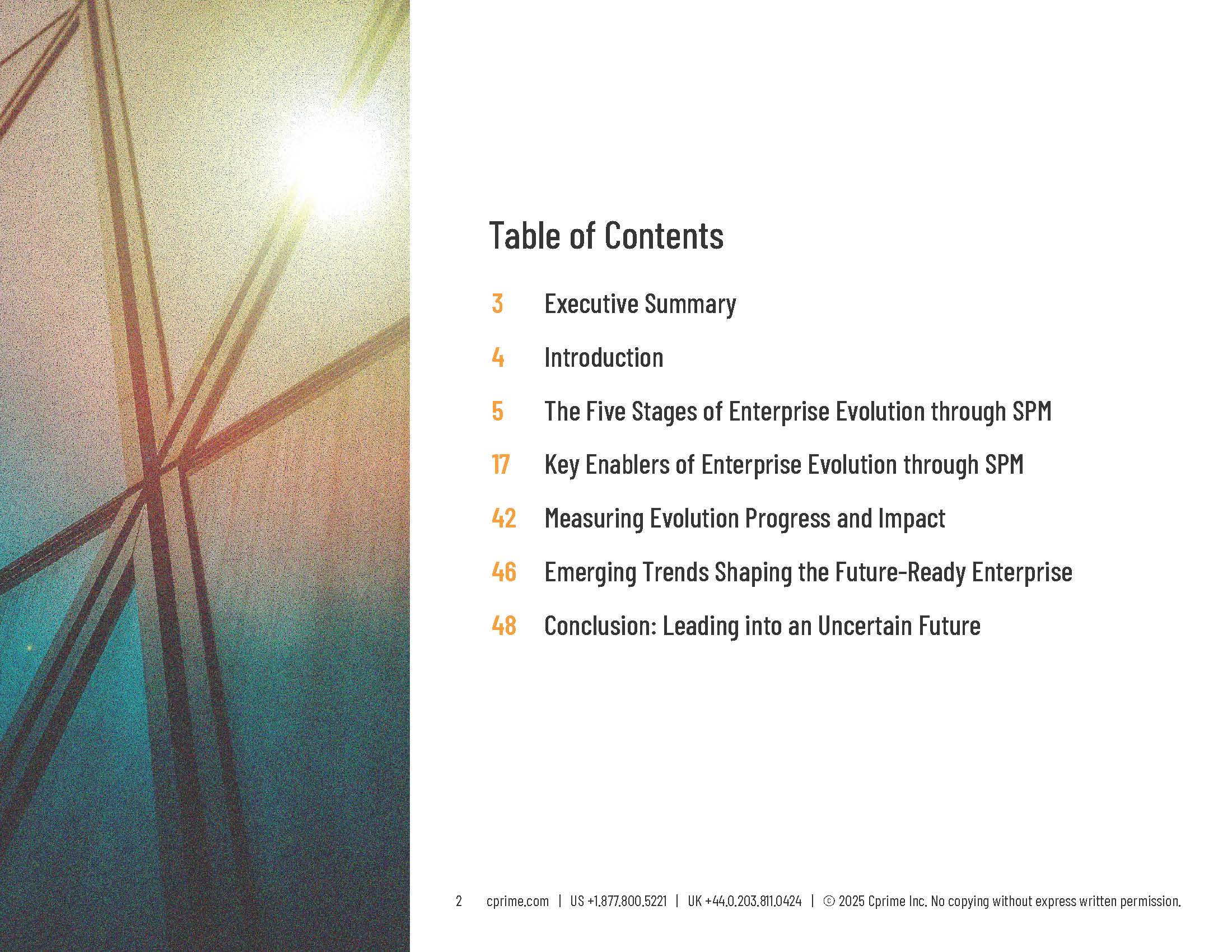
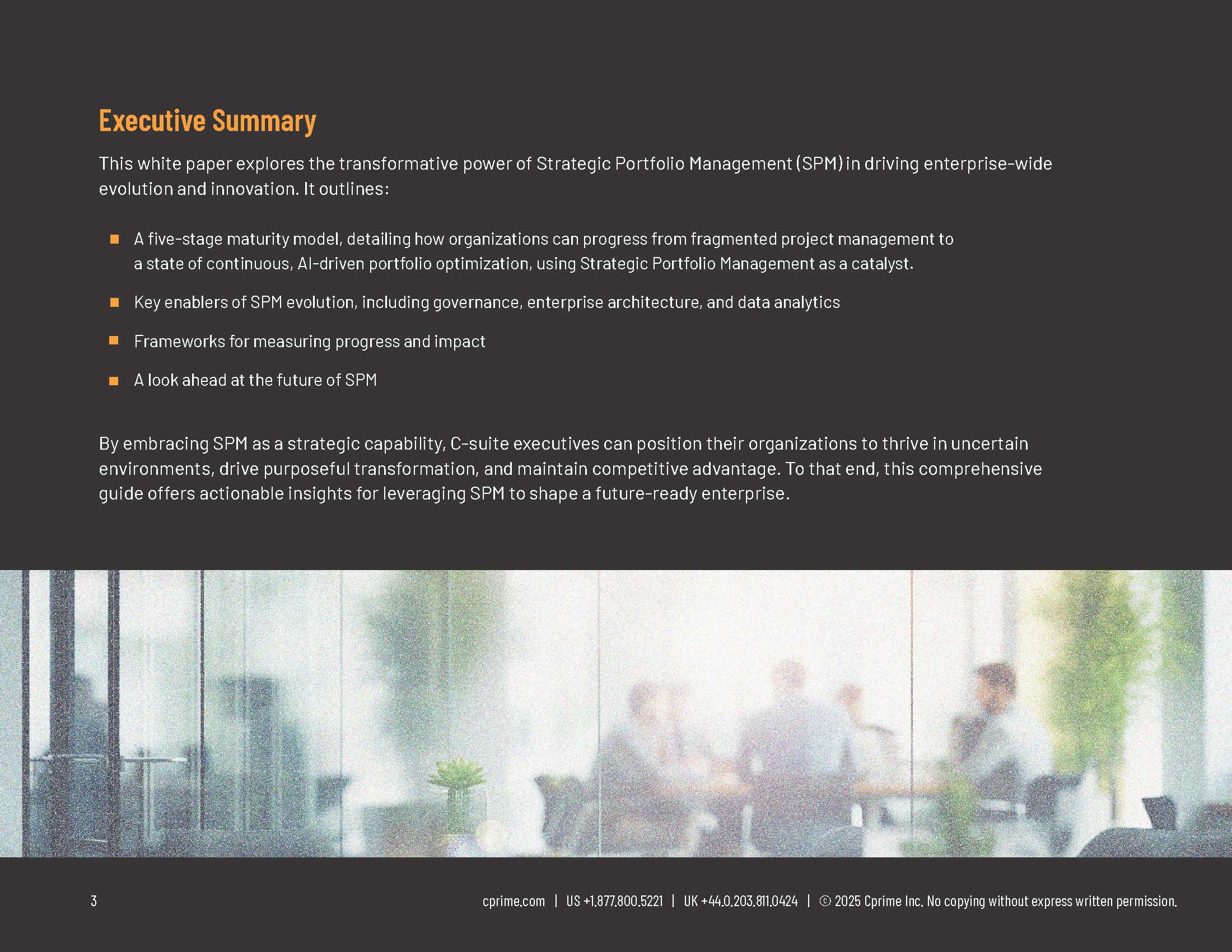
  • The Five Stages of Enterprise Evolution: From laying a solid foundation to achieving continuous, AI-driven portfolio optimization.
  • Key Enablers for Success: Governance, enterprise architecture, data analytics, and more—integrated to support strategic goals.
  • Emerging Trends and Future Insights: Understand hyper-connected ecosystems, customer-centric portfolios, and cognitive enterprise operations.
  • Actionable Frameworks and KPIs: Tools to measure progress and ensure alignment with business objectives.

“SPM serves as the nexus between strategy, execution, and adaptation, orchestrating the entire organizational ecosystem toward a common vision. This dynamic capability allows businesses to turn potential disruptions into opportunities for growth and innovation.”

Download this Strategic Portfolio Management white paper now and take the first step toward transforming your portfolio management strategy into a competitive advantage.


The Five Stages of Enterprise Evolution through SPM: Achieving Sustainable Enterprise Evolution

Is your organization honing in on an optimal Strategic Portfolio Management (SPM) program, but need that extra last-lap push to drive real enterprise-wide impact that lasts? You’re not alone. Part 1 of this series covered Stages 1-3, getting the program off the ground; Part 2 covered accelerating SPM by moving to Stage 4. In this final webinar, Cprime’s SPM experts cover the final stage of this proprietary roadmap to enterprise maturity to fully revolutionize how your enterprise aligns strategy with execution: Moving from Stage 4 to Stage 5 and achieving sustainable evolution.

We’ll dive into:

    • Transformative Leadership: Become a catalyst for industry-wide change, shaping market trends and setting innovation standards.
    • AI-Powered Strategic Foresight: Leverage advanced AI for real-time portfolio optimization and opportunity identification.
    • Dynamic Business Model Innovation: Drive continuous innovation through constant portfolio refinement at the business model level.
    • Ecosystem Orchestration: Maximize value creation across partner networks using AI-driven optimization of hyper-connected ecosystems.
    • Talent as a Strategic Differentiator: Implement AI-driven talent development and dynamic team composition to maintain a workforce aligned with evolving business needs

.

Don’t miss this chance to benchmark your journey and realize the full value of your SPM transformation. Unlock your organization’s full strategic potential!

Sneha Crews
Head of Solution Engineering
Cprime
Matt Chivers
Lead, Enterprise Technology, Strategic Portfolio, and Financial Management
Cprime

Transforming Portfolio Management at Skipton Building Society in Just 9 Weeks

When organizations evolve their strategic planning processes, their portfolio management capabilities need to evolve as well. This was the opportunity facing this leading financial services organization in the UK, until a pioneering approach to Lean Portfolio Management transformed their delivery capabilities.

When Portfolio Scale Outpaces Process  

Like many organizations, our client had historically approached their corporate planning with flexibility rather than clear commitments. “Previously, the corporate plan was more of a directional document than an execution roadmap,” explains one project leader. This approach shifted when a new CEO arrived with a vision for more structured delivery and began asking for specific execution timelines.

The organization recognized opportunities to improve portfolio visibility and team alignment. Their existing change prioritization process needed modernization, and departments had opportunities to enhance collaboration. Most importantly, they sought better ways to track delivery and value.

After evaluating seven to nine different companies, the company chose Cprime because they felt we truly understood the issues they were facing and were going to guide them to success rather than hand them a generic PowerPoint deck and walk away.

Essential LPM: A Strategic Approach to Portfolio Management

Recognizing that traditional LPM implementations had become increasingly complex, Cprime developed a streamlined, essential approach. This new methodology, piloted in partnership with our client, focused on implementing core LPM elements in just nine weeks.

The solution included:

  • A comprehensive two-day LPM training event
  • Current state portfolio evaluation
  • Value stream identification workshops
  • Strategic theme creation
  • Portfolio canvas and vision development
  • Epic identification and prioritization
  • Implementation of a Portfolio Kanban system
  • Regular portfolio sync meetings

Following the initial nine-week implementation, Cprime guided the company through SAFe PI Planning, successfully rolling it out across nine Agile Release Trains (ARTs) involving 450 people within six months.

The Results  

“We saved them four million pounds within six weeks just because they now have full visibility into the work being done, how and why it’s being funded, and how it aligns with high-level strategy.” — Gez Smith, Cprime LPM Consultant and SAFe Fellow

The impact was immediate and substantial. Within the first two months, the client identified opportunities to optimize their portfolio that resulted in £4 million in cost savings. “We got everything in the same place and could make more informed decisions about our investments,” one stakeholder reported.

The organization experienced significant improvement in project predictability, with ARTs consistently achieving their delivery commitments after the first PI Planning. Teams developed increased confidence in their planning and execution capabilities.

The benefits were so clear that they decided to retain a dedicated space for PI Planning though it cost £50,000 annually in taxes, determining that “the conversations that we’ve had have already paid for the space just through the alignment.”

Most notably, the organization achieved comprehensive portfolio visibility. As one leader noted, “This is the first time we can actually see across the organization what all of the teams are working on.”

Could Essential LPM Work for Your Organization?

Cprime’s Essential LPM approach demonstrates how portfolio management opportunities can be addressed through a focused, streamlined implementation. For organizations looking to enhance portfolio visibility, project delivery, or organizational alignment, Cprime’s proven methodology offers a path to efficient, sustainable transformation. Like our client, we’re confident your organization can achieve meaningful results through a structured, well-planned implementation with the right approach and expertise.

Moving forward, Skipton Building Society has a strong foundation for organizational transformation, providing the opportunity for even greater results through continued development of these LPM capabilities.

Explore our innovative and flexible Lean Portfolio Management solutions today!

The Five Stages of Enterprise Evolution through SPM: Accelerating Your SPM Progress

Is your organization struggling to build or accelerate its Strategic Portfolio Management (SPM) program to drive real enterprise-wide impact? You’re not alone. Part 1 of this series covered Stages 1-3, getting the program off the ground. In this follow-up webinar, Cprime’s SPM experts dive deeper into this proprietary roadmap to enterprise maturity that can revolutionize how your enterprise aligns strategy with execution: Moving from Stage 3 to Stage 4 in preparation for sustainable evolution.

We’ll dive into:

  • How collecting and analyzing data will drive fast, strategic decision-making around resource allocation and risk management
  • Leveraging AI and machine learning to supercharge data for predictive analytics and scenario planning
  • Accelerating your SPM progress with Cprime’s guidance, organizational change support, and advanced software tools
  • Case studies of companies that have effectively improved their enterprise-wide processes and capabilities
  • Practical measures to evaluate and enhance your own Strategic Portfolio Management implementation

Don’t miss this chance to benchmark your SPM and chart a course for transformation. Register for this live webinar now and unlock your organization’s full strategic potential!

Sneha Crews
Head of Global Solution Design
Cprime
Gavin Blackmer
Senior Agile/TBM Consultant
Cprime

The Five Stages of Enterprise Evolution through SPM: From the Ground Up

Is your organization struggling to get its strategic portfolio management (SPM) program off the ground? Or perhaps you’ve started, but can’t seem to drive real enterprise-wide impact? You’re not alone. In this eye-opening webinar, Cprime’s SPM experts unveil a proprietary roadmap to enterprise maturity that can revolutionize how your enterprise aligns strategy with execution.

We’ll dive into:

  • Why SPM is a strategic imperative in today’s fast-paced business landscape
  • A comprehensive overview of SPM and its key components
  • The first three critical phases—from building a solid foundation to integrating enterprise operations—and how SPM powers enterprise-wide change  
  • How Cprime’s advisory services, change management expertise, and cutting-edge tooling solutions can supercharge your SPM journey
  • Real-world examples of organizations that have successfully navigated the path to greater enterprise maturity
  • Actionable steps to assess and advance your own SPM journey

Don’t miss this chance to benchmark your SPM and chart a course for transformation. Watch the webinar on-demand now and take the first step towards unlocking your organization’s full strategic potential!

Eric Rodstein
Director, Solution Design
Gavin Blackmer
Senior Agile/TBM Consultant

WellStar Leverages INRY’s ServiceNow Expertise for a Tailored SPM Solution

WellStar chose INRY as their preferred partner to revamp their Strategic Portfolio Management System. The objective was to bring about a significant transformation, and INRY provided support to make it happen. Through detailed workshops and collaborative sessions, INRY acquired a deep insight into WellStar’s challenges and areas of concern. INRY carefully documented the workflow and processes, identified bottlenecks, and analyzed the underlying causes of inefficiencies. This in-depth understanding was crucial in crafting a solution tailored to WellStar’s needs.

A customized solution was created to address the different challenges identified, to streamline WellStar’s workflows, enhance productivity, and cut down expenses. Given the complexity of the transformation, INRY recommended a phased implementation approach to ensure success.

The first phase involved building a solid foundation, which was crucial to the entire project’s success. Once the foundation was established, Phase 2 introduced advanced features and optimization. With this approach, INRY delivered a comprehensive solution addressing WellStar’s specific challenges while minimizing disruptions to their day-to-day operations.

The Journey of Transformation

Phase 1: Building the Foundation for Success

In Phase 1, it was essential for INRY to gain a comprehensive understanding of WellStar’s current project and Portfolio Management procedures. The existing process and practices were reviewed along with historical data. Workshops were conducted, and existing reports were analyzed to conduct a thorough analysis. INRY was then able to identify areas where the platform was not being utilized to its fullest potential.

INRY efficiently optimized the existing ServiceNow Strategic Portfolio Management System to address WellStar’s specific requirements:

Project & Portfolio Management

Key processes like portfolio creation, financial planning, and project workspace functionalities were optimized to align with WellStar’s objectives. Deliverables included configuring portfolio and project management settings, enabling SPM processes, defining project criteria, and establishing task assignments. Custom fields, workflows, and templates were also configured to streamline project initiation, management, and closure. This ensured alignment with enterprise strategies and efficient resource utilization.

Idea & Demand Management

WellStar was shown management tools that encourage innovation, including initiating and collaborating on ideas, and evaluating them. Workflows, notifications, access permissions, and forms have been configured to accept different types of ideas based on demand.

Resource & Time Management

Efficient resource allocation and time tracking were prioritized to optimize resource utilization and project cost control. The Resource and Time Management module was configured ensuring alignment with WellStar’s unique requirements and workflows.

Seamless Integration for Enhanced Collaboration

The integrations aimed to foster seamless collaboration by integrating ServiceNow with external systems, such as Cloud Coach for EPMO integration and Outlook/MS Teams for project meeting tracking. Security protocols were maintained while configuring integration channels to ensure secure data exchange and compatibility between systems.

Empowering Data-Driven Decision-Making with Performance Analytics

INRY tailored performance analytics solutions to empower WellStar with actionable insights for strategic decision-making. Key configurations included the development of customer-specific reports, metrics, and benchmarks, enabling WellStar to measure performance against organizational goals effectively.

Phase 2: INRY Optimizes WellStar’s SPM Foundation

During Phase 2, WellStar partnered with INRY to enhance the operational and user experience of the existing system. INRY worked closely with WellStar stakeholders to identify areas for improvement in the functionalities introduced in Phase 1. User feedback was incorporated to streamline workflows, optimize data flow, and refine the user interface.

Streamlining Workflows, Empowering Users

Phase 2 focused on adding new features and aimed at improving the efficiency of existing processes. INRY organized workshops to analyze WellStar’s workflows and identify any bottlenecks and opportunities for optimization. Based on the feedback received from WellStar, INRY advised on how to enhance the existing solution. New features were introduced like defining project phases, managing approvals for scope changes, and capturing completed projects. Past project templates were leveraged to streamline resource allocation and task identification while defining clear milestones and budget allocation criteria.

Seamless Data Integration into Single System

Customer APIs have been designed to seamlessly integrate existing systems with Workday and Salesforce systems for data synchronization. The APIs have eliminated data silos, thereby ensuring that everyone is working from the same page. Workflows have been scheduled to automate data exchange between ServiceNow and external systems, which has further streamlined the data synchronization process.

Data-Driven Decisions for Improved Performance

INRY configured advanced features such as a Dashboard setup for targeted audiences, Gantt charts, and additional reports to enhance WellStar’s performance analytics, providing invaluable insights. Reports, metrics, and dashboards were tailored to WellStar’s KPIs.

This enabled the leadership team to anticipate trends, monitor project performance, and identify areas for improvement. Self-service reporting capabilities were configured which empowered users to access the data they need, customize reports based on their specific requirements, and gain insights into various aspects of their organization’s performance.

Unlocking the Key to Long-Term Success

WellStar’s clear vision and commitment to excellence have led the way for the transformation. Ensuring that every step taken is in line with WellStar’s unique goals and aspirations, INRY has provided tailored solutions and expertise. With advanced functionalities, strong governance, and the potential for automation, WellStar can navigate the everchanging healthcare landscape with confidence, ensuring delivery of exceptional care to their patients. Together, we celebrate WellStar’s remarkable achievements and look forward to continued collaboration.

Want to see similar results for your organization? Explore our flexible ServiceNow SPM solutions today.

Fueling the Future: How Chevron Boosted Efficiency, ROI, and Financial Alignment Using Strategic Portfolio Management

As a titan in the energy industry, Chevron found itself at a crossroads. The company was grappling with siloed operations across numerous business units and geographies, difficulty aligning IT initiatives with business strategy, and inefficient resource allocation and financial tracking. Additionally, Chevron faced challenges in adapting to market volatility and regulatory changes while balancing current operations with investments in future energy solutions.

The vast, complex organization spread across continents was hindered by legacy systems that weren’t equipped to handle the agility and strategic alignment needed in today’s fast-paced energy landscape. It became clear that a comprehensive transformation was necessary to maintain Chevron’s competitive edge and prepare for future challenges.

Crafting a Comprehensive Solution Beyond Just Implementation

Cprime’s engagement with Chevron went far beyond a simple software rollout. The solution was multifaceted, addressing Chevron’s complex needs through a series of strategic initiatives. 

Strategic Portfolio Management (SPM) supported by Lean Portfolio Management (LPM)

At the core of the transformation was the implementation of Strategic Portfolio Management practices. This involved configuring systems to map initiatives directly to strategic objectives, supporting Chevron’s drive for clarity and focus. Complementing this was the integration of Lean Portfolio Management practices within their established Scaled Agile Framework® (SAFe®), which streamlined decision-making and improved resource allocation across Chevron’s expansive portfolio.

Implementing and optimizing Apptio Targetprocess

A crucial component of the solution was the implementation and optimization of Apptio Targetprocess. Cprime tailored Apptio’s tooling to Chevron’s unique needs, enabling real-time financial tracking and strategic planning. This provided unprecedented visibility into Chevron’s massive portfolio, allowing for more informed and agile decision-making.

The transformation also included a comprehensive value stream mapping exercise. This helped Chevron identify and optimize 13 key platforms, each aligning IT and business functions to specific value streams. This alignment was critical in breaking down silos and improving collaboration across the organization.

Agile transformation

To ensure the success of these new practices and tools, Cprime supported the implementation of agile practices across the organization, with a focus on business outcomes rather than just IT delivery. This was accompanied by extensive coaching and training to ensure adoption and a cultural shift across 13 integrated platforms spanning continents, and based around 25 value streams. In total, 6,600 individuals in 50 teams-of-teams were directly impacted. 

The Ripple Effect: Transforming More Than Just IT

The impact of this transformation extended far beyond improved software systems. Chevron experienced a fundamental shift in how they approached strategic planning and execution.

Greater strategic alignment and resulting ROI

The new system dramatically enhanced strategic alignment, giving Chevron the ability to directly connect individual initiatives to overarching strategic goals. This ensured that every project contributed to the company’s vision, eliminating waste and improving overall efficiency.

Enhanced adaptability

The new system allowed Chevron to adapt more quickly to market changes, regulatory shifts, and emerging opportunities in the energy sector. This agility is crucial in an industry known for its volatility and rapid technological advancements.

Real-time, data-driven insights

Data-driven decision making became a reality across the organization. Leadership now has access to real-time data and insights, enabling more informed and timely strategic decisions. This has proven invaluable in navigating the complex landscape of the energy sector.

“Our Agile transformation has revolutionized how we manage our vast portfolio. We’ve improved alignment across our digital platforms, enhanced our decision-making process, and significantly increased our ability to adapt to market changes. This strategic approach is driving innovation and efficiency across Chevron’s operations.”

— Jiddu Ledezma, Head of Program Management, Chevron

Optimal resource allocation

Resource allocation also saw significant improvements. Chevron can now dynamically adjust resource allocation across its global operations, optimizing for both current needs and future investments. This flexibility is crucial for balancing the demands of current operations with the need to invest in future energy solutions.

Streamlined, efficient operations

Perhaps most importantly, the transformation led to streamlined operations across the board. The reduction of silos and improved collaboration between IT and business units has created a more cohesive and efficient organization, better equipped to face the challenges of the energy sector.

Looking Ahead to Continuous Improvement in a Changing World

While the transformation has been significant, Chevron’s journey is ongoing. The company is now positioned to further refine its SPM practices and expand the use of data-driven decision-making across all levels of the organization. 

Chevron is also better equipped to continue balancing current operations with investments in alternative energy sources, a crucial consideration in today’s energy landscape. The improved agility and strategic alignment allow the company to adapt more readily to regulatory changes and environmental concerns, positioning Chevron as a forward-thinking leader in the industry.

Cprime remains a trusted partner in this journey, ready to support Chevron’s evolving needs. The long-term nature of this engagement (over six years and counting!) has allowed for deep understanding and continuous refinement of the solutions.

The Bigger Picture: Lessons for the Energy Sector

Chevron’s journey offers valuable insights for other organizations in the energy sector and beyond. It demonstrates that strategic alignment is crucial in navigating complex market conditions, and that even massive, global organizations can become more agile and aligned with the right approach and tools.

The transformation underscores the non-negotiable nature of data-driven decision making in today’s volatile markets. Having real-time insights is critical for making informed strategic decisions, especially in an industry as dynamic as energy.

Finally, Chevron’s multi-year engagement with Cprime underscores the value of having a consistent, knowledgeable partner through major transformations. This long-term partnership approach allows for deep understanding, continuous refinement, and sustained success.

Would you like to see similar results for your organization? Explore our flexible Enterprise Technology and Financial Management solutions.

Upgrading the Enterprise: A Strategic Portfolio Transformation at a Global Commercial Insurance Provider

Overview

A recognized innovator, this Midwest-based insurance provider and long-term Cprime client has been developing market-leading insurance products for over a 130 years. As a top-10 insurer in the United States commercial insurance space, the company continues to build on their history and break new ground, expanding their global reach by developing new digital products and insurance technologies.

Challenge: A Top-Down Transformation to Redefine Portfolio and focus on Product

On the heels of a successful essential SAFe© transformation designed to revitalize their ways of working and improve its ability to rapidly deliver new product offerings, the Commercial P&C provider sought to pursue Strategic Portfolio Management as a catalyst to accelerate enterprise evolution. With a partial transformation under its belt, the company recognized it had reached a natural transition point—it needed to address several interrelated organizational bottlenecks before it could move forwardy.

“To achieve the next level of its organizational evolution, the company had to change its mindset and pivot away from project-oriented thinking,” explains Sneha Crews, Solutions Architect, Cprime. “It needed to focus on product and portfolio and align itself around identifying its value streams.”

Distinguishing value

Because it perceived its portfolio as a tool for funding project work rather than aligning its product strategies, the insurer’s decision makers struggled to differentiate between profitable and unprofitable aspects of the business. This lack of a proper organizational distinction between business functions and product also affected the way the company recognized and delivered value.

““From a management perspective, the company had difficulty distinguishing between business areas because all of its expenses came from the operations or claims pots,” clarifies Crews. “When it came to identifying and, more importantly, aligning value streams within its portfolios, it also had serious information silos and accountability issues. Ultimately, no one saw the big picture because no one had responsibility at the product level.”

“With their launch of a portfolio-level SAFe© pilot, the insurer has embraced strategic portfolio management. Its leaders are comfortable with the concepts of participatory budgeting and are organized around their value streams.” — Sneha Crews, Solutions Architect, Cprime

Breaking down budget barriers

Long planning and budget cycles were the company’s next choke point. Because the insurer still used traditional budgeting practices to plan its projects months in advance, it lacked the flexibility to pivot or adapt when conditions changed.

“They were locked into the old iron triangle of scope, schedule, and budget,” says Crews. “When you have a hundred-year-old company, habits become entrenched. From a functional SPM perspective, they couldn’t move forward without change.”

Solution: Leveling up from project-level successes—A Cprime partnership for organizational change

The insurer initially approached Cprime for its reputation for success and ability to effect progressive change, and the Cprime teams impressed management with the results of their early lean agile transformation efforts. Recognizing the project-level benefits of its transition from traditional waterfall ways of working to program increment (PI) planning and agile release trains (ARTs), the company wanted to continue along the scaled agile path in its executive offices.

“The initial transition with Cprime was a catalyst. Agile was the snowball that grew bigger as it rolled down the hill,” says Crews. “We started with coaching agile teams, but the insurer understood Cprime could scale up to transform its operating model from project-focused to a product-led approach. It knew that we had coaches capable at the strategic portfolio level. That’s why it began shifting its thinking and looking at changes to its org structure.”

“Because Cprime partners with them at multiple levels on topics ranging from product to enterprise operating model, the insurer really enjoys working with us. It plans to continue collaborating with us to define and execute future growth.” — Sneha Crews, Solutions Architect, Cprime

Changing the culture and reassessing traditional roles

Changing the org chart, however, meant changing the culture and reassessing traditional roles. This meant combating cultural inertia and overcoming pushback to redefine the role of the organization’s driving force—its traditional project managers.

“Moving to a focus on product, their project managers had to adapt to the organizational changes,” says Crews. “They had to be reassured their institutional and professional expertise was valuable for more than managing limited scope projects with clear beginnings, middles, and endings. They needed to see themselves as part of a greater whole.”

The changes, however, ran far deeper than project management at the operational level. Proving its commitment to change, the insurer brought in a new CIO with lean agile experience.

“It was very important to have a champion at the C-suite level to validate the SPM process and confirm it wasn’t just marketing speak,” says Crews. “With that champion in our corner, Cprime identified which areas of the organization would be ideal for a pilot. The Cprime teams began targeted training to get the insurer’s leaders up to speed with the concepts of strategic portfolio management (SPM). From there, the teams moved on to value stream identification and participatory budgeting workshops.”

Incremental change, not boiling the ocean

Having established the fundamentals of SPM, the Cprime team began its executive-level value stream identification sessions. These sessions allowed the insurer to align its portfolio objectives, streamline its product creation workflow, and speed up a product’s time to market.

“We didn’t want to boil the ocean, so we began with focusing leadership on determining the value stream of specific products within their portfolios. Once they had identified the value those products offered their customers, we broke it down to the IT infrastructure and technical systems they needed in place to manage those streams.”

Fostering involvement and accountability from the top down

The team then moved to participatory budgeting, an LPM practice that moves away from project-centric governance and approvals to provide discretionary funding to value streams directly from the portfolio budget. Participatory budgeting places decisions in the hands of the stakeholders closest to the product.

“Participatory budgeting provides multiple organizational benefits. The ability to make direct decisions creates a sense of ownership and responsibility for a product in stakeholders—that helps the company budget realistically and avoid the product neglect and the accrual of technical debt common with the traditional budgeting and approval process,” explains Crews. “It allows product owners to pivot and rapidly adjust to changes in circumstances or market conditions and encourages communication instead of silos between stakeholders.”

Leaders must not only implement changes in their operating models but evolve them—aligning technology, resources, and investments with enterprise strategy and desired business outcomes—to achieve sustainable success.

Results: A practical blueprint for Strategic Portfolio Management

Over the course of the engagement, Cprime worked with the insurer to establish clear value streams, improve stakeholder engagement and accountability, and simplify budgeting by establishing lean guardrails to fund product initiatives and form lasting product teams rather than disposable project teams.

“With the launch of its portfolio-level SAFe pilot, the insurer has its key people embracing strategic portfolio management. Its leaders are comfortable with the concepts of participatory budgeting and are organized around their value streams—the fact that they keep moving forward validates their high-level progress,” says Crews. “They have excellent momentum—they’re no longer locked into the limitations of scope, schedule, and budget or tying product funding to a restrictive long-term governance process. They are planning and re-planning on the fly to match their outcomes to changing conditions.”

Seeing the core principles of strategic portfolio management in practice, the insurer has increased its commitment to propagating a new operating model throughout all levels of the organization.


Would you like to see similar results for your organization? Explore our flexible Strategic Portfolio Management solutions today.

How to Structure Your Lean Portfolio For LPM Success

Executive Summary

Business agility: The ability to pivot quickly and efficiently based on customer feedback and changes in the market with a focus on delivering value to the customer.

This is—or certainly should be—leadership’s goal in every modern organization. The market simply moves too fast to succeed with any other aim. 

For smaller organizations with one or a small handful of related products, learning and applying some basic Lean and Agile principles can accomplish this goal. That’s why startups are traditionally so much more nimble than large enterprises. But business agility is well within the grasp of even the largest organizations when they establish and maintain a strong but flexible structure for maintaining strategic alignment and supporting Lean and Agile practices at all levels of the enterprise.

Lean Portfolio Management (LPM) is a proven method for doing just that.

What you will learn in this white paper

The first white paper in this series offered a primer for those new to the concept of Lean Portfolio Management. It covered what it is, why it’s vital for enterprises today, and the fundamentals required to set up a new LPM program.

If you haven’t already read it, and think you’d benefit from that information, download it here.

In this white paper, we take you beyond the fundamentals into a discussion of how to best structure your portfolio so that it’s optimized for your unique situation and business goals. We’ll be looking at it through the lens of how a strategic coach would analyze and prioritize your setup and get your teams and portfolios aligned effectively.

We’ll cover:

  • Four approaches to quickly establishing an optimal LPM structure
  • How to set up and upskill your teams for LPM success
  • How to best scale your team setup to work at the enterprise level

By the end, you’ll understand how to best structure a portfolio to help boost your speed to market, strategic alignment, and overall value delivery across the enterprise.

How a Strategic Coach Will Approach Your LPM Practice

No two companies are exactly the same. There are countless nuances involved in structuring the optimal LPM practice for each organization. So, if a consultant comes in and recommends some cookie-cutter plan they’ve used a thousand times, don’t be fooled. However, there are some basic approaches that can be used, combined, and customized to unique circumstances. 

Download the full white paper now to keep reading! –>