
Category: Platform Adoption & Governance

Stop Context Switching, Start Shipping: How Rovo Gives Devs Back Their Focus

Developers know the drill: time often slips away in the small moments. Searching for the right information. Jumping between Slack and Confluence. Digging through logs. Each piece of busywork pulls focus away from real priorities like coding, building, and shipping great products.

For years, Atlassian has given development teams a better way to collaborate and reduce friction through a central platform. Now, with Atlassian Rovo, an AI teammate powered by your organization’s knowledge, those capabilities go even further. 

Powered by Atlassian’s Teamwork Graph, Rovo adds a connected layer of context with built-in AI across developer workflows. Rovo Search, Chat, and Agents help teams improve productivity, streamline workflows, and eliminate repetitive tasks.

In this blog, we’ll break down exactly how Rovo benefits DevOps teams, including more real-world examples of how teams are using it today.

Disrupting Focus: The Real Cost of Developer Busywork

While developers are under pressure to innovate faster, they’re spending 84% of their valuable time on tasks outside of coding. That time is lost across four key friction points: 

  • Constant context switching. Developers jump between tasks, tools, and conversations. These interruptions can cause up to 40% in productivity loss.
  • Manual, repetitive tasks. From searching for information to organizing Jira tickets, Atlassian research shows automating this type of work can save developers up to 1.5 hours/day.
  • Lack of visibility. Tool sprawl and complex, disconnected workflows force development teams to manually piece together the full picture. Up to 23 hours a week of employee time is spent on excessive documentation, meetings, and overhead tasks.

Collaboration breakdowns. Without shared context or a single source of truth, it’s hard to move fast. One-fourth of executives and teams spend a quarter of the workweek just searching for information.

How Rovo Reduces Developer Time Drains

Rovo is easily customizable and built directly into developers’ favorite tools, absorbing Confluence intelligence, Jira intelligence, and relevant data from Compass and Bitbucket, making it a seamless way to adopt AI and reduce friction.   

Rovo AI Search: Context That Spans Your Stack

Developers work best when they have uninterrupted focus. A simple process, like attempting to debug an API issue, could take hours without a central system. It also means jumping across five tools. With 23 minutes lost on every switch of context, developers could lose almost two hours in this case.

By using Rovo Search, developers can see everything in one place instead of manually switching context across tools like Jira, Slack, and Datadog. Ask Rovo, “Why is the API timing out?” and get related tickets, docs, and threads with context provided, instantly.

Rovo Chat: Ask and Get Instant Answers

Without connected data and systems, engineers spend their day acting as human search engines, asking and answering the same questions repeatedly: 

  • “Where’s the deployment runbook?” 
  • “Who changed the database schema?” 
  • “Why did we choose Redis here?” 

Using Rovo Chat, developers can simply ask Rovo for what they need. For example, by turning on Rovo in Confluence and Bitbucket and connecting it to Slack, a developer can chat with Rovo to ask questions like, “Why do we use Redis for session storage?” Rovo will pull any related information, from the original architecture decision and performance benchmarks to the team discussion that led to the choice. No meetings, pings, or emails required.   

Rovo Agents: Automate the Work That Slows You Down 

A 3am incident means starting the day by reviewing error logs in Splunk, finding recent changes in GitHub, and searching for similar incidents in Jira. It can take an entire team of engineers hours to piece together what happened. 

Instead, developers can set up Rovo Agents to automate this work and save time. Agents can summarize deploymentsreview code, surface similar past incidents, and identify code owners automatically, delivering the incident context to the right engineer, reducing bottlenecks and getting the team back to work faster.

Building Your Intelligent Development Ecosystem

While many teams thrive on Rovo’s out-of-the-box capabilities, the biggest gains can come from tailoring agents to your unique workflows. With our Rovo-augmented product development solution, we can build specialized agents with or without coding to automate the friction points impacting your organization most.

Some of the custom agent patterns engineering teams are building today are:

  • Code Quality Agents that learn your team’s standards and flag potential issues before a merge. 
  • Deployment Orchestration Agents that coordinate releases across your specific infrastructure stack. 
  • Knowledge Capture Agents that automatically document tribal knowledge from Slack discussions and code reviews. 
  • Onboarding Pathway Agents that create personalized learning journeys based on your actual codebase. 
  • Extended integrations beyond the Atlassian ecosystem—GitHub Enterprise, internal APIs, monitoring tools, and custom databases—turn Rovo into your engineering team’s central nervous system.

The key to starting is identifying your team’s biggest pain point and building from there. Teams getting the most out of Rovo aren’t trying to automate everything at once. They’re addressing pain points and perfecting workflows before moving on to the next stage. 

At Cprime, we design and implement these intelligent development ecosystems, from custom agent development to complex integrations, ensuring your AI transformation actually moves the needle on engineering velocity. The most successful Rovo implementations combine a deep understanding of engineering workflows with thoughtful agent design and integration strategy. 

Rovo AI Search: End the Hunt for Hidden Information and Unify Knowledge Silos

Every day, teams burn hours digging through tools or pinging co-workers to track down the information they need to do their jobs. In fact, knowledge workers waste up to 25% of their time looking for answers, according to Atlassian’s 2025 State of Teams report.

Rovo Search, Atlassian’s AI-powered search feature, changes the equation by helping employees find what they need, instantly. It connects tools like Jira intelligence, Confluence intelligence, Bitbucket, Compass, Google Drive, and SharePoint into a single, unified interface. At its center is the Teamwork Graph, a dynamic knowledge layer that understands how your people, projects, goals, and tools are connected. 

Unlike basic enterprise search that returns keyword matches, Rovo AI search interprets intent, respects permissions, and connects related information across your tools. This includes AI-driven results synthesis that prioritizes the most relevant information and suggests next steps.

For example, if you search for “payment service outage,” instead of links to scattered docs, you’ll get:

  • Summarized findings from recent incidents in Jira
  • Troubleshooting steps from Confluence runbooks
  • Related commits from Bitbucket
  • Google Drive and SharePoint documents outlining past resolutions
  • Slack discussions where the issue was debugged

For more complex queries like, “Why did we move to microservices for user management?” Rovo can reconstruct the full decision trail by connecting architectural notes, performance benchmarks, team conversations, and historical requirements. 

This is intelligent knowledge orchestration in action: Rovo Search helps teams quickly understand data, act on it with confidence, and scale decisions across the business. In this post, we’ll show how Rovo AI search turns fragmented data into faster decisions and coordinated execution.

The Problems With Traditional Search (and How Rovo Search Solves Them) 

Traditional search relies primarily on scanning content for keywords. This results in a flood of semi-relevant hits that force teams to piece together an answer. It often forces teams to sift through irrelevant results, slowing decisions and increasing rework.

What Makes Rovo AI search Different 

If traditional search is like navigating a dark maze by the light of a birthday candle, Rovo Search is like switching on a spotlight that instantly reveals the quickest path to success.  

Rovo Search goes beyond simple keyword matching by leveraging Atlassian’s Teamwork Graph, a rich knowledge layer that maps relationships between people, projects, and tools across your organization. This allows Rovo to understand context, not just text, and deliver insights that reflect how your teams actually work. And because Rovo lives inside the tools your employees already use, it feels like a natural extension of their workflows, not an added step

Here’s an Example:
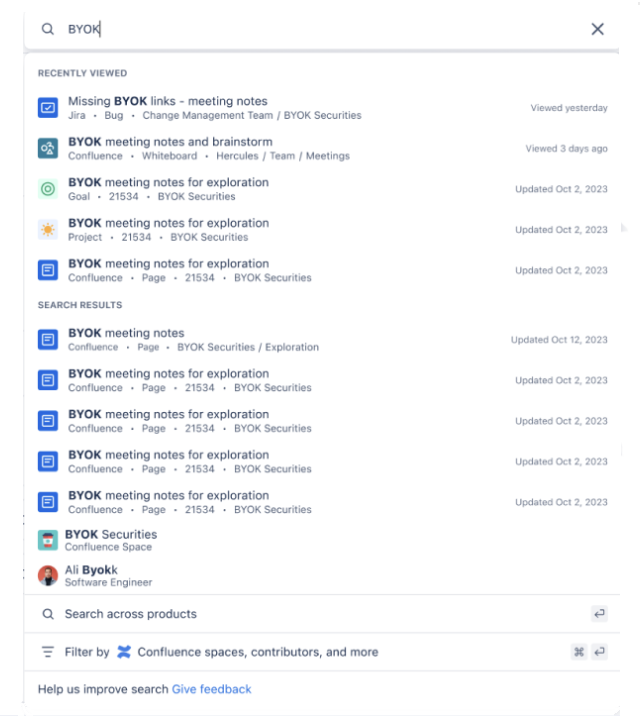
Traditional SearchRovo Search
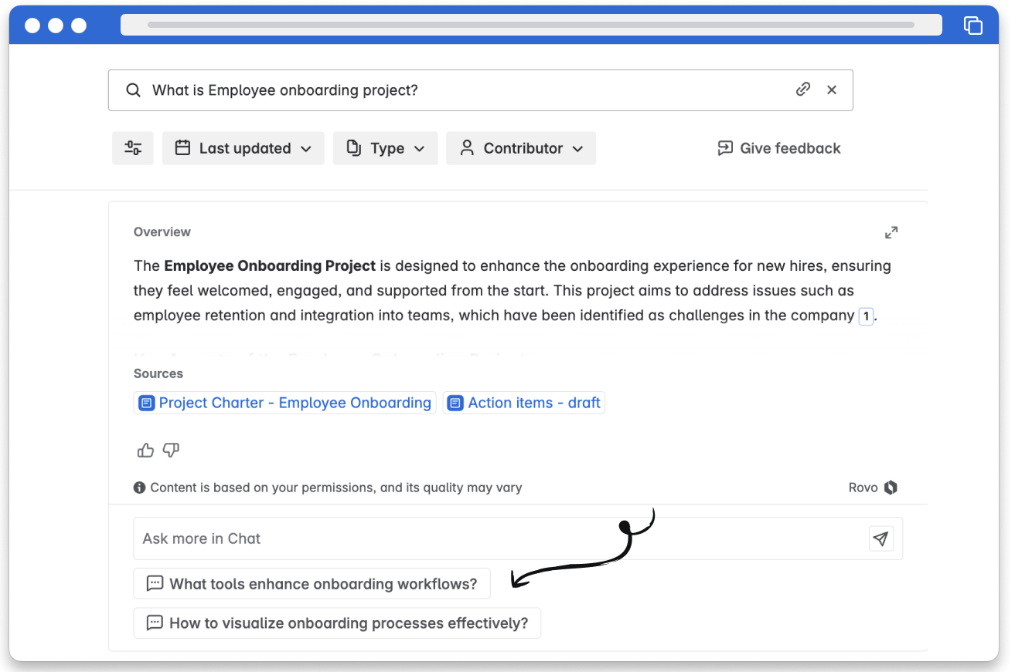
 A user types “employee onboarding” into Confluence to get a long list of pages containing those exact words. They would also have to repeat the search across every other tool they want to query.A user types “employee onboarding” into Rovo Search, which automatically understands the context to surface the most relevant resources (including training guides, HR checklists, and other materials that don’t explicitly have the “employee onboarding” keyword) and summarizes them for fast comprehension.

Rovo Search actively suggests follow-up prompts to dive deeper on a topic (Source)

How Teams are Using Rovo Search Today

Rovo Search tackles the challenges that leave nearly half of all digital workers struggling to find the information needed to do their jobs effectively.

Rovo Search is helping our teams find information much faster, reduce cognitive load, and stay in the flow. It’s really promising so far. I don’t foresee a future where we don’t have it.” – Ronny Katzenberger, Director of Engineering Enablement at Procore Technologies


“We constantly see new opportunities to optimize our work with Rovo. For example, we have the potential to kickstart our requirements and design in minutes with Rovo, turning the overall discovery process into days, not months!” – Fred Frenzel, Project Management Office Director at HarperCollins

Best Practices for Getting the Most Out of Rovo Search 

Like many sophisticated AI tools, Rovo Search’s value depends on the quality of the data you feed it and how your teams engage. Here are some tips for keeping Rovo Search sharp, relevant, and secure: 

  • Keep your data clean: Regularly update, consolidate, and remove outdated content across Atlassian and third-party systems. 
  • Train teams to ask better questions: Encourage intent-driven queries like “What were the key decisions from last quarter’s strategy meeting?” instead of vague keywords. 
  • Create a feedback loop: Monitor usage, gather feedback, and refine content and settings over time. 
  • Stay secure and compliant: Rovo respects your business’s permissions and supports audit trails and data residency, so review policies regularly to maintain control.

Taking Rovo Search to the Next Level  

Getting started with Rovo Search is straightforward, but realizing its full impact requires strategic thinking about knowledge architecture and workflows. That takes a clear plan and thoughtful integration into how your teams actually work. Successful, forward-looking implementations typically focus on: 

  • Pinpointing high-impact use cases where Rovo Search can provide the most value. 
  • Cleaning up and structuring data sources to ensure Rovo Search has the right foundation for success. 
  • Extending Rovo Search beyond Atlassian by connecting your full tech stack, including third-party apps, to unify knowledge discovery across internal systems and external tools.
  • Customizing Rovo Search to your needs with tailored configurations, purpose-built connectors, and custom solutions built on Forge or other platforms. 
  • Maintain trust and control by setting up secure access, auditability, and compliance in accordance with internal data policies and regulatory standards. 
  • Going beyond Rovo AI search by using Rovo to augment the entire produce development lifecycle.

The organizations seeing transformational results from AI are putting in the effort to rewire how knowledge moves throughout the business. As an Atlassian Platinum Solution Partner with 15+ years of experience and a deep heritage in enterprise transformation, Cprime helps organizations go beyond basic Rovo deployment to drive real and lasting change. We bring proven expertise in establishing Atlassian Cloud as a strategic foundation for AI transformation, delivering solutions that help teams unlock efficiency, agility, and measurable business impact.

Orchestrating Enterprise AI Adoption with Atlassian at the Helm

Enterprise AI adoption is reshaping how companies work, decide, and scale. By 2030, the global AI market is projected to reach $1.8 trillion (Bloomberg Intelligence), yet fewer than 10% of companies are deploying AI at scale (McKinsey). The opportunity is clear. 

So is the urgency.

What separates organizations running pilots from those generating real returns? It’s not just technical skill or executive sponsorship. The differentiator is seamless AI implementation into the systems where work already happens, and increasingly, that means the Atlassian AI ecosystem.

Here are the essential shifts that turn experimentation into execution. 

For a deeper dive featuring platform experts from Atlassian, Forrester, and Cprime’s AI-First center of excellence, watch the full panel webinar on demand.

Start with the Business, Not the Bot

Enterprises often begin their AI journey with a list of interesting use cases. But success doesn’t come from novelty. It comes from purpose. What is the business trying to achieve? Which goals matter most to leadership, customers, or the market?

The strongest AI use cases emerge from aligning AI capabilities with those high-priority objectives. That means identifying measurable outcomes, mapping relevant processes, and filtering ideas through a value-versus-feasibility lens. When you prioritize initiatives that offer real impact and can be implemented with minimal drag, you build credibility fast and gain momentum for broader adoption.

Your SDLC Is the Launchpad

AI amplifies your software delivery lifecycle. But when that lifecycle is chaotic, AI will surface the chaos.

Standardization and clean development hygiene are prerequisites for scaling AI. Whether you’re leveraging AI to streamline pull requests, automate code reviews, or accelerate CI/CD, the foundation must be solid. Teams working across inconsistent toolchains or with unmanaged tech debt are likely to see clutter, not clarity.

Atlassian users already operate in structured, traceable environments (like Jira, Confluence, Bitbucket, or Compass) which provides a head start. By embedding intelligence directly into the Atlassian toolchain, enterprises achieve low-friction gains in velocity and quality, creating AI-powered workflows with no disruption.

Integration > Replacement

Most organizations benefit from augmenting their workflows with AI, rather than replacing them entirely.

Whether it’s an AI agent summarizing a Confluence page, surfacing critical issues in Jira, or nudging developers with context-aware insights, the real power of AI lies in meeting users where they already work. Atlassian’s Rovo, integrated with third-party tools and cloud-native platforms like AWS Bedrock, enables intelligent orchestration without additional overhead.

In modern hybrid environments, AI needs to be interoperable. It should pull from APIs, recognize your enterprise architecture, and act as an invisible accelerator that enhances productivity without adding friction.

From Human Burden to Human Leverage

AI removes repeatable tasks and elevates human contribution.

The organizations seeing the most impact from their AI strategy are increasing the value of their workforce. Agents summarize updates, prepare documentation, route requests, and analyze performance. That frees developers, product owners, and operations teams to focus on the decisions, relationships, and innovations that drive growth.

This shift requires deliberate change management. Teams need training, support, and room to adapt. The best AI strategies treat people as leverage.

Intelligent Orchestration Is Already Underway

Orchestration is happening now across core workflows, decision layers, and user-facing processes.

AI agents in the Atlassian ecosystem already interact with Confluence, Jira, Bitbucket, Compass, and third-party tools, making work visible, actionable, and automatically aligned with execution standards. With access to the right data and structure, AI moves information faster and smarter.

This shift delivers more than automation. It creates intelligent flow. Work moves with fewer obstacles. Knowledge gets where it’s needed. Redundancy drops. Quality rises. Time-to-value shrinks.

Don’t Tinker. Orchestrate.

AI-first transformation goes beyond testing technology. It turns AI into a core operational capability.

The enterprises making the leap are building AI into the fabric of their operating model. They embed agents in workflows, activate cross-platform intelligence, and accelerate value across development, delivery, and decision-making.

This shift is active. And in the Atlassian ecosystem, it’s gaining momentum.

Watch the full webinar on demand to learn from the architects behind these strategies, including Atlassian, Forrester, and the enterprise AI leaders at Cprime’s AI-First center of excellence. See how real organizations are scaling AI across development, delivery, and operations, and how you can too.

Your AI Teammate: How Atlassian Rovo Agents Are Revolutionizing the Way Work Gets Done

AI is everywhere these days. But your average workday still feels stuck in manual updates, endless meetings, and constant context-switching. It’s time for something better.

So why hasn’t AI yet made a real difference for most teams? One reason is the assumption that doing so requires a complete system overhaul. While that may have been true just a few years ago, that’s no longer the case. Those working in Atlassian can start seeing real results almost immediately. More flow, less friction. 

Rovo Agents are a new AI teammate providing generative AI capabilities within Atlassian tools like Jira, Confluence, and Bitbucket. These AI-powered teammates are designed to help teams across every department, from HR to IT to engineering, automate repetitive tasks (e.g., answering common employee questions, triaging support tickets, summarizing meetings) to keep things flowing so teams can dive deeper into strategic work.

“If you’re already working in Jira or Confluence, Rovo Agents are a no-brainer. They’re built into the Atlassian stack and immediately start delivering value where your work already happens.”
— Drew Garvey, Agile Tooling Solutions Practice Director at Cprime

In this post, we’ll cover how Rovo Agents work, how teams are using them today, and what steps to take to start seeing results quickly.

What Are Atlassian Rovo Agents, and Why Are They Valuable? 

Rovo Agents are enterprise AI-powered assistants that uses workflow automation to reduce the “work about work,” by automating tedious tasks. This allows teams to focus on more complex problems, with the average user saving one to two hours weekly Through this no-code workflow automation, you can launch prebuilt agents or build your own to match specific team needs and workflows. Even better, Rovo Agents also integrate with third-party tools like Slack, Asana, GitHub, and Dropbox.

Some ways Rovo Agents help out teams:

  • Automate the busywork like ticket triage, meeting summaries, and password resets. 
  • Function as an enterprise search platform, pulling answers instantly from a unified knowledge base across all your connected tools. 
  • Keep teams in sync by streamlining handoffs and avoiding duplicate work. 
  • Customize easily with a low-code setup, allowing for the creation of custom AI agents for business that fit each team’s unique needs.
  • Accelerate impact with out-of-the-box use cases for every team. 

How Cprime Used Rovo Agents to Transform a Company’s HR Operations   

A business services company came to Cprime with an overburdened HR team. Between onboarding, benefits, and policy questions, HR employees were spending 30-40% of their time fielding repetitive requests and tracking down information across scattered systems. 

Cprime worked closely with the client to design and launch custom Rovo Virtual Agents trained to handle routine HR service management inquiries. Using Rovo Studio, we shaped each agent’s persona, fine-tuned their scope, and built smart handoff logic to ensure employees always got the right support.

The results were immediate: HR’s workload dropped sharply. Employees quickly noticed faster answers and fewer hassles. The HR team finally had breathing room for strategic projects, demonstrating how rewiring just a few workflows can accelerate productivity across the whole organization.

Tips for Getting Started with Rovo Agents 

Rovo Agents are ready to work. Here’s how to help them start delivering value on day one.

  • Start with high-impact automations: Target high-volume tasks like automated ticket routing or natural language search queries to quickly demonstrate value and build momentum.
  • Build a reliable knowledge base: Rovo pulls from your internal knowledge and tools, so make sure Confluence pages, Jira fields, and other sources are accurate and clearly organized.
  • Rally your champions: Tap early adopters to drive usage and reassure teams that agents support, not replace, human work. 
  • Measure impact: Track key success metrics, like time saved or resolution speed, and use the insights to drive excitement among teams and refine how agents operate. 

Bring in experts: A trusted partner like Cprime can help identify the most valuable use cases, tailor custom agents, and scale across teams.

Why Cprime? A Smarter Path to Scalable AI 

We’re here to help you launch Rovo Agents quickly, so your team can immediately benefit. And we’ll keep working together to scale that success into broader AI-powered orchestration across your business. Every deployment is tailored to your goals, tools, and ways of working.

With deep experience across industries and functions, we guide you from setup through optimization, ultimately helping your business become truly AI-first

“Cprime doesn’t just flip a switch and walk away. We get to know the company’s core strategy and priorities to make sure agents are trained, scoped, and continuously improved to support how the business actually runs.” 

Drew Garvey, Agile Tooling Solutions Practice Director at Cprime

With Rovo Agents, Cprime helps companies: 

  • Identify where to start with workshops that connect agent use cases to your team’s biggest needs. 
  • Design custom agents with hands-on Rovo Studio experience. 
  • Orchestrate full Rovo-augmented product development workflows.
  • Ensure security and compliance by configuring access, audit trails, and data policies that meet your standards. 
  • Drive adoption with training and change management that’s tailored to specific roles. 
  • Keep improving over time by using feedback to fine-tune agents, expand use cases, and boost impact. 

Solution in Action: Accelerating Atlassian Cloud Migrations with AI + Cprime Expertise

Migrate smarter. De-risk at scale. Modernize faster to accelerate innovation in Atlassian Cloud

Atlassian Cloud migration is often viewed as a technical lift, but in reality, it is a strategic opportunity. With the right tools and partner, migration becomes a fast, controlled path to unlocking next-generation Atlassian capabilities like Rovo, advanced automation, and tighter cross-tool integration.

By combining AI-assisted migration tooling with Cprime’s proven end-to-end migration framework and backed by recognition as Atlassian’s 2025 Cloud Transformation Partner of the Year, teams can simplify complexity, reduce risk, and get to the cloud faster. The result is not just a cleaner platform; it is a foundation for continuous innovation at scale.

Unlocking the Why: Problems, Solutions and Measurable Outcomes

ProblemSolution Outcome
Inconsistent execution of migration tasks across environments.Cprime’s proven frameworks + scalable AI augmentationImproved repeatability and reduced error rates.
Lack of in-house knowledge around migration complexity.Automation with human-in-the-loop validation via Cprime experts.Shorter learning curve, faster time-to-cloud.
Manual, error-prone scripting is required for JCMA migrations.AI-generated PowerShell and Bash scripts through conversational prompts.Reduced scripting time from hours to minutes.

AI-Powered Cloud Upgrade Demonstration: See It in Action

Key Features: Scalable Architecture + Intelligent Automation

  • AI-Assisted Scripting: Generate precise migration scripts in seconds using natural language.
  • Cprime Migration Playbooks: Proven frameworks to operationalize AI-generated tasks at scale.
  • Version-Controlled Configurations: Treat migration logic like code: trackable, testable, repeatable.
  • Expert-in-the-Loop Validation: Every AI output is verified by Cprime consultants to ensure enterprise-readiness.
  • Integrated Risk Mitigation: Automated pre-checks, rollback strategies, and compliance safeguards

AI might write the script. But Cprime gets you to the cloud with speed, safety, and strategic impact.

ServiceNow Knowledge ’25: Orchestrating the AI-First Enterprise

In recent weeks, industry leaders converged at ServiceNow Knowledge ’25, where the company unveiled a bold vision for AI-powered enterprise transformation. This event marked a shift from AI experimentation to enterprise-scale execution, and surfaced key signals about where the future is heading.

The Agentic AI Platform: A New Operating Model

ServiceNow’s introduction of the AI Control Tower signals a major advancement in how enterprises govern AI at scale. This centralized command center brings enterprise-grade accountability to AI deployments, enabling organizations to track performance, mitigate risk, and maximize ROI across initiatives.

What makes this shift operationally significant is the AI Agent Fabric, a communications backbone that allows AI agents to coordinate seamlessly across enterprise tools using standardized protocols. AI now operates as a coordinated workforce, acting, adapting, and scaling across the enterprise.

Data as the Foundation for AI-Native Transformation

AI agents are only as effective as the data that powers them. ServiceNow reinforced this reality by enhancing Configuration Management Database (CMDB) capabilities and introducing the Workflow Data Network. By connecting data platforms through the Workflow Data Fabric—and incorporating the planned acquisition of data.world—ServiceNow is activating intelligent orchestration across systems.

This enables real-time, context-rich decisioning across functions. Information that was once static becomes actionable, powering enterprise-wide intelligence.

Expanding Beyond Traditional Boundaries

ServiceNow’s expansion into the CRM space via the acquisition of Logik.ai and the launch of Configure, Price, Quote (CPQ) functionality shows clear intent: become the unified platform for managing the customer journey.

By bringing opportunity management, quoting, fulfillment, and renewals into one integrated platform, ServiceNow aims to remove friction across the customer lifecycle. Intelligent automation streamlines these processes to deliver seamless, responsive engagement.

What This Means for Your Business

As organizations move toward AI-native operations, three strategic imperatives stand out:

  1. Orchestrate AI at Scale: Fragmented AI adoption limits value. Enterprises must adopt structured models to deploy, govern, and scale AI across workflows and teams.
  2. Rewire Data Systems: Trusted, fluid data is the foundation of intelligence. Enterprises must unify sources and enable flow across systems to feed AI agents the right information at the right time.
  3. Reshape Core Workflows: AI-native enterprises rewire instead of automating. From workforce management to CX, workflows must become intelligent, adaptive, and outcome-optimized.

Cprime’s Perspective: Guided Evolution to AI-Native Success

ServiceNow is delivering powerful innovations. But sustainable transformation demands more than advanced platforms. Success requires clear strategy, prioritized execution, and adaptive momentum.

At Cprime, we call this approach guided evolution. It empowers enterprises to target high-impact workflows, orchestrate change with confidence, and scale what works. This complements ServiceNow’s evolution by enabling transformation that’s structured, not overwhelming.

Our work with leading healthcare providers, financial institutions, and manufacturers proves the model. One healthcare client cut physician onboarding time from weeks to days by orchestrating workflows and embedding AI agents at key decision points. They turned a once-manual process into a responsive, intelligent system.

The Path Forward: Three Actions to Take Now

Based on what we’ve seen at Knowledge ’25—and what we’ve delivered in the field—we recommend five immediate priorities:

  1. Assess AI Governance Readiness: Evaluate your ability to manage an expanding AI workforce. The AI Control Tower provides visibility and control across both human and machine execution.
  2. Map Your Data Integration Strategy: Identify how data flows today—and where friction exists. Build the mechanics that support fluid data movement, an essential dimension of AI-native operations.
  3. Target Workflow Reinvention: Pinpoint processes where delay, inefficiency, or fragmentation disrupts value. These are the best candidates for intelligent orchestration.
  4. Build an Agent: Move beyond GenAI exploration and begin developing practical AI agents. Start with a targeted use case and use real workflows to drive learning and impact.
  5. Start Orchestrating Agents: Use the AI Agent Fabric to connect and coordinate agents across your platforms. Treat this as a foundational capability, not a future aspiration.

Let’s Accelerate Your Operating Model Transformation

The future belongs to enterprises that orchestrate workflows, decisions, and engagement through intelligence. With the right partner and the right platform, AI-native operation can become an active strategy instead of a distant dream.

Let’s explore how these innovations can accelerate your operating model transformation.

Atlassian’s Bold Move to AI-Native: What Leaders Need to Know

Atlassian Teams ’25 marked a decisive moment. Putting the full focus on the platform’s AI-native trajectory, a slew of exciting product announcements prove that it is actively shaping how modern enterprises operate.

With new capabilities embedded across Jira, Confluence, Jira Service Management, and the Strategy and Teamwork Collections, Atlassian has introduced a scalable model for transforming enterprise execution. For leaders focused on performance, alignment, and speed, this roadmap signals a shift from tool deployment to operational reinvention.

Key Product Announcement Highlights

Atlassian is now positioning its platform as a catalyst for orchestrated, intelligent workflows across the business.

AI Becomes the Architecture

Rovo AI is now available across all Atlassian Cloud plans at no cost, no longer as a paid add-on. It delivers an integrated intelligence layer for search, chat, and automation. With the introduction of Rovo Studio, enterprises can also design agents that operate inside the Atlassian ecosystem.

These tools accelerate execution, streamline decisions, and surface knowledge at the moment of need. Instead of relying on disconnected automation pilots or third-party solutions, teams can now work with AI as a built-in capability. It is configurable, contextual, and connected to the rest of the stack.

From Bundled Apps to Integrated Execution

Atlassian’s Strategy and Teamwork Collections represent more than convenience. They are purpose-built environments for aligning strategy with execution.

  • The Strategy Collection (Jira Align, Focus, and Talent) gives leaders continuous visibility into enterprise priorities. It supports dynamic planning, workforce alignment, and portfolio funding within a single coordinated view.
  • The Teamwork Collection (Jira, Confluence, Loom, and Rovo agents) unifies collaboration across teams and platforms. It enhances speed and clarity in daily execution while supporting long-term adaptability.

Together, these collections transform Atlassian from a set of productivity tools into a cohesive operating layer.

Jira Service Management Expands Its Reach

Jira Service Management (JSM) now serves enterprise-wide needs. New capabilities for HR and Customer Service Management expand its footprint well beyond IT. AI features such as sentiment-aware triage and predictive assignment enhance speed, resolution quality, and insight across functions.

This evolution positions JSM as a unified service platform. It enables organizations to streamline delivery without layering on additional tools or sacrificing cross-team alignment.

A Platform for Unified Workflows

Atlassian is executing a clear platform strategy. The transition from “products” to “apps,” combined with standardized global navigation and the Teamwork Graph data layer, provides a modular and integrated foundation for enterprise operations.

This new architecture makes it easier to:

  • Connect workflows across functions
  • Deliver consistent user experiences
  • Enable real-time orchestration of work, data, and engagement

Atlassian is moving from collaboration suite to system of record for intelligent execution.

What Enterprise Leaders Should Prioritize

With AI now embedded at the platform level, enterprise leaders must shift from exploration to orchestration. The value of these tools is no longer hypothetical. The focus turns to where intelligence can generate the greatest impact across operations.

Leaders should begin by identifying the points in their operating model where intelligence has the power to remove friction and accelerate outcomes. These include high-cost handoffs, complex decisions, and workflows that demand speed and scale.

Maximizing these capabilities requires more than layering automation on top of legacy processes. It starts with a fundamental reassessment of whether current workflows are still fit for purpose. Intelligent systems now provide real-time data flow, adaptive execution, and agent-led support that make traditional models obsolete.

Key areas to evaluate include:

  • Decision velocity. Where are approvals, prioritizations, or escalations slowing momentum? Introducing AI agents into these flows can unlock faster execution while maintaining the necessary oversight.
  • Organizational fragmentation. Which departments still operate in isolation, with limited connection to enterprise objectives? The Strategy Collection provides shared visibility that aligns teams with high-priority outcomes.
  • Service delivery. Where do static request queues or disconnected tools reduce responsiveness? Expanding Jira Service Management into HR, customer support, or legal enables enterprise-wide service transformation.
  • Scalability. Are platforms and data architectures designed to support modular, agent-driven operations? A platform-oriented structure prepares the enterprise to scale intelligence without rework or disruption.

Each organization has different starting points. The most successful transformations begin by focusing on the areas where opportunity and urgency converge. That is where intelligent orchestration delivers the fastest returns and creates momentum for broader change.

Cprime’s Role in What Comes Next

Atlassian has stepped confidently into the AI-native future. Cprime is already putting that vision into motion with exciting solutions.

As a platinum partner, we’ve been building AI-powered solutions across the Atlassian ecosystem. Long before Teams ’25. Our teams are actively developing Rovo agents to solve real challenges across strategy, product, and service workflows. These use cases are already producing measurable gains in efficiency, clarity, and coordination.

We bring proven experience in scaling enterprise service models. That foundation positions us to help organizations fully leverage Jira Service Management across business functions like HR, customer support, and finance. And we’re primed with the expertise to guide teams through the adoption of the Strategy Collection to ensure enterprise priorities are continuously reflected in execution.

Our focus is clear: align platform capability with business ambition. Activate AI where it drives outcomes. And rewire the operating model for scale, speed, and strategic clarity.

Let’s make that happen, together.

How to Maximize the Return on Your GitHub Copilot Investment

If you’re a software developer, you know the struggle: adapting to ever-changing market conditions, keeping up with new technologies, and responding to customer feedback—all while trying to maintain consistent coding practices. The pressure to innovate and deliver high-quality products quickly can be overwhelming. Bugs, delayed releases, and the grind of manual coding only add to the frustration. It’s a tough landscape, and finding ways to streamline your workflow and boost productivity is more important than ever.

GitHub Copilot has quickly become a standout tool in the industry, offering AI-powered assistance that can transform the way you code. By providing real-time suggestions and automating repetitive tasks, it promises to make your development process faster and more efficient. However, given its premium price, ensuring you get the most out of GitHub Copilot is essential.

Fortunately, a solution exists to that thorny problem. But first, see if you can relate to this:

How GitHub Copilot Addresses Common Development Challenges

GitHub’s AI-powered coding assistant has become the industry standard for a reason. It’s a powerful, sleek solution that addresses the pains modern development teams are experiencing:

  • Adapting to Market Changes: GitHub Copilot provides real-time coding suggestions, helping your team quickly adapt to new technologies and market demands.
  • Reducing Manual Coding: By automating repetitive tasks, GitHub Copilot speeds up development and minimizes the risk of errors, allowing your team to focus on more strategic work.
  • Accelerating Feature Delivery: Streamlined coding processes enable faster delivery of features that provide real customer value.
  • Promoting Consistency: Standardized code suggestions help maintain quality and streamline workflows, reducing inefficiencies and technical debt.
  • Minimizing Bugs: Intelligent code suggestions and early identification of potential issues reduce the incidence of bugs, leading to more stable releases.
  • Fostering Innovation: By handling boilerplate code, GitHub Copilot frees up developers to focus on creative problem-solving and new product development.

With Copilot, you can tackle these challenges head-on, making your development process more efficient, consistent, and innovative. But, that doesn’t mean getting the most out of all the features Copilot offers is simple or easy. 

Which is why expert help can make all the difference.

Introducing Custom, Actionable Support to Get the Most Out of GitHub Copilot

Ensuring you get the most out of your investment in GitHub Copilot is crucial, and Cprime is here to make that happen. As a GitHub partner, we’re in an optimal position to guide you to the optimal Copilot setup. Here’s how we can help you overcome common development challenges and maximize your ROI:

  • Comprehensive Support and Seamless Integration: Adopting GitHub Copilot can be daunting, especially when you’re already dealing with existing challenges. Cprime offers comprehensive support to ensure a smooth integration into your workflows. Our experts work closely with your team to address any adoption hurdles, providing tailored training and consultation to fully leverage GitHub Copilot’s capabilities from day one.
  • Overcoming Adoption Challenges: Slow adoption and underutilization of new tools can hinder productivity. Cprime provides customized training and enablement, ensuring your developers not only use GitHub Copilot but master it. This seamless integration into daily routines maximizes productivity and efficiency.
  • Enhancing Productivity: GitHub Copilot has the potential to significantly boost productivity by automating repetitive tasks and providing intelligent code suggestions. Cprime focuses on optimizing this potential, allowing your developers to concentrate on innovation and solving complex problems.
  • Measuring ROI with Allstacks: Investing in GitHub Copilot is a significant commitment, and seeing a return on that investment is essential. Cprime provides the tools and methodologies to accurately measure the ROI of your GitHub Copilot implementation. Using Allstacks, we offer detailed insights into how the tool impacts developer productivity, code quality, and project timelines, ensuring you can quantify the benefits and make informed decisions.
  • Flexible, Secure Infrastructure: Cprime offers a range of hosting options, whether cloud-based or non-cloud-based, ensuring seamless integration of GitHub Copilot into your existing infrastructure without compromising security or performance.
  • Quick Roll-Out with Measurable Impact: Time is of the essence in software development. Cprime ensures a swift implementation of GitHub Copilot, minimizing downtime. By leveraging Allstacks for ROI evaluation, Cprime provides clear, quantifiable metrics demonstrating benefits like increased productivity and improved code quality.
  • Tailored Enablement, Training, and Support: Every development team is unique, and a one-size-fits-all approach rarely works. Cprime offers tailored enablement, training, and support to meet the specific needs of your team. Hands-on training sessions and ongoing support ensure your developers are fully equipped to maximize GitHub Copilot’s capabilities.
  • Flexible Packaging Options: Whether you’re a small team or a large enterprise, Cprime has flexible packaging options to suit your needs. We offer packages for 10 developers, 100 developers, or even an enterprise-wide rollout. This scalability ensures that you can start small and expand as needed, managing costs and resources effectively.

By addressing these key areas, Cprime gives you the best chance at maximizing your investment in GitHub Copilot by helping you overcome common development challenges and achieve your goals more efficiently. As a GitHub solution partner, we’re thrilled to be able to assist all GitHub developers to get the very most out of this exceptional tool.

Impressive Results from Previous Implementations

This approach has made a world of difference for development teams, addressing key challenges and enhancing overall performance:

  • Efficiency Gains: Automating repetitive tasks and providing intelligent code suggestions has resulted in as much as a 100% increase in developer productivity in as little as ten weeks! 
  • Developer Satisfaction: Reducing the burden of manual coding and streamlining workflows through automation leads to less frustration and higher job satisfaction. This boost in morale can result in higher retention rates and a more motivated team, ready to tackle new challenges.
  • Improved Code Quality: GitHub Copilot’s intelligent suggestions, combined with Cprime‘s tailored support, help developers catch potential issues early and maintain consistent coding standards. This proactive approach reduces bugs and technical debt, leading to more stable and reliable software releases.
  • Faster Feature Delivery: Optimizing the use of GitHub Copilot streamlines processes and reduces manual tasks, enabling your team to bring new features to market more quickly. This provides real value to your customers and keeps you ahead of the competition.

By leveraging the proven benefits of our GitHub and Allstacks partnership, you can ensure that your investment in GitHub Copilot translates into tangible results, driving your projects forward with greater efficiency and effectiveness.

Are You Ready to Make the Most of GitHub Copilot?

Maximizing the potential of GitHub Copilot can transform your development process, making it more efficient, innovative, and productive. With GitHub partner Cprime, you can overcome common challenges and ensure you get the most out of your investment. Ready to take your coding to the next level? Learn more or set up a consultation, and let’s unlock the future of software development together.

Integrating Your Atlassian Cloud Ecosystem: Expert Insights for Maximizing Tool Synergy


Atlassian ecosystem integrations FAQs addressed in this article:

  • What is the value of integrating the Atlassian ecosystem? – Integrating the Atlassian Cloud ecosystem enhances productivity, efficiency, and collaboration by leveraging AI and ensuring tools complement each other.
  • How does IT Service Management fit into the Atlassian ecosystem? – IT Service Management (ITSM) within the Atlassian ecosystem, particularly through Jira Service Management, streamlines incident, problem, and change management to align IT services with business needs.
  • Can non-IT teams benefit from Atlassian ecosystem integrations? – Yes, non-IT teams can utilize tools like Atlassian Jira Cloud (which will soon absorb all the functionality of the current Jira Work Management solution) for project management, risk tracking, and aligning with business objectives, enhancing team productivity and project clarity.
  • What role does enterprise agility play in the Atlassian ecosystem? – Enterprise agility, supported by tools like Jira Align, is crucial for adapting to market changes, aligning team efforts with business goals, and making informed decisions swiftly.
  • How can organizations optimize their Atlassian Cloud ecosystem? – Organizations can optimize their Atlassian ecosystem by consuming quality content for practical applications, leveraging live software demonstrations, and seeking expert assistance from Cprime for strategic tool integration.


The Atlassian suite is known for its robust set of tools designed to enhance productivity and collaboration. However, to truly harness the power of these tools, a strategic approach to integration is essential. This approach not only maximizes return on investment (ROI) but also significantly improves functionality, efficiency, and results across teams and projects.

The key to unlocking this potential lies in understanding and implementing best practices and strategies that maximize the use of the entire Atlassian Cloud ecosystem. Doing so effectively, businesses can create a seamless workflow that leverages the full spectrum of Atlassian tools, ensuring that every team member—both inside and outside IT—can contribute to the organization’s success in a meaningful way.

As we delve into the intricacies of creating an integrated tooling ecosystem, we’ll explore the transformative impact of artificial intelligence (AI), the importance of tool interaction and synchronization, and the critical areas of focus within the Atlassian suite. And, we’ll direct you to further resources that can aid your move to a better integrated Atlassian ecosystem.

Harnessing the Power of AI and Synergy in Atlassian’s Cloud Ecosystem

The synergy between different areas within the Atlassian ecosystem amplifies the benefits of a unified approach. When cloud-native tools such as Jira Software, Confluence, Jira Align, and others are seamlessly integrated, they create a cohesive environment that supports a wide range of business functions. This interconnectedness ensures that information flows freely between teams, enhancing collaboration, improving decision-making, and accelerating project timelines.

Moreover, a well-integrated tooling ecosystem facilitates a holistic view of projects and operations, allowing leaders to identify bottlenecks, allocate resources more effectively, and track progress in real-time. This comprehensive visibility is crucial for adapting to market changes swiftly and maintaining a competitive edge.

For modern enterprises, the value of leveraging artificial intelligence (AI) as they optimize their tooling ecosystem cannot be overstated. AI’s ability to analyze vast amounts of data, automate repetitive tasks, and provide actionable insights can significantly enhance the efficiency and effectiveness of the tools within the Atlassian suite. Some powerful AI features are already baked into many Atlassian Cloud tools, and additional AI functionality can be leveraged via strategic third-party integrations

Elevating Collaboration Through Strategic Tool Integration

One of the foundational best practices for tool integration is ensuring that tools not only interact but also complement each other. This approach allows for the seamless exchange of information and workflows across different platforms, eliminating silos and fostering a more collaborative and efficient work environment. 

For instance, integrating Jira Software with Confluence enables teams to link project tasks directly to relevant documentation, ensuring that all team members have access to the information they need, when they need it. And, integrating Bitbucket with Jira Software allows development teams to track the progress of code commits and pull requests directly within the context of their Jira tasks.

Moreover, the synchronization between tools can provide value across different levels of the organization. For example, integrating Jira Software with Jira Service Management ties together incident and change management with the development-level tasks needed to resolve the associated issues. And, tying together Jira Software and Jira Align opens incredible real-time monitoring and reporting capabilities, right up to the enterprise strategic level. This level of integration ensures that project managers and executive stakeholders have real-time visibility into the development process, facilitating better planning and decision-making.

Furthermore, the strategic integration of Atlassian Cloud tools can enhance the agility of an organization, enabling teams to respond more quickly to changes and opportunities. By automating workflows and creating a unified source of truth, teams can reduce the time spent on manual tasks—such as manually manipulating data or digging into another department’s tool looking for relevant information—and focus on delivering value to customers.

The strategic integration of Atlassian tools is a critical step towards building a more connected, efficient, and agile organization. By leveraging the strengths of each tool and ensuring they work together seamlessly, businesses can unlock new levels of productivity and innovation.

Navigating the Core Pillars of the Atlassian Cloud Ecosystem

While the suite of Atlassian tools cover a wide range of use cases and capabilities, there are three core functions we’ve found of most concern to our clients:

Transforming IT Service Management

At the core of efficient IT operations lies IT Service Management (ITSM), a discipline that has been significantly enhanced within the Atlassian ecosystem. ITSM’s role transcends traditional IT support, evolving into a strategic asset for aligning IT services with business needs. 

Within this ecosystem, Jira Service Management stands out by offering a versatile platform that streamlines incident, problem, and change management. This tool not only facilitates rapid response to IT issues but also fosters a proactive approach to minimizing future disruptions, thereby ensuring business continuity and enhancing customer satisfaction.

Empowering Teams Beyond IT

Beyond the realm of IT, the Atlassian Cloud suite offers robust solutions for work management, catering to the diverse needs of non-IT teams. 

Atlassian Jira Cloud (which will soon absorb all the functionality of the current Jira Work Management solution) emerges as a pivotal tool for project management, risk tracking, and aligning with overarching business objectives. This platform democratizes the power of project management, making it accessible to teams across the organization, from marketing to HR and finance. By providing a unified view of tasks, deadlines, and resources, Jira empowers teams to plan, execute, and track projects with unprecedented clarity and coordination.

Accelerating Enterprise Agility

Modern enterprises must be as nimble as small startups if they’re going to capitalize on the advantages of size and scope. The Atlassian ecosystem supports this agility through tools like Jira Align, which bridges the gap between strategic planning and execution. 

Jira Align serves as a strategic “hub” uniting the work being tracked and managed within Jira Software, JSM, and elsewhere, facilitating the alignment of team efforts with business goals, and ensuring that every task and project contributes to the broader objectives of the organization. This tool provides real-time insights into progress, dependencies, and outcomes, enabling leaders to make informed decisions and adapt strategies swiftly to meet evolving market demands.

Unlocking the Full Potential of Your Atlassian Ecosystem

To truly unlock the full potential of your Atlassian ecosystem, it’s essential to dive deeper into the practical applications and witness these tools in action.

We invite you to explore further by watching our webinar on demand, “Mastering an Integrated Atlassian Tooling Ecosystem: Strategies, Success Stories, and Best Practices”. This resource is packed with live software demonstrations that illustrate the transformative power of integrating Atlassian Cloud tools. Witness firsthand how Jira Service Management, Jira Work Management (now integrated into Jira Software), and Jira Align can be leveraged to streamline operations, enhance collaboration, and drive enterprise agility.

For organizations looking to optimize their Atlassian tooling ecosystem, Cprime stands ready to assist. Our expertise in Atlassian Cloud solutions can help you navigate the complexities of tool integration, ensuring that your business leverages the full suite of capabilities offered by the Atlassian ecosystem. Whether you’re seeking to enhance IT service management, empower non-IT teams with effective work management tools, or accelerate your enterprise agility, Cprime has the knowledge and experience to guide you towards achieving your goals.

Don’t let the potential of your Atlassian Cloud tools go untapped. Explore the webinar and more relevant content to gain valuable insights and strategies for mastering an integrated Atlassian tooling ecosystem. For personalized assistance and expert advice on optimizing your tooling ecosystem, contact Cprime today. Together, we can transform the way your organization works, making it more efficient, collaborative, and agile.

Privacy, Profit, and Protection: Why Your Business May Not Survive Without a Private ChatGPT Clone

I don’t need to tell you that Generative AI systems using Large Language Models (LLMs) like Open AI’s ChatGPT v4 are exploding across every aspect of modern business. These models have carved out a niche, showcasing immense potential in varying fields, and for good reason: they represent one of the biggest sea changes in tech history. 

With the meteoric rise in popularity of public LLM products, a critical question arises: Should organizations work on creating private LLM systems customized with their own internal data? 

The unequivocal answer is yes.

It’s not a simple undertaking. Most organizations will need help leveraging the technology effectively. But the rewards can be huge: from cost savings to faster value delivery to enhanced customer satisfaction. So, by all means, get the help you need and start building your private GenAI app today.

Here’s why.

Why venture into private, customized LLMs?

Public LLMs like ChatGPT have brought the diverse benefits of GenAI to the forefront. However, they also raise significant privacy and security concerns. One of the major concerns is the potential misuse of data input by users. As these models learn and evolve with every interaction, the data you feed them can actually be accessed by third parties. “Data breach” isn’t a corner case with public LLM’s – it’s more or less a feature of the system. This situation becomes a breeding ground for privacy issues, especially when sensitive or proprietary information is involved.

Potential issues with using public LLMs

  1. Prompt Injection Vulnerability: Public LLMs are particularly susceptible to a type of attack known as prompt injection. This vulnerability could lead to the retention and leakage of sensitive information, which may be used inappropriately to retrain AI models.
  2. Privacy Preservation Gap: The soaring adoption of LLM applications has revealed a glaring gap in preserving the privacy of data processed by these models.
  3. Data Leakage Risk: There is a potential risk of data leakage with public LLMs as they might inadvertently memorize sensitive information from the training data.
  4. Data Security Principles: The data security principle of ‘least privilege’ is often at odds with the operational mechanism of public LLMs.
  5. Boundary Limitations: Public LLMs often lack clearly defined boundaries, contrasting with private LLMs that operate within specific data boundaries.

The compelling benefits

Private LLMs offer a banquet of benefits that are too enticing to overlook:

  1. Privacy Preservation: Transmitting data to a centralized LLM provider can sometimes be a gamble with privacy. There have been instances where companies like Samsung reportedly leaked secrets through public LLMs. On the other hand, a private LLM keeps your data in-house, significantly reducing such risks.
  2. Intellectual Property (IP) Retention: The problems and datasets that can be well-addressed by AI tend to be sensitive and proprietary. By deploying in-house models, organizations can keep their valuable IP under wraps while harnessing the power of AI.
  3. Cost Efficiency: Training an LLM from scratch or trying to use freeware can be a costly affair, especially when relying on cloud resources. However, using a private model with enterprise-grade commercial support can be a doorway to cost-efficient fine-tuning and retraining, aligning with the organization’s specific needs without breaking the bank.

Thriving examples in the industry

Companies are already treading the path of deploying private LLMs and reaping the benefits. The ability to create bespoke AI solutions has enabled them to stay ahead in the fiercely competitive market. Of course, most companies doing so are keeping details close to their chest. But we’re seeing it first hand at Cprime and our community of support and development partners: 

  • Atlassian has integrated Atlassian Intelligence into a number of their Cloud products, offering real-time virtual assistance that securely culls public and private data and knowledge base stores to help internal and external customers alike.
  • Gitlab Duo applies the power of GenAI to support developer, security, and ops teams with everything from planning and code creation to testing, security, and monitoring, using AI-assisted workflows.
  • ServiceNow has released the Now Intelligence platform to incorporate machine learning, natural language processing, search, data mining, and analytics to empower customer service representatives, internal support teams, and robust customer self service capabilities.

And these are just a few examples of a skyrocketing trend.

In fact, Cprime is also a leader in the bespoke AI space: we have developed our own private LLM framework in house, optimized for rapid deployment. Our “CprimeAI” system can help organizations quickly stand up a PoC with a private, customized LLM for surprisingly low cost, allowing them to experiment with the tech category while evaluating heavier-weight products from our partners.

The CprimeAI solution helps connect an entirely private world-class LLM to your own internal data sets, enabling you to cost-effectively explore a wide range of use cases while deciding how to proceed in the long term.

Harnessing the unseen potential

The journey towards developing a private LLM is not without challenges, but the payoff could be monumental. With the right resources and a keen eye on the evolving AI landscape, organizations can unlock a future where AI is not just an aid but a critical business ally.

Ready to dive into the world of private LLMs and chatbots? It’s an exciting yet demanding venture that promises a competitive edge in the fast-evolving tech landscape. The leading companies are already investing heavily in these technologies, recognizing the untold advantages they bring to the table. It’s high time your organization does too, embracing the AI-driven future with open arms.