
Resource Topic: Platform Adoption & Governance

How a global healthcare company unified delivery and IT support through Atlassian consolidation

Global healthcare company unifying software delivery and IT support through Atlassian consolidation

When disconnected systems begin to slow the business 

The client is a global healthcare company with approximately 1,500 employees. Its Enterprise Technology organization supports critical functions across enterprise applications, cybersecurity, infrastructure, SAP, and business process engineering. 

As the organization grew, teams worked across separate systems for software delivery and IT support. Development teams operated in Azure DevOps, while IT support relied on ServiceNow. Consequently, visibility fragmented, ways of working diverged, and operational friction spread across the department. 

Within ServiceNow, teams treated nearly every request as an incident, regardless of the actual need. Routing lacked clarity, workflows were missing or poorly designed, and alignment to ITIL practices stayed limited. End users had little visibility into ticket status. Meanwhile, support agents struggled with awkward interfaces, limited customization, and inefficient processes. 

At the same time, product and development teams lacked standardized workflows and governance in Azure DevOps. This made consistency across delivery teams hard to achieve. 

The client set a clear goal: one unified operating model for delivery and support. This model needed to improve visibility, standardize execution, and support future growth. 

Turning fragmented delivery into a connected operating model 

Cprime partnered with the client to design and configure a connected Atlassian environment. This environment supports both software delivery and enterprise IT service management. 

To support software development and product delivery, Cprime implemented: 

  • Atlassian Guard 
  • Jira Software 
  • Confluence 
  • Big Picture for portfolio management 
  • Jira Product Discovery for future work pipeline management 

The implementation introduced a standardized work hierarchy across teams. It spans Themes, Initiatives, Epics, Features, Stories, Tasks, and Test Cases. In addition, dedicated product and team spaces now support consistent planning, prioritization, sprint execution, and collaboration. 

On the service management side, Cprime configured Jira Service Management (JSM) to align with ITIL practices. This work modernized the support experience through several changes: 

  • Separate workflows for incidents, service requests, and change requests 
  • Defined SLAs and routing processes 
  • Workflow automations 
  • Tailored customer portals for Business Application Support, Enterprise Technology Support, and Global Technical Support 
  • A bespoke deployment management solution to support CAB approvals and transport movement across environments 

Throughout the engagement, Cprime ran collaborative working sessions with Enterprise Technology leaders across IT, cybersecurity, and business process engineering. 

Standardizing work across teams without disrupting delivery 

One outcome stood out: the client consolidated disconnected delivery and support functions into a single Atlassian environment. 

Following the implementation: 

  • Product and development teams now operate with standardized workflows and consistent delivery structures 
  • Enterprise Technology teams gained improved visibility into work, priorities, and dependencies 
  • IT support operations align to ITIL best practices, with clearer categorization, routing, and SLA management 
  • End users have greater visibility into ticket status and support progress 
  • Support agents benefit from improved, customizable views within JSM 
  • The team removed licensing limitations that had restricted broader departmental participation 

In addition, Jira Product Discovery gave the client a structured approach for evaluating and managing future work. 
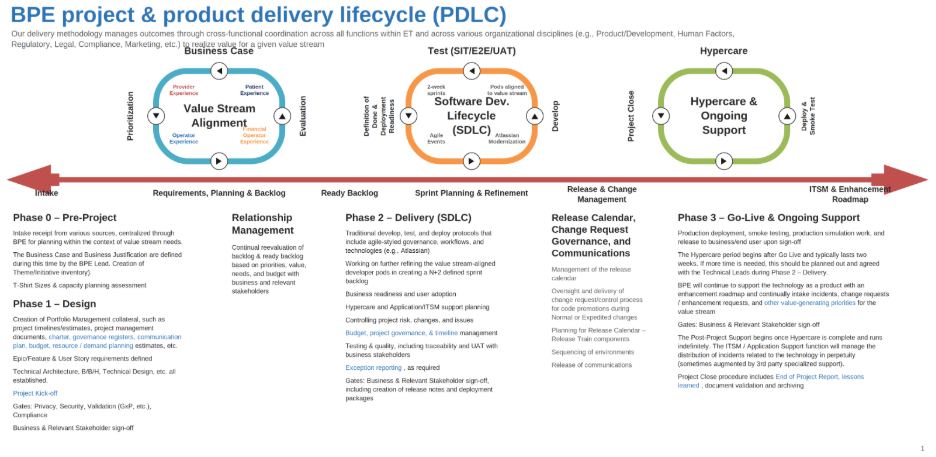
image

The connected delivery and change lifecycle established in the Atlassian environment.

Building a foundation for long-term operational maturity 

For the client, the engagement established a connected, standardized foundation for software delivery, IT support, and operational governance. 

By aligning teams within one environment, the client improved consistency across delivery and support. As a result, leaders gained clearer visibility into how work moves across the organization. 

As the organization continues to evolve, this foundation now supports scaling collaboration, governance, and enterprise delivery practices. Because the model is built to grow with the business, adoption continues well beyond the initial rollout. 

Frequently asked questions (FAQs) 

What is Atlassian consolidation? 

Atlassian consolidation brings software delivery and IT support onto one connected Atlassian environment. Teams replace disconnected tools with shared workflows, clearer governance, and consistent visibility across delivery and service management. 

How does Jira Service Management support ITIL practices? 

Jira Service Management aligns with ITIL through separate workflows for incidents, service requests, and changes. Defined SLAs, routing rules, and change approvals help IT support operate with clearer categorization and accountability. 

Can teams move from Azure DevOps and ServiceNow to Atlassian? 

Yes. Development work can move into Jira Software and Confluence, while IT support moves into Jira Service Management. A partner-led implementation standardizes workflows and governance, so the shift improves consistency rather than adding disruption. 

What are the benefits of unifying software delivery and IT support? 

Unified delivery and support give leaders shared visibility into work, priorities, and dependencies. Standardized workflows reduce friction, while end users and support agents gain clearer status and more usable service experiences. 

How does Cprime approach an Atlassian implementation? 

Cprime works through collaborative sessions with technology leaders to design the operating model first. Configuration of Jira Software, Confluence, and Jira Service Management then reflects how work and decisions actually flow, which supports adoption over time. 

Ready to modernize delivery and service management?

Disconnected systems and inconsistent processes make it hard to scale delivery and maintain visibility. Cprime helps organizations unify workflows, modernize service management, and build operating models that sustain execution.

Through Atlassian consolidation, your teams can replace fragmented tooling with one connected way of working. If fragmented tools or limited visibility are slowing your teams, now is the time to act.
From Idea to Impact: Getting Immediate Value from Atlassian Intelligence 

ATL-Idea-to-Impact_Ft-image-3-1

Getting disappointing results from AI? It could be because AI is often used like a vending machine — type a prompt, hope something usable comes back. 

There’s a better approach. 

This session demonstrates a repeatable, human-guided AI loop where curated discovery inputs turn Atlassian Intelligence into a true teammate that delivers actionable, high-quality work. You’ll learn a framework for improving Atlassian AI performance by providing the right context through the Teamwork Graph, a pattern that works across teams and workflows. We’ll make it real with a live product discovery-to-development example, showing how better inputs turn rough ideas into clear, buildable work. 

The key insight: AI is only as good as the context it’s given. Curation drives quality. Verification drives confidence. When humans invest in the right inputs up front and confirm the output, AI starts producing work that’s genuinely useful, and speed to value follows. 

Key Takeaways 

  • Learn a repeatable framework for improving Atlassian AI outcomes by providing the right context through the Teamwork Graph. 
  • See how curated context, not clever prompts, determines AI output quality. 
  • Build reusable context assets using pattern pages and agent configuration. 
  • Brief an AI agent the same way you’d brief a new team member. 
  • Apply the iterative loop: human curates context, AI drafts and improves, human verifies. 
  • Compress idea-to-ready timelines without sacrificing clarity or rigor 

The Work Behind the Work: Building Measurable, Compounding Value from Atlassian Cloud

Atlassian TechTalk Webinar

As Atlassian Data Center approaches end of life, organizations face a critical inflection point. Some are planning their move to cloud. Others already in cloud are asking a different question: how do we realize the value we expected?

In both cases, the challenge is the same. Moving platforms does not change how teams work. Without an intentional approach, migrations carry forward existing behaviors, adoption slows, and AI capabilities remain underused.

In this webinar, Cprime presents a clear view of what drives value in Atlassian Cloud and introduces a proven path for turning migration or existing cloud investments into measurable outcomes. We show how to redesign ways of working, govern change with discipline, and embed intelligence across Jira and Confluence so cloud supports better decisions, faster execution, and sustained improvement.

What you will gain:

  • What drives value realization in Atlassian Cloud, whether you are migrating or already live
  • The risks of moving to cloud or operating in cloud without a clear path
  • How leading organizations turn migration and cloud investments into measurable, compounding ROI
  • Why most teams capture only a fraction of Atlassian Cloud’s potential
  • How to close adoption gaps and embed AI into real workflows
  • The core elements of a path from migration to sustained performance
  • The operating model behind aligned, high-velocity teams
  • How to measure and improve Atlassian value over time

Fill out the form to watch now

Ebook: Atlassian Cloud—From First Step to Full Mastery

cover-stack-cprime-no-bg (1)

Six months after migrating to Atlassian Cloud, most organizations ask the same question:

“Are we working better?”

Too often, the answer is unclear.

Tools moved, but behaviors did not.

AI features are enabled, but adoption is limited.

ROI is expected, but difficult to measure.

The result is cloud investment without sustained value.

Turn Atlassian Cloud into a system for measurable business outcomes

What you will learn

  • How high-performing organizations translate cloud migration into measurable ROI
  • Why most teams capture only a fraction of Atlassian Cloud value
  • What limits adoption, alignment, and AI readiness
  • The operating model behind high-performing teams
  • How to measure and improve your Atlassian investment over time

Built by the partner behind more than 1,000 successful Atlassian migrations

Cprime is a trusted Atlassian Platinum Solution Partner with a proven approach to supporting cloud transformation from migration through ongoing optimization:

  • More than 1,000 successful migrations
  • 100% migration success rate
  • 99.9% customer retention
  • 8-time Atlassian Partner of the Year

Cprime helps organizations move beyond migration by improving how work gets done, how decisions are made, and how value is measured over time.


Ready to increase the value of your Atlassian Cloud investment?

Get your copy of this guide now.

Bringing clarity and control to Atlassian at enterprise scale 

Dreamy holographic rainbow light refraction texture overlay with abstract soft bokeh effect on a white wall. Organic prismatic glow and natural shadows

When an organization supports mission-critical location intelligence for global automotive brands, execution clarity is foundational.

For this enterprise technology company, that clarity became harder to sustain as teams scaled. Over time, Jira and Confluence were adopted independently across the organization. Environments multiplied to meet local needs. Administration, workflows, and add-ons evolved in parallel.

What worked for individual teams no longer worked at enterprise scale.

Leadership struggled to see how work connected across initiatives. Costs increased without clear ownership. Teams unknowingly duplicated effort in disconnected systems. Flexibility slowly introduced friction.

The organization needed a way to reconnect work, governance, and accountability without disrupting delivery.

The challenge: fragmentation at scale

At the start of the engagement, the company supported more than 10,000 users across seven Jira environments and two Confluence instances. Each environment had its own administrators, workflows, and add-ons. Teams often worked on related initiatives in parallel with little visibility across boundaries.

Several issues converged:

  • Rising infrastructure and operating costs
    On-premises data centers required ongoing maintenance and investment. Add-ons were purchased locally, sometimes duplicating tools already in use elsewhere.
  • Inconsistent ways of working
    Workflows, reporting, and governance varied by environment. Standardization proved difficult without shared visibility.
  • Limited executive insight
    Leaders could not easily see where major investments were going or how initiatives were progressing across teams.
  • Operational friction
    IT service management lived outside the Atlassian environment, splitting execution and support across platforms.

The organization knew a move to Atlassian Cloud was coming. It also knew that a rushed, top-down migration would create adoption risk and delivery disruption.

The approach: migration designed for adoption

Cprime partnered with the organization on a two-year, phased transformation designed around how teams actually work. The focus stayed on adoption, governance, and continuity rather than speed alone.

Several principles guided the program.

Teams retained agency.
Rather than enforcing a single migration path, each project owner selected the approach that fit their context. Some moved to clean, greenfield environments. Others transitioned in phases or retained elements of legacy structure temporarily. Timing followed delivery realities rather than a fixed mandate.

Change moved middle-up.
Teams closest to the work helped define standards and practices. That involvement increased trust and reduced resistance while creating patterns that could scale.

Governance evolved alongside execution.
Financial accountability shifted closer to teams. Add-on budgets moved from shared overhead to visible ownership. Decisions became clearer once cost and value were visible together.

Platforms consolidated with intent.
Seven Jira environments were consolidated into three optimized instances designed for production, archival needs, and specialized use cases. Confluence remained separated for internal and external collaboration to support secure work with external partners. IT service management moved into Jira Service Management, bringing support into the same flow as delivery work.

Analytics replaced custom reporting.
Instead of maintaining bespoke dashboards, the organization adopted Atlassian Analytics to establish consistent, scalable insight into throughput, capacity, and investment.

Enablement remained central throughout. Each migration phase included coaching, workflow design support, and adoption reinforcement. Progress followed learning rather than a single cutover event.

The results: from disconnected tools to enterprise clarity

By the end of the program, the organization had fundamentally changed how work and decisions connected across the enterprise.

  • Operating costs declined.
    Shutting down on-premises data centers removed recurring infrastructure expense, reducing tool-related overhead by 40%. Duplicate licenses and overlapping add-ons were eliminated through visibility and standardization.
  • Governance became consistent without slowing teams.
    Three Jira environments now support more than 10,000 users under shared templates and policies. Teams still adapt locally within a common enterprise frame.
  • Visibility improved at every level.
    Leaders can see how major investments translate into work and outcomes. Teams can understand dependencies and reduce duplicate effort.
  • IT operations aligned with delivery.
    Moving IT service management into Jira Service Management unified support, IT, and business operations inside a single system of record.
  • The foundation is ready for what comes next.
    With clean data, connected workflows, and consistent governance in place, the organization is positioned to adopt AI capabilities inside Atlassian with confidence.

The most meaningful change was not the tooling. Decision flow improved. Accountability became clearer. Teams gained a shared view of work across the enterprise.

Why this approach worked

The organization treated migration as an operating model change rather than a technical exercise.

By designing for adoption from the start, it avoided common enterprise migration pitfalls, including stalled usage, shadow systems, and short-lived gains. The program respected how teams work while giving leadership the visibility required to steer at scale.

The result is continuity. Progress did not reset at go-live. Value continues to compound as teams build on a shared foundation.

What this means for your organization

Many enterprises face similar pressure as Atlassian Data Center timelines approach. The risk lies less in the move to Cloud and more in how the move is handled.

Migration succeeds when governance, execution, and adoption evolve together. It stalls when speed replaces learning and standardization replaces trust.

If your organization is navigating Atlassian Cloud migration, optimization, or post-migration value realization, the same principles apply. With the right structure and enablement, Cloud becomes a source of clarity and scale rather than another layer of complexity.


Could this be you?

If you want to bring the same clarity, accountability, and momentum to your Atlassian environment, we’re ready to help you design what comes next.

Micron’s Story: Rapid Cloud Upgrades with Atlassian’s FastShift Program in a Complex Enterprise Landscape

Cprime-Micron

Micron Technology had a bold vision: to see its operations in a new light as it became an AI-first enterprise. But their journey was constrained by the limits of on-premises infrastructure. With more than 60,000 users across global teams and 26 terabytes of Jira and Confluence data, their Atlassian Data Center environment had grown too large, too complex, and too costly to sustain. Scalability was slowing. Innovation was stalling. And the push toward AI adoption demanded a modern, cloud-based foundation. 

Cprime had been Micron’s trusted Atlassian partner for over a decade, managing licenses, delivering consulting engagements, and supporting platform growth at every step. When Micron committed to the move, they turned again to Cprime, partnering under Atlassian’s FastShift program to rearchitect their system of work for the next era. 

Designing a migration built for scale and certainty 

The challenge was to move a living ecosystem without disruption. Cprime developed a phased, full-service migration strategy centered on precision, collaboration, and resilience. 

Planning began with an on-site kickoff and strategy session to define every phase, role, and timeline. Cprime, Atlassian, and Micron formed a single integrated team operating within a shared Jira and Confluence Cloud workspace to maintain real-time visibility. Daily standups, weekly syncs, and steering committee meetings kept every decision transparent and every milestone accountable. 

To ensure reliability, Cprime executed extensive sandbox testing, dry runs, and add-on remediation to modernize integrations and eliminate technical debt before go-live. The migration was intentionally structured in two phases: external instances first, then internal, to minimize business risk and downtime. The solution also implemented Bring Your Own Key (BYOK) encryption to meet Micron’s stringent data security and compliance requirements. 

Engineering confidence through partnership 

At the heart of the engagement was collaboration. Cprime’s technical architects and project leads worked shoulder to shoulder with Micron’s internal experts and Atlassian’s FastShift team to anticipate challenges and adapt quickly. This integrated approach ensured decisions were made with full visibility and that stakeholders could resolve issues in real time. The result was a program that operated with the speed and clarity of a single, orchestrated team. 

Cprime also embedded enablement into every phase of delivery. From training and user acceptance testing to structured hypercare, the team ensured that Micron’s workforce could fully embrace the new environment from day one. The goal extended beyond migration, driving sustained momentum. 

A seamless transition to cloud-scale performance 

The results illuminated the impact of careful planning. Cprime successfully migrated four Atlassian Data Center instances—more than 60,000 users, 8 million issues and pages, and 26 terabytes of attachments—to Atlassian Cloud with under eight hours of total downtime. The new environment now operates with a 99.9% uptime guarantee and delivers up to 40% measurable performance improvement across teams. The cloud-native platform delivers faster response times, stronger security compliance, and seamless collaboration across global teams. 

Micron now operates on a unified, cloud-native Atlassian platform that accelerates visibility, reduces maintenance overhead, and positions the enterprise for AI-first innovation. With Cprime as a long-term partner, Micron has modernized its tools and redefined how its teams connect, create, and deliver value. 

The foundation for intelligent orchestration 

By transitioning to Atlassian Cloud, Micron brought new clarity to how its teams collaborate and advanced from static systems to dynamic orchestration. The migration eliminated silos, unlocked continuous scalability, and enabled data flow across systems, creating the environment needed for AI-driven efficiency and insight. 

As enterprises like Micron evolve toward AI-first operating models, Cprime continues to lead at the intersection of technology, strategy, and transformation, helping organizations rewire their systems of work into intelligent, adaptive, and future-ready ecosystems. 

Want to explore what Atlassian Cloud can do for you?

Building an AI Enabled Tech Stack with Atlassian

Ebook_Building-an-AI-Enabled-Tech-Stack-with-Atlassian2x_R2-new

This guide shows how to build AI maturity with Atlassian’s Rovo, moving from quick-win use cases to enterprise-wide intelligence. It outlines a phased approach—starting small, expanding through smart integrations, and embedding AI into everyday operations—while ensuring governance, security, and team adoption for long-term impact.

3 Key Takeaways:

  1. Begin with focused, high-value AI use cases to prove ROI quickly.

  2. Scale results by integrating AI across your full tech stack.

  3. Sustain success with clean data, strong governance, and skilled teams.

5 Critical Decision Points for AI Adoption with AI-Powered Tools from Atlassian

Ebook_5 critical decision points for AI adoption with AI-powered tools from Atlassian2x_R2

Don’t waste this opportunity!

Unlock the secrets to AI transformation success in Atlassian with this essential guide that reveals the five game-changing decision points every forward-thinking organization needs to master.

Discover how industry leaders are leveraging Atlassian Rovo and AI-ready ecosystem to drive 40% higher productivity, 70% faster decision-making, and revolutionary business outcomes that leave competitors behind.

Download your copy of 5 Critical Decision Points for AI Adoption with AI-Powered Tools from Atlassian now!

AI at the Crossroads: Scaling Adoption Across Your Atlassian Ecosystem & Beyond

Webinar_AI at the Crossroads_ Scaling Adoption Across Your Atlassian Ecosystem & Beyond

A Fireside Chat Featuring Forrester, Atlassian, and Cprime AI Leaders


Brought to you by:

AI at the Crossroads: Scaling Adoption Across Your Atlassian Ecosystem & Beyond       AI at the Crossroads: Scaling Adoption Across Your Atlassian Ecosystem & Beyond

Featuring:

AI at the Crossroads: Scaling Adoption Across Your Atlassian Ecosystem & Beyond


AI isn’t just transforming software development—it’s redefining it. But the difference between AI hype and actual impact comes down to strategic decisions, not just technology adoption.

Join this exclusive executive conversation where industry leaders from Forrester, Atlassian, and Cprime break down the five critical decision points that separate successful enterprise AI implementations from costly experiments.

  • Defining AI’s Role – How do you ensure AI aligns with strategic goals and drives real value?
  • Seamless Integration – What does AI compatibility look like within your Atlassian ecosystem and beyond?
  • Enhancing vs. Replacing – How can AI empower teams without disrupting workflows?

This interactive discussion cuts through the noise with battle-tested insights from leaders who’ve navigated the complex AI landscape. Whether you’re beginning your AI journey or looking to accelerate adoption, you’ll walk away with actionable insights to make confident decisions about where, when, and how to implement AI across your enterprise.


Featured Speakers:

AI at the Crossroads: Scaling Adoption Across Your Atlassian Ecosystem & Beyond  Sankar Melathat
Vice President – Global Head of Solution Design and Engineering
Cprime
AI at the Crossroads: Scaling Adoption Across Your Atlassian Ecosystem & Beyond  Aaron Bockelie
Principle Consultant AI DevOps and Developer Experience
Cprime
AI at the Crossroads: Scaling Adoption Across Your Atlassian Ecosystem & Beyond  Rowan Curran
Senior Analyst -AI Applications, Data Science, Generative AI, and Cognitive Search
Forrester
AI at the Crossroads: Scaling Adoption Across Your Atlassian Ecosystem & Beyond  Nick Caprioli
Senior Partner Solutions Architect – Cloud Platform
Atlassian

Navigating your Responsibility in Atlassian Cloud: Security, Identity, and Data Protection

hycu-logo

In partnership with:

Navigating your Responsibility in Atlassian Cloud: Security, Identity, and Data Protection

As IT leaders, understanding both the benefits and responsibilities of data protection while considering a migration to Atlassian Cloud is crucial. This webinar aims to demystify our security obligations and highlight the advantages of cloud-based operations.

This insightful session will be led by Peter Hayes, Practice Director of Managed Services at Cprime, Andy Fernandez, Director of Product Management at HYCU, and Kevin Powers, Founder & Director, M.S. Cybersecurity Policy and Governance, Boston College.

Drawing from their extensive experience, they will provide practical insights, real-life scenarios, and actionable strategies to empower you in crafting a comprehensive Atlassian Cloud security framework.

Join us to explore:

  1. Enhanced Security and Availability: How data backups and the ability to manage those backups help to mitigate system-level risks and improve overall security posture
  2. Comprehensive Data Protection: How segregated backup systems and management offer secure redundancies for your critical data
  3. Effective Incident Response: Differentiating between outage recovery and accidental deletion scenarios, and how to handle each
  4. Identity and Access Management: The critical role in managing tenant access
  5. Ensuring Compliance: Addressing data retention policies, litigation holds, and offsite storage requirements


Navigating your Responsibility in Atlassian Cloud: Security, Identity, and Data Protection Peter Hayes
Practice Director
Cprime
Navigating your Responsibility in Atlassian Cloud: Security, Identity, and Data Protection Andy Fernandez
Director of Product Management
HYCU
Navigating your Responsibility in Atlassian Cloud: Security, Identity, and Data Protection Kevin Powers
Founder & Director,
M.S. Cybersecurity Policy and Governance
Boston College