
Resource Topic: Service Management

Leading Healthcare System Transforms HR for 23,000 Employees with ServiceNow

Case_Study_SCL Health Elevates the Provider Onboarding Experience

The Challenge

As one of the largest integrated healthcare systems in its region, the organization supports more than 23,000 employees and nearly 1,900 providers. Like many growing healthcare organizations, its HR teams struggled to deliver consistent service experiences across multiple locations and departments:

  • Manual processes and disconnected workflows created inefficiencies for employees and HR staff alike.
  • Limited self-service meant employees relied on direct outreach for routine support.
  • HR teams spent valuable time on administrative requests instead of strategic workforce initiatives.

The Opportunity

Leadership recognized the need for a modern HR service delivery model, one that could improve employee experiences, increase operational efficiency, and provide greater visibility into service performance. To pursue that vision, the organization selected INRY, a Cprime company, for its:

  • Healthcare industry expertise
  • Proven ServiceNow delivery experience
  • Ability to guide organizations through both strategy and implementation

The Solution

INRY delivered an advisory-led transformation, beginning with a consulting phase to align stakeholders, assess existing HR processes, and define a future-state vision. Through discovery workshops, process assessments, and tailored ServiceNow demonstrations, leadership saw how the platform could support employee experience, workflow automation, governance, and continuous improvement. This phase also introduced a Center of Excellence governance framework establishing process ownership, decision-making structures, and long-term platform management.

INRY then implemented ServiceNow HR Service Delivery, including:

  • Employee Center Pro and HR Agent Workspace
  • Case management workflows with intelligent routing
  • Knowledge management and self-service capabilities
  • Executive dashboards
  • Oracle integration

The program covered solution design, workflow configuration, integrations, change management, and user adoption support, backed by a structured 90-day hypercare period. Close collaboration between HR leadership, executive sponsors, departmental stakeholders, and delivery teams kept the initiative aligned and organizationally ready throughout.

The Results

The results demonstrate the impact of a modern, workflow-driven HR service delivery model:

  • 14 HR request forms available through Employee Center
  • 6,451 HR cases managed during August
  • 2,713 HR cases processed in the first half of September
  • 100+ HR knowledge articles published in a centralized repository
  • 6,974 knowledge article views since go-live
  • Intelligent case routing across multiple HR service categories
  • Executive dashboards tracking 10+ key HR performance metrics

Beyond the metrics, the organization established a more consistent, scalable HR operating model: employees gained easier access to services through a unified portal, HR teams reduced manual effort through automation, and leadership gained the visibility needed for more informed decisions and continuous improvement.

Looking Ahead

The new ServiceNow HRSD foundation positions the organization to keep expanding automation, self-service, analytics, and workforce experience capabilities. The governance model established during the advisory phase provides a framework for ongoing innovation, ensuring future enhancements stay aligned with business priorities and employee needs. By combining strategic advisory services with a scalable platform, the organization transformed HR from a primarily transactional function into a strategic capability supporting workforce effectiveness, operational excellence, and long-term growth.

Ready to Modernize HR Service Delivery?

Organizations that modernize HR service delivery improve employee experiences, increase operational efficiency, and build a foundation for continuous improvement. If your HR organization faces fragmented processes, limited self-service, or inconsistent service experiences, a structured ServiceNow HRSD transformation can deliver measurable business value.

Connect with our team to learn how a governance-led HR transformation can build a scalable foundation for your future.

Modernize HR Service Delivery with ServiceNow

Transform HR service delivery with ServiceNow HRSD to improve employee experiences, streamline HR operations, and build a scalable foundation for continuous improvement.


Modernizing Public Safety Operations with ServiceNow WSD

Webinar_The-Five-Stages-of-Enterprise-Evolution-through-SPM_-Accelerating-Your-SPM-Progress-1

What had been a fragmented maze of spreadsheets, siloed emails, and manual approval chains became a single, intelligent platform built on ServiceNow Workplace Service Delivery (WSD), seamlessly managing everything from maintenance and leasing to contracts and workspace reservations. Powered by INRY’s proprietary SMART Success methodology, the engagement eliminated operational bottlenecks, established structured request workflows, automated approval routing, and delivered real-time visibility through executive-ready dashboards. The result: a 70% reduction in manual effort, dramatically strengthened compliance posture, and an audit-ready infrastructure built to scale.

The Hidden Cost of Manual Operations at Statewide Scale

As one of the nation’s most prominent public safety institutions, the agency manages a vast network of facilities across the state. At that scale, the way workplace services are requested, approved, and tracked has a direct impact on operational efficiency, cost control, and compliance.

The agency was running this complex operation on outdated, manual processes. Maintenance requests, lease tracking, and contract approvals were handled through spreadsheets and email, creating data silos and making it difficult to see the full picture of workplace activity. The challenges compounded across several areas:

  • Fragmented systems: Maintenance requests, lease tracking, and contract approvals lived in disconnected spreadsheets and inboxes, creating inefficiencies and data silos.
  • Lack of visibility: No centralized dashboard existed to track service requests, lease statuses, or contract compliance.
  • Delayed approvals: Manual routing of approvals slowed down maintenance work and contract execution.
  • Compliance risks: Enforcing lease terms and tracking contract thresholds was difficult, increasing the risk of overspending and audit issues.

Leadership recognized that a modern, automated approach was needed: one that could bring these processes onto a single platform, give the organization real-time visibility, and reduce the manual burden on facility teams.

One Win Became Many: How INRY Grew From ITSM Advisor to Enterprise Platform Partner

The agency and INRY were first introduced through ServiceNow to explore solutions for an employee workflows challenge. That relationship opened the door to IT Service Management modernization work, where INRY delivered services that exceeded expectations and earned the organization’s confidence.

Building on that success, the agency selected INRY to take on new platform initiatives. The decision was driven by the strength of INRY’s ServiceNow capability, a hybrid delivery model, a commitment to refine the agency’s implementation with leading practices, a compelling proposal and competitive pricing, and local presence.

“Your support for ITSM work was miles better than the last vendor, and your support on this project is even better than that. You’ve been amazing.”

— Agency stakeholder

Building an automated workplace platform on ServiceNow

INRY implemented ServiceNow Workplace Service Delivery using its SMART Success methodology, tailored to the agency’s unique facilities, leasing, and contract needs. The solution brought workplace operations onto a single platform and automated the workflows that had previously required manual effort.

Key capabilities delivered

  • Employee Center Pro: A self-service portal that lets facility analysts initiate maintenance, lease, and workspace requests through structured forms.
  • Workspace Central Case Management: Centralized tracking of all workplace service cases, including maintenance, lease, and contract workflows.
  • Streamlined space reservations: Dedicated request forms gave users a structured, efficient way to reserve workspaces and related facilities, significantly reducing the manual tracking of reservations.
  • Automated workflows: Emergency maintenance prioritization driven by prefilled questionnaires, multi-level approval routing for contracts exceeding $9,999, and task sequencing across maintenance completion, invoice receipt, and stamping.
  • Lease & contract management: Lease initiation and approval through Workplace Central, contract model selection with dynamic routing to the right approvers, and dashboards for active contracts and payment schedules.
  • E-signature & PDF generation: Support for digital signatures and auto-generated PDFs, improving compliance and audit readiness.
  • Unified dashboard: A single dynamic dashboard that keeps track of all WSD-related forms, giving the agency one place to monitor workplace activity in real time.

The engagement followed a structured delivery path. Collaborative design workshops mapped the agency’s current processes and defined future-state workflows. Iterative configuration and user acceptance testing were carried out hand-in-hand with power users to validate each build. After technical go-live in July 2025 and business go-live in September 2025, INRY provided a 90-day CloudCover support period to drive adoption and resolve issues as the new model took hold.

“Very professional and accommodating, working with us to make sure everything was done correctly.”

— Agency stakeholder

Delivering measurable efficiency, visibility, and compliance

The impact was felt across day-to-day operations, with the most significant gain in the sheer reduction of manual work.

Efficiency and productivity

  • Manual work reduced by 70% after implementation, with the platform absorbing the tracking and routing that teams previously handled by hand.
  • Automated routing and task management reduced delays in both maintenance and contract approvals, improving turnaround time.
  • Optimized workspace planning and utilization through structured request forms and centralized reservation management.

Visibility and compliance

  • A single dynamic dashboard delivered real-time insight into active leases, pending approvals, and maintenance statuses.
  • Lease and contract workflows enforced spending thresholds and approval hierarchies, strengthening compliance and reducing the risk of overspending.
  • Digital signatures and auto-generated PDFs improved audit readiness across leasing and contract processes.

Cultural and collaborative gains

  • Stronger collaboration between facility analysts and approvers through shared, transparent workflows.
  • Increased confidence in compliance and audit readiness across the organization.
  • A positive cultural shift toward digital-first processes.

From manual spreadsheets to connected workplace operations

Before: The agency relied on manual spreadsheets and email-based approvals, with a high risk of delays and compliance breaches and little visibility into the status of any given request.

After: Workplace services run on a centralized, automated platform with structured request forms, real-time dashboards, and digital signatures, cutting manual effort by 70% and giving leadership the visibility to manage facilities by evidence rather than guesswork.

The relationship continues to grow. Following the ITSM modernization and the WSD implementation, the agency selected INRY to deliver Software Asset Management (SAM) as well, work that is currently underway, extending the value of ServiceNow further across the organization.

Ready to modernize your workplace operations?

Organizations that move workplace services onto a single, automated platform reduce manual effort, strengthen compliance, and gain the visibility to manage facilities proactively.

If your teams are managing maintenance, leasing, contracts, or workspace reservations through spreadsheets and email, a structured ServiceNow Workplace Service Delivery implementation can deliver measurable results. Connect with INRY to learn how WSD can transform your workplace operations into a connected, efficient capability.

Modernize Workplace Operations with ServiceNow WSD

Transform workplace operations with ServiceNow WSD. Improve visibility, streamline workflows, and create more connected experiences across your organization.

Modern HR Transformation with Human-First AI and ServiceNow HRSD

Case_Study_Helping Nebraska Methodist Health System Become a Dominant Regional Provider through HR Services Innovation

When a legacy HR platform limits self-service and insight

Inry’s health system client delivers people services to a large clinical and support workforce across a multi-state footprint. At that scale, a consistent employee experience depends on HR services that are responsive, accessible, and measurable.

Those services previously ran on a legacy platform with no AI capability in addition to limited analytics, and self-service features. Knowledge resources available to employees were fragmented and difficult to find with the platform’s search functionality, so employees rarely resolved questions on their own and defaulted to contacting a person. The HR team was forced to absorb a steady stream of repetitive, administrative requests, while limited reporting made service quality difficult to measure and identify areas of improvement. The platform also constrained any move toward a modern, scalable operating model, and because employees had adapted to the quirks of the old system, any transition carried real risk of friction and disruption.

Yet, Leadership recognized an opportunity to modernize, beyond digitizing existing processes. Their goal was to create more connected, efficient self-service-led experience that significantly improved the employee experience without removing human access. Through a formal RFP, the organization selected INRY for both its healthcare and ServiceNow experience, and ability to guide both strategic transformation and technical delivery.

Aligning stakeholders and ownership before configuration

Rather than open with the typical list of requirements and configuration, the engagement began by aligning on outcomes. INRY worked closely with HR practice heads and Center of Excellence leaders to understand how employees actually behaved: how they sought support, where knowledge lived, and which interactions could move to self-service without compromising quality.

These conversations established two foundations that shaped everything that followed. The first was a human-first principle: AI would expand what employees could resolve on their own, but it would never remove their seamless access to a specialist. The second was shared ownership. Working through the Centers of Excellence, INRY and the client co-created the initial Virtual Agent topics and the AI-ready content behind them, so those who owned each service area shaped how it would work.

By designing for adoption and ownership from the start, the organization entered the implementation phase with a clear view of how the platform would operate, who would govern it, and how it would continuously improve after go-live.

Building an AI-enabled HR service foundation on ServiceNow

Once aligned, INRY implemented a ServiceNow HR Service Delivery solution designed for both immediate self-service value and future expansion. With an eye on the defined objectives and foundational principles of the initiative, the solution brought together:

  • ServiceNow HR Service Delivery as the core service platform
  • Now Assist for HRSD, providing generative AI assistance to service agents
  • Now Assist in Virtual Agent, giving employees conversational, AI-powered self-service
  • AI Search and AI Recommendations, surfacing relevant answers at the point of need
  • 25–26 Virtual Agent topics covering the most common employee requests at launch
  • Knowledge migration and management, with legacy content validated and structured for AI consumption

The project extended well beyond configuration. Much of the knowledge assets employees needed did not yet exist on the platform, so INRY migrated content from legacy systems, validated it with the teams who owned it, and structured it for AI so that search and Virtual Agent responses drew on accurate, current information.

Additionally, INRY recognized the importance of helping the organization adopt the transformed employee experience. Organizational change management and training ran in tandem with the build to ensure it was embedded into the program rather than treated as a final step. INRY also trained the client’s teams to create and manage new Virtual Agent topics on their own after go-live, giving the organization durable, sustainable ownership of how the model evolves.

Throughout each strategic decision, the commitment to a human-first HR services never waivered. . AI accelerated self-service, but it never blocked access to a specialist. Employees could escalate to a person at any time, and that transparency gave both employees and service teams the confidence to adopt the new model.

Delivering measurable improvements across HR service

The impact was visible almost immediately. Employees gained a single, intelligent way to find answers and request support, while service teams gained generative assistance and clearer visibility into performance.

Self-service and deflection

  • 78% Virtual Agent success rate within weeks of launch
  • 25–26 self-service topics live at go-liv
  • Redundant queries reduced as AI Search and Virtual Agent deflection took hold

Agent productivity and adoption

  • 100% Now Assist adoption across the enabled HR service teams
  • Generative assistance helps agents resolve cases with less manual effort

Knowledge and experience

  • Legacy content migrated, validated, and structured for AI consumption
  • Faster employee access to accurate answers through conversational self-service
  • Human escalation is preserved at every step, strengthening trust in the new AI

Visibility and governance

  • Engagement and adoption are observable and managed for the first time
  • Ownership anchored with internal teams and the HR Centers of Excellence for continuous improvement

Transforming HR from a transactional function into a strategic capability

While the technology delivered measurable operational gains, the most significant outcome was organizational. The transformation helped the organization redefine the role of its people function. Freed from a steady stream of repetitive requests, service teams could redirect time toward higher-value workforce initiatives. Employees gained faster, easier access to the information and services they needed, and leaders gained the visibility to manage service on evidence rather than anecdote.

The foundation is also built to grow. With validated content, internally owned governance, and proven adoption, the organization is positioned to extend AI-enabled service to additional Centers of Excellence, widen the range of needs employees resolve on their own, and mature toward more context-aware, workflow-embedded automation over time, always within a human-first model where people retain ownership of judgment and escalation. What began as an HRSD modernization became a foundation for long-term, human-first transformation.

Ready to modernize your HR service experience?

The most effective HR transformations extend beyond platform or technology implementations. They align technology, governance, and employee experience around a shared vision, and they prioritize a human-first approach as AI expands the boundaries of employee self-service. When your organization is looking to streamline service delivery, improve its employee experience, or build a scalable, human-first AI foundation, INRY is your transformation partner.

Connect with INRY to explore how ServiceNow HR Service Delivery can transform employee support into a strategic capability.

Transform HR with ServiceNow

Modernize HR service delivery with ServiceNow HRSD, AI-powered workflows, and connected employee experiences designed to improve efficiency and workforce outcomes.

How a global healthcare company unified delivery and IT support through Atlassian consolidation

Global healthcare company unifying software delivery and IT support through Atlassian consolidation

When disconnected systems begin to slow the business 

The client is a global healthcare company with approximately 1,500 employees. Its Enterprise Technology organization supports critical functions across enterprise applications, cybersecurity, infrastructure, SAP, and business process engineering. 

As the organization grew, teams worked across separate systems for software delivery and IT support. Development teams operated in Azure DevOps, while IT support relied on ServiceNow. Consequently, visibility fragmented, ways of working diverged, and operational friction spread across the department. 

Within ServiceNow, teams treated nearly every request as an incident, regardless of the actual need. Routing lacked clarity, workflows were missing or poorly designed, and alignment to ITIL practices stayed limited. End users had little visibility into ticket status. Meanwhile, support agents struggled with awkward interfaces, limited customization, and inefficient processes. 

At the same time, product and development teams lacked standardized workflows and governance in Azure DevOps. This made consistency across delivery teams hard to achieve. 

The client set a clear goal: one unified operating model for delivery and support. This model needed to improve visibility, standardize execution, and support future growth. 

Turning fragmented delivery into a connected operating model 

Cprime partnered with the client to design and configure a connected Atlassian environment. This environment supports both software delivery and enterprise IT service management. 

To support software development and product delivery, Cprime implemented: 

  • Atlassian Guard 
  • Jira Software 
  • Confluence 
  • Big Picture for portfolio management 
  • Jira Product Discovery for future work pipeline management 

The implementation introduced a standardized work hierarchy across teams. It spans Themes, Initiatives, Epics, Features, Stories, Tasks, and Test Cases. In addition, dedicated product and team spaces now support consistent planning, prioritization, sprint execution, and collaboration. 

On the service management side, Cprime configured Jira Service Management (JSM) to align with ITIL practices. This work modernized the support experience through several changes: 

  • Separate workflows for incidents, service requests, and change requests 
  • Defined SLAs and routing processes 
  • Workflow automations 
  • Tailored customer portals for Business Application Support, Enterprise Technology Support, and Global Technical Support 
  • A bespoke deployment management solution to support CAB approvals and transport movement across environments 

Throughout the engagement, Cprime ran collaborative working sessions with Enterprise Technology leaders across IT, cybersecurity, and business process engineering. 

Standardizing work across teams without disrupting delivery 

One outcome stood out: the client consolidated disconnected delivery and support functions into a single Atlassian environment. 

Following the implementation: 

  • Product and development teams now operate with standardized workflows and consistent delivery structures 
  • Enterprise Technology teams gained improved visibility into work, priorities, and dependencies 
  • IT support operations align to ITIL best practices, with clearer categorization, routing, and SLA management 
  • End users have greater visibility into ticket status and support progress 
  • Support agents benefit from improved, customizable views within JSM 
  • The team removed licensing limitations that had restricted broader departmental participation 

In addition, Jira Product Discovery gave the client a structured approach for evaluating and managing future work. 

image

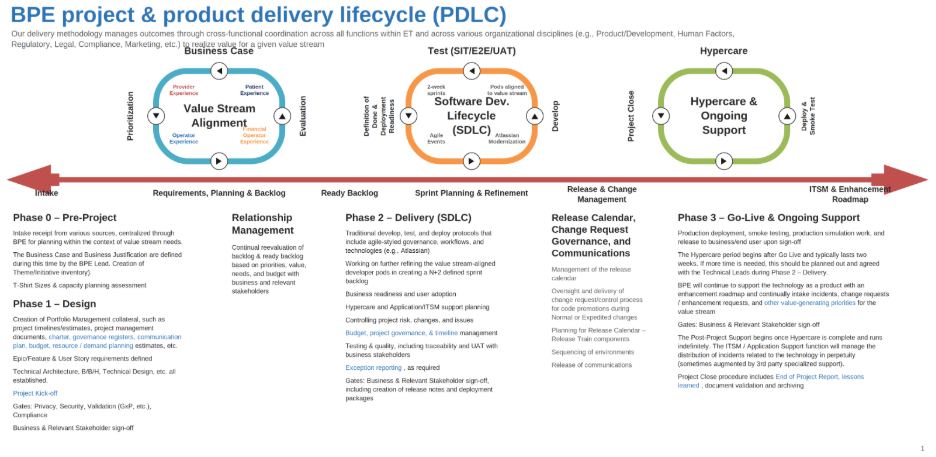
The connected delivery and change lifecycle established in the Atlassian environment.

Building a foundation for long-term operational maturity 

For the client, the engagement established a connected, standardized foundation for software delivery, IT support, and operational governance. 

By aligning teams within one environment, the client improved consistency across delivery and support. As a result, leaders gained clearer visibility into how work moves across the organization. 

As the organization continues to evolve, this foundation now supports scaling collaboration, governance, and enterprise delivery practices. Because the model is built to grow with the business, adoption continues well beyond the initial rollout. 

Frequently asked questions (FAQs) 

What is Atlassian consolidation? 

Atlassian consolidation brings software delivery and IT support onto one connected Atlassian environment. Teams replace disconnected tools with shared workflows, clearer governance, and consistent visibility across delivery and service management. 

How does Jira Service Management support ITIL practices? 

Jira Service Management aligns with ITIL through separate workflows for incidents, service requests, and changes. Defined SLAs, routing rules, and change approvals help IT support operate with clearer categorization and accountability. 

Can teams move from Azure DevOps and ServiceNow to Atlassian? 

Yes. Development work can move into Jira Software and Confluence, while IT support moves into Jira Service Management. A partner-led implementation standardizes workflows and governance, so the shift improves consistency rather than adding disruption. 

What are the benefits of unifying software delivery and IT support? 

Unified delivery and support give leaders shared visibility into work, priorities, and dependencies. Standardized workflows reduce friction, while end users and support agents gain clearer status and more usable service experiences. 

How does Cprime approach an Atlassian implementation? 

Cprime works through collaborative sessions with technology leaders to design the operating model first. Configuration of Jira Software, Confluence, and Jira Service Management then reflects how work and decisions actually flow, which supports adoption over time. 

Ready to modernize delivery and service management?

Disconnected systems and inconsistent processes make it hard to scale delivery and maintain visibility. Cprime helps organizations unify workflows, modernize service management, and build operating models that sustain execution.

Through Atlassian consolidation, your teams can replace fragmented tooling with one connected way of working. If fragmented tools or limited visibility are slowing your teams, now is the time to act.

Behavioral health leader accelerates IT service delivery with a modern ServiceNow ITSM foundation 

Transforming-IT-Demand-Management-A-Global-Pharmaceutical-Success-Story-1

When legacy ITSM limits growth and visibility 

This U.S.-based behavioral health and foster care leader, a 5,000-employee healthcare organization, had relied on BMC Footprints ITSM for more than eight years. Over time, the platform constrained automation, scalability, and user experience. Manual ticketing processes and siloed systems slowed service delivery and limited actionable insights. 

Critical incidents often required up to 72 hours to resolve. The absence of a service catalog and self-service portal drove employees to depend on email and phone-based support. High mean time to resolution (MTTR) affected workforce productivity, increased compliance exposure, and weakened satisfaction with IT services. 

Leadership recognized that modern healthcare operations require responsive, analytics-driven IT services that scale across distributed teams. The organization sought a platform and partner capable of delivering that shift quickly and sustainably. 

Building a scalable ITSM engine on ServiceNow 

They selected INRY, a Cprime company, for its deep ITSM transformation expertise, ITIL-aligned implementation approach, and proven ability to deliver scalable ServiceNow solutions. Industry referrals and prior successful engagements reinforced confidence in the partnership. 

The engagement introduced the ServiceNow ITSM platform with Incident, Problem, Change, and Request Management modules. The team implemented an integrated CMDB, automation workflows, analytics dashboards, and Employee Center to enable self-service. 

Delivery extended beyond configuration. The program included consulting, solution design, integrations, user acceptance testing support, and comprehensive training, including train-the-trainer sessions to drive sustained adoption. 

Close collaboration with the client’s CIO, IT Service Desk Manager, and Change Management Lead ensured strong stakeholder alignment. Joint workshops and phased implementation milestones created momentum while maintaining operational continuity. The team leveraged ServiceNow out-of-the-box capabilities to accelerate deployment and reduce unnecessary customization. 

From reactive support to measurable performance gains 

The results demonstrate the impact of a modern, workflow-driven ITSM model: 

  • MTTR reduced by 35%, exceeding the 30% target. 
  • Operational costs reduced by 20% through automation. 
  • Self-service adoption increased by 50%. 

Time to resolution for critical incidents dropped from 72 hours to 24 hours. Teams collaborate more effectively across functions, supported by shared visibility into incidents, changes, and configuration data. 

Beyond the metrics, the client advanced toward a proactive service management culture. Analytics dashboards provide leadership with clearer insight into performance trends. Standardized workflows create consistency across locations, supporting compliance and operational resilience. 

Creating a foundation for future-ready service operations 

The new ServiceNow foundation positions this growing healthcare leader to expand automation and intelligence across the IT landscape. The roadmap includes AI-driven predictive analytics and expanded automation for change approvals and asset lifecycle management. 

By establishing a scalable, analytics-enabled ITSM backbone, the organization strengthened service reliability while enabling future innovation. They now operate with a platform designed to evolve alongside its growth across 16 states. 

Ready to modernize your IT service experience? 

Organizations that modernize ITSM unlock measurable gains in speed, cost efficiency, and user satisfaction. If your IT service operations face similar constraints, a structured, stakeholder-aligned ServiceNow transformation can deliver comparable impact. 

Connect with our team to explore how your organization can accelerate service performance and build a foundation for long-term value. 

Explore our flexible ServiceNow ITSM solutions

How ServiceNow HRSD Helped California DMV Reimagine Workforce Efficiency 

dual-lockup-inry-dmv@2x

Modernizing the backbone of California’s workforce 

The California DMV’s Field Operations Division manages one of the largest public-facing workforces in the state. Yet until recently, HR teams and field office managers relied on spreadsheets and emails to track staff movements, vacancies, and reassignments across 150+ locations. Without real-time data, workloads were often unbalanced, vacancies lingered, and citizen wait times climbed. 

As part of the agency’s broader modernization initiative—Improving Field Office Address to Public (IFOAP)—DMV leaders set out to transform how the department managed its most valuable resource: its people. 

“Before we began this project, it was difficult to know who was available, where gaps existed, or how quickly we could fill them. Every staffing decision required manual coordination that slowed everything down.” — Field Operations Division Lead, California DMV 

Turning complexity into intelligent flow 

DMV selected INRY, a Cprime company, to design and deliver a position control solution on ServiceNow HR Service Delivery (HRSD). The engagement unified HR, IT, and Field Operations around a single platform for managing positions, approvals, and staffing actions in real time. 

Key capabilities included: 

  • Automated Position Control: Digitized creation, update, and movement of staff positions. 
  • Request for Position Action (RPA): Streamlined approval chains and document handling. 
  • Employee Center + Knowledge Management: Provided a unified employee self-service portal. 
  • Integrations: Connected ServiceNow with Oracle, Active Directory, SCO systems, and DMV’s in-house Org Chart Tool. 
  • Dashboards and Analytics: Delivered live visibility into vacancies, workloads, and workforce allocation trends. 

Each sprint applied INRY’s PASS (Process Area Specific Sprints) methodology, combining agile delivery speed with the governance structure required in state government programs. The result was a rapid, transparent implementation that kept stakeholders aligned and value visible at every stage. 

“We designed the system not just to automate tasks, but to orchestrate a living network of data and decisions. “The DMV team embraced that mindset quickly as we moved from pilot to statewide adoption in record time.” — Anuj Raparthi, Engagement Manager at INRY 

Guided evolution: from pilot to statewide transformation 

The project unfolded as a true partnership between DMV’s HR, IT, and Field Operations teams and INRY’s delivery experts. 

  • December 2024 – May 2025: Technical go-live achieved in just six months. 
  • June – October 2025: All 10 divisions onboarded; adoption scaled statewide. 
  • December 2025: Phase II enhancements completed, introducing offboarding workflows, reorganization capabilities, and form automation (STD 607/625). 

Organizational change management played a defining role. INRY’s CloudCover team delivered hands-on training, hosted “Open House” sessions across all eight regions, and supported communication planning to ensure user confidence. 

“Public sector transformation demands patience and precision. Our goal was to build trust first, showing results with each sprint so adoption could happen naturally, not forcefully.” — Scott Carney, Sales Director at INRY. 

ServiceNow HRSD as a system of record and intelligence 

The modernized system replaced fragmented workflows with one connected environment that manages over 9,600 position records and 11,000 HR profiles, encompassing more than 1.2 million data elements. 

Every function—from hiring to offboarding—is now informed by the same source of truth. ServiceNow HRSD serves as both the system of record and the operational brain, feeding data to related systems such as Oracle, Dayforce, and the DMV’s Org Chart visualization tool. 

With the integrations in place, DMV can: 

  • See workforce status updates instantly rather than through monthly reconciliations. 
  • Automate reporting to the State Controller’s Office. 
  • Track performance metrics and staffing trends with precision dashboards. 

The agency’s IT and HR units now operate as a unified system of work, laying the foundation for AI-enabled decision-making and predictive resource planning. 

Tangible impact on efficiency and service quality 

Although full measurement is ongoing, early results are already reshaping public service delivery. 

  • Significant reduction in citizen wait times across pilot offices 
  • Saved time and reduced errors due to tremendous decrease in manual spreadsheet use for HR and position tracking 
  • Accelerated staff redeployment because managers can now rebalance workloads within minutes. 
  • Speedy adoption as 10 divisions onboarded within twelve months of technical launch. 

Additionally, the qualitative results are also impressive: 

  • A unified, transparent culture between HR, Budgets, and Field Operations. 
  • Greater accountability through live dashboards and executive reports. 
  • A foundation for further automation, including onboarding and telework management. 

“We finally have one accurate, live view of every position across the organization. Managers can make informed staffing decisions on the spot—something that used to take weeks.” — Field Operations Division Lead, California DMV 

Sustaining momentum through CloudCover 

INRY’s CloudCover Managed Services now provides ongoing support, performance tuning, and continuous improvement. Enhancements underway include expanding AI search capabilities, refining org-chart visualization, and introducing proactive alerts for workforce imbalances. 

The DMV’s modernization success has already gained recognition from the California Department of Technology for innovation and public impact. More importantly, it established a repeatable framework for future automation efforts, proving that data-driven workforce management can accelerate citizen service at scale. 

“This project exemplifies how government can evolve without disruption. ServiceNow HRSD gave DMV the structure to modernize continuously, guided by real insight and measurable value.” — Scott Carney, Sales Director at INRY. 

A platform for the AI-first era of public service 

The California DMV’s Position Control initiative shows what’s possible when process modernization meets intelligent orchestration. By unifying data, decisions, and workflows on ServiceNow HRSD, the DMV has turned complexity into clarity, creating a foundation for AI-first operations that can adapt and scale with the needs of 32 million Californians. 

If you’d like to see similar results in your organization, explore our SMART Success program for ServiceNow HRSD. 

AI That Works: A Pragmatic Guide for Service Management Leaders 

Screenshot 2025-10-27 at 9.35.40 AM

Turn everyday service management into an engine of intelligent flow. 

AI is redefining how service teams operate, cutting resolution times by up to 50%, automating 70% of routine requests, and freeing talent for higher-value work. 
But success doesn’t begin with a grand AI strategy. It begins by solving real service challenges: faster triage, continuous coverage, unified knowledge, and actionable insights. 

This practical guide shows how to use Atlassian Jira Service Management and Rovo to: 

  • Automate repetitive requests and reduce backlog
  • Extend coverage without expanding headcount 
  • Surface answers instantly across systems 
  • Predict and prevent recurring issues 
  • Deliver insights leaders can act on without analyst support 

Written for ITSM and service management leaders, this ebook translates AI potential into measurable outcomes you can activate today. 

Ready to see what AI can do for your service organization? 
Fill out the form to get your copy of AI That Works and start building a smarter, more resilient service operation. 

Empowering the Hard-to-Reach Workforce: Modern Enterprise Service Management

Webinar_Empowering the Hard-to-Reach Workforce_ Modern Enterprise Service Management

Reaching the Frontline, Redefining the Experience

Deskless workers are the driving force behind the transportation and logistics industry, but they’re often left disconnected from the tools and support they need to succeed. Whether they’re on the road, in warehouses, or operating in the field, giving them direct access to enterprise services is no longer optional—it’s essential.

Join experts from Cprime and ServiceNow for a live session on how forward-thinking organizations are delivering modern, AI-driven employee experiences to their deskless workforce—anytime, anywhere.

What You’ll Discover

  • Top Challenges: Explore the real barriers faced by frontline and deskless teams today

  • Mobile-First Self-Service: See how Employee Center Pro makes support accessible from any device

  • Real-World Use Cases: Learn how leading organizations handle safety reporting, time-off requests, onboarding, and more

  • AI in Action: Discover how Now Assist and Virtual Agent enable instant, personalized responses

  • Tangible Outcomes: Lower case volumes, faster resolutions, increased satisfaction

Key Considerations When Implementing ServiceNow CSM for Mature and Evolving Organizations

Ebook_Key considerations when implementing ServiceNow CSM for mature and 
evolving organizations2x_R2

Unlock the full potential of your customer service management with ServiceNow CSM, tailored for both mature and evolving organizations.

Mature Organizations

  • Established systems and processes
  • Seeking to replace end-of-life systems
  • Aiming to develop customer self-service capabilities
  • Looking to advance in their maturity model

Evolving Organizations

  • Newer CSM department
  • Migrating from manual processes (e.g., Excel, homegrown apps)
  • Implementing foundational CSM systems

Note: Organization size doesn’t determine maturity. Evaluate your processes, customer feedback collection, and awareness of capability gaps to determine your organization’s type.

Discover how to:

  • Overcome common implementation challenges
  • Accelerate your CSM maturity
  • Boost customer satisfaction by 30%

Get Your Free Guide Now

The HR Team’s Guide to Implementing Enterprise Service Management

HR-Teams-Guide-To-ESM-page-1

The HR Team’s Guide to Implementing Enterprise Service Management

The HR Team’s Guide to Implementing Enterprise Service Management

Introduction

Like nearly all organizations today, you’re struggling to streamline internal processes even as the speed and complexity of the market keeps requiring you to change. Success depends on clear communication, smooth collaboration, and alignment across business units. But this isn’t easy, considering the variety of processes, metrics, and tools various teams use across the organization.

Many companies have discovered that a relatively new concept, Enterprise Service Management (ESM), offers significant benefits. It’s proving to be a healthy step toward the optimal state of enterprise agility the modern organization must strive for.

One of the most important aspects of ESM is the fact that it unites and aligns departments across the organization with one tool stack and one set of processes. So, if your Human Resources team could benefit from streamlining and alignment of your internal and external service offerings, ESM should be high on your priority list.

In the first white paper in this series, Your Practical Guide to Enterprise Service Management, we provided a primer explaining:

  • What Enterprise Service Management is
  • What is required to craft a basic ESM system
  • Why your company should consider pursuing this program, and
  • A simple three-step process for successful implementation

In this white paper, we’ll:

  • Introduce you to the hard-working HR team at XYZ Corporation
  • Describe their current situation (which you may find very familiar)
  • Consider why and how they decided to pursue ESM
  • Lay out how they prepared for implementation, what challenges they faced, how these were overcome, and the outcomes they achieved
  • Reveal how you can follow suit in your own organization

Download the full white paper now to keep reading! –>