Resource Type: Case Study

Leading Healthcare System Transforms HR for 23,000 Employees with ServiceNow

Case_Study_SCL Health Elevates the Provider Onboarding Experience

The Challenge

As one of the largest integrated healthcare systems in its region, the organization supports more than 23,000 employees and nearly 1,900 providers. Like many growing healthcare organizations, its HR teams struggled to deliver consistent service experiences across multiple locations and departments:

  • Manual processes and disconnected workflows created inefficiencies for employees and HR staff alike.
  • Limited self-service meant employees relied on direct outreach for routine support.
  • HR teams spent valuable time on administrative requests instead of strategic workforce initiatives.

The Opportunity

Leadership recognized the need for a modern HR service delivery model, one that could improve employee experiences, increase operational efficiency, and provide greater visibility into service performance. To pursue that vision, the organization selected INRY, a Cprime company, for its:

  • Healthcare industry expertise
  • Proven ServiceNow delivery experience
  • Ability to guide organizations through both strategy and implementation

The Solution

INRY delivered an advisory-led transformation, beginning with a consulting phase to align stakeholders, assess existing HR processes, and define a future-state vision. Through discovery workshops, process assessments, and tailored ServiceNow demonstrations, leadership saw how the platform could support employee experience, workflow automation, governance, and continuous improvement. This phase also introduced a Center of Excellence governance framework establishing process ownership, decision-making structures, and long-term platform management.

INRY then implemented ServiceNow HR Service Delivery, including:

  • Employee Center Pro and HR Agent Workspace
  • Case management workflows with intelligent routing
  • Knowledge management and self-service capabilities
  • Executive dashboards
  • Oracle integration

The program covered solution design, workflow configuration, integrations, change management, and user adoption support, backed by a structured 90-day hypercare period. Close collaboration between HR leadership, executive sponsors, departmental stakeholders, and delivery teams kept the initiative aligned and organizationally ready throughout.

The Results

The results demonstrate the impact of a modern, workflow-driven HR service delivery model:

  • 14 HR request forms available through Employee Center
  • 6,451 HR cases managed during August
  • 2,713 HR cases processed in the first half of September
  • 100+ HR knowledge articles published in a centralized repository
  • 6,974 knowledge article views since go-live
  • Intelligent case routing across multiple HR service categories
  • Executive dashboards tracking 10+ key HR performance metrics

Beyond the metrics, the organization established a more consistent, scalable HR operating model: employees gained easier access to services through a unified portal, HR teams reduced manual effort through automation, and leadership gained the visibility needed for more informed decisions and continuous improvement.

Looking Ahead

The new ServiceNow HRSD foundation positions the organization to keep expanding automation, self-service, analytics, and workforce experience capabilities. The governance model established during the advisory phase provides a framework for ongoing innovation, ensuring future enhancements stay aligned with business priorities and employee needs. By combining strategic advisory services with a scalable platform, the organization transformed HR from a primarily transactional function into a strategic capability supporting workforce effectiveness, operational excellence, and long-term growth.

Ready to Modernize HR Service Delivery?

Organizations that modernize HR service delivery improve employee experiences, increase operational efficiency, and build a foundation for continuous improvement. If your HR organization faces fragmented processes, limited self-service, or inconsistent service experiences, a structured ServiceNow HRSD transformation can deliver measurable business value.

Connect with our team to learn how a governance-led HR transformation can build a scalable foundation for your future.

Modernize HR Service Delivery with ServiceNow

Transform HR service delivery with ServiceNow HRSD to improve employee experiences, streamline HR operations, and build a scalable foundation for continuous improvement.

Modernizing Public Safety Operations with ServiceNow WSD

Webinar_The-Five-Stages-of-Enterprise-Evolution-through-SPM_-Accelerating-Your-SPM-Progress-1

What had been a fragmented maze of spreadsheets, siloed emails, and manual approval chains became a single, intelligent platform built on ServiceNow Workplace Service Delivery (WSD), seamlessly managing everything from maintenance and leasing to contracts and workspace reservations. Powered by INRY’s proprietary SMART Success methodology, the engagement eliminated operational bottlenecks, established structured request workflows, automated approval routing, and delivered real-time visibility through executive-ready dashboards. The result: a 70% reduction in manual effort, dramatically strengthened compliance posture, and an audit-ready infrastructure built to scale.

The Hidden Cost of Manual Operations at Statewide Scale

As one of the nation’s most prominent public safety institutions, the agency manages a vast network of facilities across the state. At that scale, the way workplace services are requested, approved, and tracked has a direct impact on operational efficiency, cost control, and compliance.

The agency was running this complex operation on outdated, manual processes. Maintenance requests, lease tracking, and contract approvals were handled through spreadsheets and email, creating data silos and making it difficult to see the full picture of workplace activity. The challenges compounded across several areas:

  • Fragmented systems: Maintenance requests, lease tracking, and contract approvals lived in disconnected spreadsheets and inboxes, creating inefficiencies and data silos.
  • Lack of visibility: No centralized dashboard existed to track service requests, lease statuses, or contract compliance.
  • Delayed approvals: Manual routing of approvals slowed down maintenance work and contract execution.
  • Compliance risks: Enforcing lease terms and tracking contract thresholds was difficult, increasing the risk of overspending and audit issues.

Leadership recognized that a modern, automated approach was needed: one that could bring these processes onto a single platform, give the organization real-time visibility, and reduce the manual burden on facility teams.

One Win Became Many: How INRY Grew From ITSM Advisor to Enterprise Platform Partner

The agency and INRY were first introduced through ServiceNow to explore solutions for an employee workflows challenge. That relationship opened the door to IT Service Management modernization work, where INRY delivered services that exceeded expectations and earned the organization’s confidence.

Building on that success, the agency selected INRY to take on new platform initiatives. The decision was driven by the strength of INRY’s ServiceNow capability, a hybrid delivery model, a commitment to refine the agency’s implementation with leading practices, a compelling proposal and competitive pricing, and local presence.

“Your support for ITSM work was miles better than the last vendor, and your support on this project is even better than that. You’ve been amazing.”

— Agency stakeholder

Building an automated workplace platform on ServiceNow

INRY implemented ServiceNow Workplace Service Delivery using its SMART Success methodology, tailored to the agency’s unique facilities, leasing, and contract needs. The solution brought workplace operations onto a single platform and automated the workflows that had previously required manual effort.

Key capabilities delivered

  • Employee Center Pro: A self-service portal that lets facility analysts initiate maintenance, lease, and workspace requests through structured forms.
  • Workspace Central Case Management: Centralized tracking of all workplace service cases, including maintenance, lease, and contract workflows.
  • Streamlined space reservations: Dedicated request forms gave users a structured, efficient way to reserve workspaces and related facilities, significantly reducing the manual tracking of reservations.
  • Automated workflows: Emergency maintenance prioritization driven by prefilled questionnaires, multi-level approval routing for contracts exceeding $9,999, and task sequencing across maintenance completion, invoice receipt, and stamping.
  • Lease & contract management: Lease initiation and approval through Workplace Central, contract model selection with dynamic routing to the right approvers, and dashboards for active contracts and payment schedules.
  • E-signature & PDF generation: Support for digital signatures and auto-generated PDFs, improving compliance and audit readiness.
  • Unified dashboard: A single dynamic dashboard that keeps track of all WSD-related forms, giving the agency one place to monitor workplace activity in real time.

The engagement followed a structured delivery path. Collaborative design workshops mapped the agency’s current processes and defined future-state workflows. Iterative configuration and user acceptance testing were carried out hand-in-hand with power users to validate each build. After technical go-live in July 2025 and business go-live in September 2025, INRY provided a 90-day CloudCover support period to drive adoption and resolve issues as the new model took hold.

“Very professional and accommodating, working with us to make sure everything was done correctly.”

— Agency stakeholder

Delivering measurable efficiency, visibility, and compliance

The impact was felt across day-to-day operations, with the most significant gain in the sheer reduction of manual work.

Efficiency and productivity

  • Manual work reduced by 70% after implementation, with the platform absorbing the tracking and routing that teams previously handled by hand.
  • Automated routing and task management reduced delays in both maintenance and contract approvals, improving turnaround time.
  • Optimized workspace planning and utilization through structured request forms and centralized reservation management.

Visibility and compliance

  • A single dynamic dashboard delivered real-time insight into active leases, pending approvals, and maintenance statuses.
  • Lease and contract workflows enforced spending thresholds and approval hierarchies, strengthening compliance and reducing the risk of overspending.
  • Digital signatures and auto-generated PDFs improved audit readiness across leasing and contract processes.

Cultural and collaborative gains

  • Stronger collaboration between facility analysts and approvers through shared, transparent workflows.
  • Increased confidence in compliance and audit readiness across the organization.
  • A positive cultural shift toward digital-first processes.

From manual spreadsheets to connected workplace operations

Before: The agency relied on manual spreadsheets and email-based approvals, with a high risk of delays and compliance breaches and little visibility into the status of any given request.

After: Workplace services run on a centralized, automated platform with structured request forms, real-time dashboards, and digital signatures, cutting manual effort by 70% and giving leadership the visibility to manage facilities by evidence rather than guesswork.

The relationship continues to grow. Following the ITSM modernization and the WSD implementation, the agency selected INRY to deliver Software Asset Management (SAM) as well, work that is currently underway, extending the value of ServiceNow further across the organization.

Ready to modernize your workplace operations?

Organizations that move workplace services onto a single, automated platform reduce manual effort, strengthen compliance, and gain the visibility to manage facilities proactively.

If your teams are managing maintenance, leasing, contracts, or workspace reservations through spreadsheets and email, a structured ServiceNow Workplace Service Delivery implementation can deliver measurable results. Connect with INRY to learn how WSD can transform your workplace operations into a connected, efficient capability.

Modernize Workplace Operations with ServiceNow WSD

Transform workplace operations with ServiceNow WSD. Improve visibility, streamline workflows, and create more connected experiences across your organization.

Modern HR Transformation with Human-First AI and ServiceNow HRSD

Case_Study_Helping Nebraska Methodist Health System Become a Dominant Regional Provider through HR Services Innovation

When a legacy HR platform limits self-service and insight

Inry’s health system client delivers people services to a large clinical and support workforce across a multi-state footprint. At that scale, a consistent employee experience depends on HR services that are responsive, accessible, and measurable.

Those services previously ran on a legacy platform with no AI capability in addition to limited analytics, and self-service features. Knowledge resources available to employees were fragmented and difficult to find with the platform’s search functionality, so employees rarely resolved questions on their own and defaulted to contacting a person. The HR team was forced to absorb a steady stream of repetitive, administrative requests, while limited reporting made service quality difficult to measure and identify areas of improvement. The platform also constrained any move toward a modern, scalable operating model, and because employees had adapted to the quirks of the old system, any transition carried real risk of friction and disruption.

Yet, Leadership recognized an opportunity to modernize, beyond digitizing existing processes. Their goal was to create more connected, efficient self-service-led experience that significantly improved the employee experience without removing human access. Through a formal RFP, the organization selected INRY for both its healthcare and ServiceNow experience, and ability to guide both strategic transformation and technical delivery.

Aligning stakeholders and ownership before configuration

Rather than open with the typical list of requirements and configuration, the engagement began by aligning on outcomes. INRY worked closely with HR practice heads and Center of Excellence leaders to understand how employees actually behaved: how they sought support, where knowledge lived, and which interactions could move to self-service without compromising quality.

These conversations established two foundations that shaped everything that followed. The first was a human-first principle: AI would expand what employees could resolve on their own, but it would never remove their seamless access to a specialist. The second was shared ownership. Working through the Centers of Excellence, INRY and the client co-created the initial Virtual Agent topics and the AI-ready content behind them, so those who owned each service area shaped how it would work.

By designing for adoption and ownership from the start, the organization entered the implementation phase with a clear view of how the platform would operate, who would govern it, and how it would continuously improve after go-live.

Building an AI-enabled HR service foundation on ServiceNow

Once aligned, INRY implemented a ServiceNow HR Service Delivery solution designed for both immediate self-service value and future expansion. With an eye on the defined objectives and foundational principles of the initiative, the solution brought together:

  • ServiceNow HR Service Delivery as the core service platform
  • Now Assist for HRSD, providing generative AI assistance to service agents
  • Now Assist in Virtual Agent, giving employees conversational, AI-powered self-service
  • AI Search and AI Recommendations, surfacing relevant answers at the point of need
  • 25–26 Virtual Agent topics covering the most common employee requests at launch
  • Knowledge migration and management, with legacy content validated and structured for AI consumption

The project extended well beyond configuration. Much of the knowledge assets employees needed did not yet exist on the platform, so INRY migrated content from legacy systems, validated it with the teams who owned it, and structured it for AI so that search and Virtual Agent responses drew on accurate, current information.

Additionally, INRY recognized the importance of helping the organization adopt the transformed employee experience. Organizational change management and training ran in tandem with the build to ensure it was embedded into the program rather than treated as a final step. INRY also trained the client’s teams to create and manage new Virtual Agent topics on their own after go-live, giving the organization durable, sustainable ownership of how the model evolves.

Throughout each strategic decision, the commitment to a human-first HR services never waivered. . AI accelerated self-service, but it never blocked access to a specialist. Employees could escalate to a person at any time, and that transparency gave both employees and service teams the confidence to adopt the new model.

Delivering measurable improvements across HR service

The impact was visible almost immediately. Employees gained a single, intelligent way to find answers and request support, while service teams gained generative assistance and clearer visibility into performance.

Self-service and deflection

  • 78% Virtual Agent success rate within weeks of launch
  • 25–26 self-service topics live at go-liv
  • Redundant queries reduced as AI Search and Virtual Agent deflection took hold

Agent productivity and adoption

  • 100% Now Assist adoption across the enabled HR service teams
  • Generative assistance helps agents resolve cases with less manual effort

Knowledge and experience

  • Legacy content migrated, validated, and structured for AI consumption
  • Faster employee access to accurate answers through conversational self-service
  • Human escalation is preserved at every step, strengthening trust in the new AI

Visibility and governance

  • Engagement and adoption are observable and managed for the first time
  • Ownership anchored with internal teams and the HR Centers of Excellence for continuous improvement

Transforming HR from a transactional function into a strategic capability

While the technology delivered measurable operational gains, the most significant outcome was organizational. The transformation helped the organization redefine the role of its people function. Freed from a steady stream of repetitive requests, service teams could redirect time toward higher-value workforce initiatives. Employees gained faster, easier access to the information and services they needed, and leaders gained the visibility to manage service on evidence rather than anecdote.

The foundation is also built to grow. With validated content, internally owned governance, and proven adoption, the organization is positioned to extend AI-enabled service to additional Centers of Excellence, widen the range of needs employees resolve on their own, and mature toward more context-aware, workflow-embedded automation over time, always within a human-first model where people retain ownership of judgment and escalation. What began as an HRSD modernization became a foundation for long-term, human-first transformation.

Ready to modernize your HR service experience?

The most effective HR transformations extend beyond platform or technology implementations. They align technology, governance, and employee experience around a shared vision, and they prioritize a human-first approach as AI expands the boundaries of employee self-service. When your organization is looking to streamline service delivery, improve its employee experience, or build a scalable, human-first AI foundation, INRY is your transformation partner.

Connect with INRY to explore how ServiceNow HR Service Delivery can transform employee support into a strategic capability.

Transform HR with ServiceNow

Modernize HR service delivery with ServiceNow HRSD, AI-powered workflows, and connected employee experiences designed to improve efficiency and workforce outcomes.

How a global healthcare company unified delivery and IT support through Atlassian consolidation

Global healthcare company unifying software delivery and IT support through Atlassian consolidation

When disconnected systems begin to slow the business 

The client is a global healthcare company with approximately 1,500 employees. Its Enterprise Technology organization supports critical functions across enterprise applications, cybersecurity, infrastructure, SAP, and business process engineering. 

As the organization grew, teams worked across separate systems for software delivery and IT support. Development teams operated in Azure DevOps, while IT support relied on ServiceNow. Consequently, visibility fragmented, ways of working diverged, and operational friction spread across the department. 

Within ServiceNow, teams treated nearly every request as an incident, regardless of the actual need. Routing lacked clarity, workflows were missing or poorly designed, and alignment to ITIL practices stayed limited. End users had little visibility into ticket status. Meanwhile, support agents struggled with awkward interfaces, limited customization, and inefficient processes. 

At the same time, product and development teams lacked standardized workflows and governance in Azure DevOps. This made consistency across delivery teams hard to achieve. 

The client set a clear goal: one unified operating model for delivery and support. This model needed to improve visibility, standardize execution, and support future growth. 

Turning fragmented delivery into a connected operating model 

Cprime partnered with the client to design and configure a connected Atlassian environment. This environment supports both software delivery and enterprise IT service management. 

To support software development and product delivery, Cprime implemented: 

  • Atlassian Guard 
  • Jira Software 
  • Confluence 
  • Big Picture for portfolio management 
  • Jira Product Discovery for future work pipeline management 

The implementation introduced a standardized work hierarchy across teams. It spans Themes, Initiatives, Epics, Features, Stories, Tasks, and Test Cases. In addition, dedicated product and team spaces now support consistent planning, prioritization, sprint execution, and collaboration. 

On the service management side, Cprime configured Jira Service Management (JSM) to align with ITIL practices. This work modernized the support experience through several changes: 

  • Separate workflows for incidents, service requests, and change requests 
  • Defined SLAs and routing processes 
  • Workflow automations 
  • Tailored customer portals for Business Application Support, Enterprise Technology Support, and Global Technical Support 
  • A bespoke deployment management solution to support CAB approvals and transport movement across environments 

Throughout the engagement, Cprime ran collaborative working sessions with Enterprise Technology leaders across IT, cybersecurity, and business process engineering. 

Standardizing work across teams without disrupting delivery 

One outcome stood out: the client consolidated disconnected delivery and support functions into a single Atlassian environment. 

Following the implementation: 

  • Product and development teams now operate with standardized workflows and consistent delivery structures 
  • Enterprise Technology teams gained improved visibility into work, priorities, and dependencies 
  • IT support operations align to ITIL best practices, with clearer categorization, routing, and SLA management 
  • End users have greater visibility into ticket status and support progress 
  • Support agents benefit from improved, customizable views within JSM 
  • The team removed licensing limitations that had restricted broader departmental participation 

In addition, Jira Product Discovery gave the client a structured approach for evaluating and managing future work. 

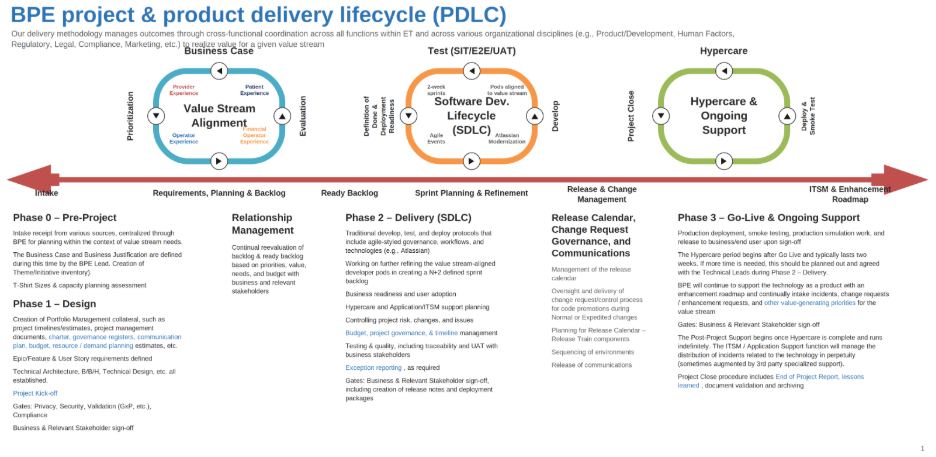
image

The connected delivery and change lifecycle established in the Atlassian environment.

Building a foundation for long-term operational maturity 

For the client, the engagement established a connected, standardized foundation for software delivery, IT support, and operational governance. 

By aligning teams within one environment, the client improved consistency across delivery and support. As a result, leaders gained clearer visibility into how work moves across the organization. 

As the organization continues to evolve, this foundation now supports scaling collaboration, governance, and enterprise delivery practices. Because the model is built to grow with the business, adoption continues well beyond the initial rollout. 

Frequently asked questions (FAQs) 

What is Atlassian consolidation? 

Atlassian consolidation brings software delivery and IT support onto one connected Atlassian environment. Teams replace disconnected tools with shared workflows, clearer governance, and consistent visibility across delivery and service management. 

How does Jira Service Management support ITIL practices? 

Jira Service Management aligns with ITIL through separate workflows for incidents, service requests, and changes. Defined SLAs, routing rules, and change approvals help IT support operate with clearer categorization and accountability. 

Can teams move from Azure DevOps and ServiceNow to Atlassian? 

Yes. Development work can move into Jira Software and Confluence, while IT support moves into Jira Service Management. A partner-led implementation standardizes workflows and governance, so the shift improves consistency rather than adding disruption. 

What are the benefits of unifying software delivery and IT support? 

Unified delivery and support give leaders shared visibility into work, priorities, and dependencies. Standardized workflows reduce friction, while end users and support agents gain clearer status and more usable service experiences. 

How does Cprime approach an Atlassian implementation? 

Cprime works through collaborative sessions with technology leaders to design the operating model first. Configuration of Jira Software, Confluence, and Jira Service Management then reflects how work and decisions actually flow, which supports adoption over time. 

Ready to modernize delivery and service management?

Disconnected systems and inconsistent processes make it hard to scale delivery and maintain visibility. Cprime helps organizations unify workflows, modernize service management, and build operating models that sustain execution.

Through Atlassian consolidation, your teams can replace fragmented tooling with one connected way of working. If fragmented tools or limited visibility are slowing your teams, now is the time to act.

How a global wealth management platform accelerated enterprise Agile transformation through learning at scale

FNZ teams in a global Agile at Scale learning workshop delivered by Cprime

Enterprise Agile transformation requires more than introducing new frameworks or delivery practices. Sustainable change depends on building the knowledge, behaviours, and confidence that enable teams to adopt new ways of working consistently across the organisation.

As part of its delivery operating model transformation, a global provider of wealth management and investment platforms partnered with Cprime to develop a global Agile learning programme aligned to its Agile Playbook. The objective extended beyond training employees on Agile concepts. The client wanted to create a shared understanding of Agile@Scale, reinforce the behaviours required for long-term transformation, and enable thousands of technology and delivery professionals to adopt a consistent delivery approach across regions.

To support this ambition, Cprime designed a structured learning journey that combined Agile enablement, behavioural change, embedded programme management, and continuous measurement. Delivered across EMEA, APAC, India, and North America, the programme reached more than 80% of the target workforce while providing measurable improvements in Agile capability, learner confidence, and readiness to apply Agile practices within day-to-day delivery.

Rather than treating learning as a standalone initiative, the client positioned capability building as a core component of its enterprise transformation strategy, helping create stronger alignment between people, processes, and the organisation’s future delivery model.

The challenge of scaling Agile transformation across a global enterprise

Like many global organisations modernising their delivery operating models, the client recognised that introducing Agile practices alone would not create lasting organisational change.

The organisation was undertaking a significant transformation of its delivery model centred on its Agile Playbook. Success depended on creating a shared understanding of Agile principles while helping teams adopt consistent ways of working regardless of geography, business unit, or role.

The transformation presented several complex challenges.

First, the programme needed to reach thousands of employees across multiple continents within an accelerated timeframe. Teams operated across different time zones, requiring a learning model capable of delivering consistent experiences without compromising quality.

Second, the client wanted to reinforce behaviours that extend beyond Agile ceremonies and delivery mechanics. Collaboration, client focus, empowerment, resilience, continuous learning, and adaptability were viewed as essential characteristics of the future operating model.

Finally, leadership required measurable evidence that learning was contributing to transformation objectives. Beyond attendance metrics, the organisation wanted visibility into capability improvements, learner confidence, facilitator effectiveness, and readiness to apply new practices within live delivery environments.

Meeting these objectives required more than traditional Agile training. The client needed a partner capable of combining enterprise-scale learning operations with measurable capability development and continuous programme optimisation.

Why the client selected Cprime

Following a competitive evaluation process, the client selected Cprime based on its ability to deliver enterprise-scale Agile transformation learning while maintaining consistency across regions and business functions.

Rather than proposing a series of isolated training sessions, Cprime introduced a Learning Academies approach that integrated learning design, programme governance, operational delivery, and continuous improvement into a single scalable model.

Several factors differentiated the proposed solution.

Cprime demonstrated the global delivery capability required to support learners across EMEA, APAC, India, and North America while maintaining a consistent learning experience regardless of location.

The proposed learning journey aligned directly with the client’s Agile Playbook, ensuring that Agile principles, delivery practices, and organisational behaviours reinforced one another throughout the programme.

The client also recognised the value of embedding a dedicated Learning Manager within programme operations. This role provided end-to-end coordination across scheduling, communications, logistics, reporting, facilitator management, and stakeholder engagement, enabling the organisation to manage a large-scale global rollout efficiently.

Equally important was Cprime’s commitment to continuous improvement. Participant and stakeholder feedback informed rapid refinements throughout the programme, with updates incorporated within 24 to 48 hours to improve learning effectiveness as the rollout progressed.

This combination of enterprise learning expertise, operational discipline, and data-driven iteration gave the client confidence that capability building could scale alongside its delivery transformation.

Designing an Agile learning programme for enterprise transformation

To support long-term Agile adoption, Cprime designed a structured learning journey that connected foundational knowledge with practical application and behavioural reinforcement.

Instead of focusing solely on Agile frameworks, the programme aligned every learning experience with the client’s evolving delivery operating model and the behaviours required to sustain organisational change.

The programme architecture included several interconnected components.

Agile foundations aligned to the client’s Agile Playbook

Participants first developed a common understanding of Agile principles, delivery practices, and the organisation’s target operating model. These workshops established consistent language and expectations across global teams while introducing Agile@Scale concepts within the client’s delivery context.

Agile@Scale enablement

Subsequent workshops expanded learners’ understanding of scaled delivery by exploring roadmap planning, dependency management, backlog prioritisation, cross-team collaboration, outcomes-based delivery, and value measurement.

Rather than presenting theoretical concepts, facilitators connected discussions directly to the practical challenges teams encounter during enterprise delivery.

Behavioural capability development

Recognising that successful Agile transformation depends on mindset as much as process, the programme reinforced behaviours including collaboration, communication, client focus, empowerment, adaptability, resilience, and continuous improvement.

These capabilities were embedded throughout workshop discussions, collaborative exercises, and facilitated activities instead of being treated as separate learning topics.

Learning reinforcement

The programme also encouraged participants to apply new knowledge within live delivery environments following each workshop. This emphasis on practical application helped bridge the gap between conceptual understanding and day-to-day execution while providing valuable insights for future learning phases.

Programme at a glance

What we deliveredWhat it enabled
Workshop 1: Agile@ScaleA shared foundation in Agile@Scale and the target operating model
Workshop 2: Learning, Adaptation and ExecutionApplied understanding of execution mechanics including backlogs, roadmaps, dependencies, metrics, and outcomes focus
Prioritised in-person delivery supported by virtual learningGlobal reach combined with deeper engagement where facilitated collaboration was most valuable
Embedded Learning ManagerEnd-to-end co-ordination of scheduling, logistics, communication, reporting, oversight, and analytics

Delivering Agile learning at global scale

Supporting enterprise transformation required a delivery model capable of reaching thousands of employees without sacrificing learner engagement or instructional quality.

Cprime adopted a multi-modal delivery approach that balanced the scalability of virtual learning with the collaboration benefits of targeted in-person workshops.

During Phase 1, the programme delivered 229 workshops across the client’s global operations, including 110 sessions of the Agile@Scale workshop and 119 sessions focused on Learning, Adaptation and Execution.

Delivery profile (Phase 1)

  • Regional distribution: APAC (123 sessions), EMEA (102 sessions), and North America (4 sessions)
  • 168 workshops delivered remotely, supported by 56 instructor-led classroom sessions
  • Five planned in-person workshops were successfully transitioned to virtual delivery to maintain momentum
  • Key classroom locations: Gurugram (India), Brno (Czech Republic), Wellington (New Zealand), and Shanghai (China)

Virtual delivery formed the foundation of the programme, allowing participants across multiple regions to access consistent learning experiences, while targeted classroom sessions strengthened collaboration in major delivery centres and maintained consistency with the broader global curriculum.

By combining flexible delivery methods with embedded programme management, the programme reached 80% of the target workforce for Workshop 1 and 81% for Workshop 2 during the first phase of the transformation.

Measured impact

The programme measured capability, confidence, and readiness before and after each workshop, giving the client evidence of impact well beyond attendance.

Workshop 1: Agile@Scale impact highlights

  • Average capability uplift of approximately 0.9 across six core Agile@Scale knowledge areas, reflecting movement from “Basic” to “Competent” across measured capability areas
  • Likelihood to Recommend score of 4.3 out of 5, with more than 80% of respondents rating the workshop 4 or 5
  • Facilitator Effectiveness score of 4.6 out of 5, with feedback highlighting engagement, clarity, and psychologically safe learning environments
  • Improved readiness to apply learning, alongside a clear signal that targeted follow-on enablement would support stronger client-specific application

Additional insight identified lower-than-expected Scrum fundamentals knowledge, reinforcing the need for follow-on coaching and Phase 2 enablement to further support Scrum Masters and Product Owners in role execution and responsibilities.

Workshop 2: Learning, Adaptation and Execution impact highlights

  • Progression from predominantly Basic or Developing baseline capability towards broader Competent capability, with some participants reporting Expert confidence in selected areas and an average capability uplift of approximately 0.8
  • Likelihood to Recommend score of 4.4 out of 5, supported by qualitative feedback describing the sessions as useful, informative, and valuable
  • Facilitator Effectiveness score of 4.6 out of 5, with positive feedback around facilitation quality, practical examples, and discussion management
  • The largest ongoing opportunity was translating concepts into practical application within the client’s delivery environments, reinforcing demand for role-based guidance and operational reinforcement

What helped the programme succeed

Across both workshops, several consistent factors contributed to programme effectiveness:

  • Interactive learning design including breakout discussions, quizzes, collaborative exercises, and facilitated group work to support shared understanding
  • High-trust facilitation with clear explanations, strong pacing of complex topics, and psychologically safe learning environments
  • Data-informed iteration using pre- and post-session self-assessment, sentiment analysis, and readiness indicators to refine delivery and guide follow-on enablement
  • Delivery flexibility that enabled the programme to evolve based on participant and stakeholder feedback

Insights and next steps: Phase 2 learning and coaching

Phase 1 reporting highlighted an opportunity to move from conceptual understanding towards more consistent, role-based application within the client’s delivery environment. Phase 2 focuses on strengthening this capability through targeted learning and coaching.

Phase 2 scope includes:

  • Role-based enablement for Scrum Masters and Product Owners, strengthening capability in facilitation, collaboration, backlog prioritisation, planning, and alignment to strategic outcomes while supporting consistent adoption of Agile practices across teams
  • Simulation-based application for Agile@Scale, using structured simulations to help teams practise cross-team co-ordination, dependency management, and roadmap alignment within realistic client scenarios

Early Phase 2 outcomes include:

  • Improved confidence in applying Agile@Scale practices within delivery environments
  • Greater consistency in ways of working across teams and domains
  • Stronger alignment between roles, responsibilities, and day-to-day execution

This work is being reinforced through an embedded Cprime coaching team working alongside Scrum Masters, Product Owners, and leadership stakeholders to support transformation efforts across both team and leadership levels.

How Cprime helps

Cprime’s Learning Academies model helps global organisations build and embed enterprise Agile transformation capability at scale by combining multi-modal learning, embedded operational delivery, and data-informed insight to support measurable outcomes.

By aligning learning to ways of working and reinforcing capability through delivery support and coaching, Cprime helps organisations strengthen execution consistency across teams, regions, and roles while building confidence, capability, and long-term adoption.

Speak to a Learning expert

How a global transportation leader built executive AI readiness for responsible transformation

Executives in an AI leadership training workshop building executive AI readiness

AI has become a strategic priority across industries, but many organisations still face an executive AI readiness gap as enterprise AI adoption accelerates. Leaders are expected to sponsor AI adoption while navigating evolving technology, governance expectations, and operational risk. Cprime Learning partnered with a global transportation leader to design a tailored executive AI learning programme that built AI fluency, strengthened governance understanding, and helped leaders translate AI interest into practical, business-aligned action. 

The executive AI readiness challenge 

AI adoption was accelerating across the organisation, yet leadership confidence and readiness varied across teams and functions. Leaders recognised the potential value of AI, but many wanted clearer guidance around governance, ownership, practical use cases, and responsible implementation. 

The organisation understood that sustainable AI adoption would require more than technical training. Leaders needed a learning experience that connected AI to strategic priorities, operational workflows, governance expectations, and measurable business outcomes. 

At the same time, leaders were at different stages of familiarity with AI technologies and tools. Some had already begun experimenting with platforms such as Microsoft Copilot and ChatGPT, while others wanted a clearer understanding of how AI could support decision-making, productivity, and operational execution. 

Why a learning-first approach mattered 

From the outset, the organisation prioritised leadership capability building over premature implementation decisions. The programme was designed to help leaders develop a shared understanding of AI, strengthen decision-making confidence, and create a common language around opportunity, governance, and execution. 

This learning-first approach created space for leaders to explore practical applications, discuss operational concerns, and evaluate risks without pressure to immediately commit to specific solutions or investments. 

The result was a programme focused on clarity, confidence, responsible governance, and applied learning. 

Designing a learning system rather than a one-off workshop 

Cprime designed the engagement as an interconnected learning system that combined discovery, enablement, practical application, reinforcement, and coaching. 

The programme architecture included: 

  • Leadership alignment and discovery activities, including executive interviews and a leadership AI survey to identify readiness levels, barriers, priorities, and existing language patterns 
  • A four-part executive enablement workshop series that progressed from foundational AI fluency to governance, strategy, and operational application 
  • Embedded exercises that produced reusable business artefacts, including use case charters, prioritisation models, workflow blueprints, and draft roadmaps 
  • Dedicated office hours where leaders could extend discussions, ask questions, and explore practical scenarios 
  • Ongoing one-to-one coaching support through “Ask the AI Expert” sessions that reinforced learning and supported responsible experimentation 

Discovery shaped the programme from the beginning 

The engagement began with a structured discovery process designed to understand how leaders viewed AI across the organisation. 

Survey findings and executive interviews revealed a common pattern seen across many enterprises: 

  • AI experimentation was already occurring in pockets across the business 
  • Confidence and familiarity varied significantly between functions 
  • Leaders wanted greater clarity around governance boundaries and approved use 
  • Teams recognised potential value but lacked a consistent framework for prioritisation and decision-making 

These findings directly informed the programme design. 

The workshops incorporated realistic, role-relevant examples connected to leadership workflows such as reporting, document-heavy processes, procurement reviews, meeting summarisation, and operational coordination. 

The discovery process also highlighted uncertainty around ownership and decision rights. As a result, governance and accountability became a core theme throughout the programme. 

The executive enablement workshop series 

Each workshop followed a practical instructional structure built around concise framing, focused concepts, live demonstrations, and collaborative exercises that produced actionable outputs. 

Workshop 1: AI foundations and business impact 

The first workshop established a shared executive understanding of AI and generative technologies while helping leaders connect AI capabilities to business value. 

Leaders explored: 

  • The practical differences between AI, generative AI, and AI agents 
  • High-value enterprise applications and realistic implementation opportunities 
  • Prompting techniques and AI limitations, including hallucinations and reliability considerations 
  • Business friction points where AI could support operational improvement 

The session included live demonstrations, collaborative discussions, and exercises designed to identify department-specific opportunities, blockers, and measurable outcomes. 

Workshop 2: AI strategy, planning, and growth 

This AI strategy workshop focused on translating understanding into strategic planning and prioritised execution. 

Leaders learned how to: 

  • Align AI initiatives to business outcomes, KPIs, and operational priorities 
  • Develop structured use case charters with consistent evaluation criteria 
  • Prioritise opportunities using Value × Feasibility analysis 
  • Build practical 30/60/90 day roadmaps with ownership and prerequisite planning 

The workshop introduced portfolio-style thinking to help leaders avoid fragmented experimentation and create more deliberate sequencing for AI investment and adoption. 

Workshop 3: AI governance, ethics, and change management 

The third workshop focused on responsible AI governance and leadership accountability. 

Leaders explored: 

  • The practical application of responsible AI principles including fairness, transparency, privacy, and accountability 
  • Ethical, legal, reputational, and operational risks associated with scaled AI adoption 
  • Governance oversight models, decision rights, and a practical AI governance framework 
  • AI change management considerations including trust, shadow AI usage, and workforce concerns 

The workshop used scenario-based exercises and case discussions to help leaders evaluate governance decisions within realistic operational contexts. 

Leaders also developed communication approaches designed to support organisational trust and responsible adoption behaviours. 

Workshop 4: From strategy to execution 

The final workshop focused on operational execution and workflow redesign, the practical side of AI The final workshop focused on operational execution and workflow redesign, the practical side of AI workflow transformation. 

Leaders worked through practical exercises designed to: 

  • Identify workflow friction points and operational inefficiencies 
  • Select high-impact workflow candidates for AI augmentation 
  • Design AI-enabled workflow blueprints with clear ownership, controls, and success measures 
  • Define appropriate AI and human responsibilities within operational processes 
  • Embed governance and quality controls directly into workflow design 

Hands-on exercises helped leaders move from conceptual understanding into practical application linked to real operational workflows. 

Reinforcement beyond the workshops 

To support sustained adoption and AI capability building, the programme included ongoing expert-led drop-in sessions. 

These sessions gave leaders and teams a practical environment where they could: 

  • Bring forward real operational questions and scenarios 
  • Refine use cases and prioritisation decisions 
  • Improve prompting approaches and workflow design 
  • Validate governance considerations during experimentation and rollout 

This reinforcement model helped extend learning beyond the workshop environment and supported continued confidence-building as adoption progressed. d the workshop environment and supported continued confidence-building as adoption progressed. 

A programme shaped through continuous feedback 

As the programme evolved, leaders provided ongoing feedback that influenced session pacing, discussion structure, and practical depth. 

Participants consistently asked for: 

  • More time for practical discussion and collaborative exploration 
  • Clearer explanations of technical limitations and governance risks 
  • Greater focus on realistic implementation expectations 
  • Applied exercises connected directly to operational decision-making 

That feedback informed how later sessions balanced theory, governance guidance, and practical application. 

What other organisations can learn about building executive AI readiness 

This engagement reinforced several important principles for organisations building executive AI readiness: 

Start with discovery 

AI learning programmes become more relevant and actionable when they reflect leadership priorities, operational realities, and existing organisational language. 

Focus on leadership decision-making 

Executive readiness depends on how leaders evaluate, prioritise, govern, and sponsor AI initiatives within real business environments. 

Connect learning to operational outputs 

Practical artefacts such as use case charters, prioritisation models, roadmaps, and workflow blueprints help bridge the gap between learning and execution. 

Build governance into the process from the beginning 

Clear guardrails, ownership structures, and escalation pathways strengthen leadership confidence and support responsible adoption. 

Sustain momentum through reinforcement and coaching 

Ongoing support helps organisations convert workshop learning into long-term behavioural change and operational capability. 

A practical tool for evaluating AI readiness 

Organisations planning AI initiatives often struggle to evaluate feasibility, governance readiness, and operational sustainability before investment decisions are made. 

Cprime’s AI Initiative Readiness Canvas helps leadership teams assess initiative viability, identify operational dependencies, and evaluate governance considerations before scaling implementation efforts. 

Download: AI Initiative Readiness Canvas 

Build leadership confidence for responsible AI adoption 

Cprime Learning partners with organisations to design executive-ready AI learning programmes grounded in real workflows, measurable outcomes, and responsible governance. 

Whether the goal is executive AI readiness, operational enablement, or responsible AI adoption at scale, the focus remains the same: helping leaders build the confidence, decision-making capability, and governance understanding required to move AI initiatives forward responsibly and effectively. 

Speak to a Learning expert 

Move from AI interest to executive AI readiness

Organisations often invest in AI tools but struggle to build the leadership capability to use them responsibly. The gap usually appears in confidence, governance, and day-to-day decision-making.

Cprime Learning focuses on closing that gap by designing executive AI training that connects learning, governance, and execution.

If you want to build executive AI readiness in your organisation, start by aligning how leaders evaluate, prioritise, and govern AI. Then build the capability and guardrails that sustain responsible AI adoption over time.

From legacy constraints to scalable execution: How custom learning enabled Agile at Scale in a 330-year-old British financial institution

Column 2 AI Adoption and Change Coaching

A 330-year-old British financial institution partnered with Cprime to enable enterprise-wide Agile transformation through structured learning and role-based upskilling. By aligning stakeholders, embedding new ways of working, and designing a scalable learning system, the organization established the foundation for faster decision-making, improved collaboration, and sustained adoption of Agile practices. 

When legacy operating models slow growth and decision-making 

A global, 330-year-old British financial institution faced structural constraints that limited its ability to respond to market change. Rigid operating models slowed decision-making, fragmented collaboration across teams, and delayed the delivery of customer value. Legacy systems and entrenched processes added complexity, while the scale of the organization made coordinated transformation difficult. 

Previous delivery approaches created persistent execution challenges. Work moved slowly through hierarchical structures. Teams operated in silos with partial allocation to initiatives. Planning relied on fixed scope and late-stage feedback. Governance added cost without improving outcomes. These conditions reduced responsiveness and limited the organization’s ability to scale digital capabilities. 

Leadership had defined a clear ambition. They sought faster time to market, stronger customer-centric execution, and a shift toward an Agile at Scale operating model. Progress required more than introducing new practices. It required enabling people to work differently across roles, teams, and geographies. 

Aligning people, roles, and learning to support a new way of working 

The organization partnered with Cprime based on strong internal recommendations and prior delivery success. The objective was clear. Equip teams with the knowledge, behaviors, and role clarity required to operate within a new Agile at Scale model. 

Cprime began with discovery workshops that brought together leadership, transformation teams, and key stakeholders. These sessions aligned priorities, clarified roles, and defined learning outcomes tied to business objectives. This foundation ensured that learning was directly connected to how work and decisions needed to change. 

The program design focused on building capability at scale. Cprime developed a structured Agile foundations curriculum delivered through seven instructor-led workshops, covering core principles, frameworks, planning approaches, and customer focus. These sessions were later converted into eLearning modules to support ongoing onboarding and continuous upskilling. 

Beyond foundational learning, Cprime created targeted workshops for leadership and critical roles. These included Agile leadership, onboarding for tribe leads, and large-scale planning events. The intent was consistent. Ensure leaders could guide execution within the new model, not just understand it conceptually. 

Role-based development formed the next phase. Product Owners and Scrum Masters received specialized training aligned to their responsibilities. Certification pathways reinforced capability and created consistency in how roles were executed across teams. 

To support day-to-day execution, Cprime also enabled tooling adoption through targeted Jira training, equipping internal champions to extend capability across the organization.  

Defined transformation targets 

To guide the shift to Agile at Scale, the organization established clear performance targets tied to customer value, risk reduction, and execution speed: 

  • 10.5× increase in digitization of customer and client goals 
  • 66% reduction in risk events 
  • 88% reduction in major incidents 
  • ~65% reduction in service level agreements 
  • ~50% increase in productivity 
  • ~27% improvement in on-time, on-budget delivery 
  • 2× increase in governed data 
  • 6.25× increase in critical process automation 

These targets defined the outcomes the new operating model and enablement program were designed to support. 

Building a unified learning system across teams and partners 

The engagement required coordination across internal teams and external partners. Cprime worked closely with stakeholders across leadership, UX, Agile coaching, and transformation functions to ensure alignment. 

Early phases involved collaboration with other learning providers to deliver a unified experience. As the program progressed, Cprime became the sole learning provider, reflecting the consistency and quality of delivery achieved. 

Stakeholders recognized the partnership approach as a differentiator. 

“We appreciate that Cprime wants to build a partnership, not just a teacher/student dynamic. And to that end both parties have been open, honest, and flexible in their dealings with each other.”  ~ Client transformation lead

This approach ensured that learning was not treated as a one-time activity. It became part of how the organization enabled change, reinforced behaviors, and supported execution at scale. 

Establishing the foundation for Agile at Scale execution 

The Agile at Scale model introduced clear shifts in how work was executed: 

  • Full allocation to cross-functional squads 
  • Faster, iterative delivery with continuous feedback 
  • Greater autonomy supported by simplified structures 
  • Stronger focus on customer value and rapid outcomes 

These changes addressed the core constraints of the previous operating models. Decision-making moved closer to teams. Feedback loops shortened. Work became more visible and coordinated across functions. 

While the model had only recently been implemented at the time of this engagement, early indicators showed strong alignment and readiness for sustained change. 

“Feedback on the training and trainers has been overwhelmingly positive.” ~ Client transformation lead

Feedback on training and delivery was consistently positive, particularly for leadership enablement. 

The strength of the partnership also created expansion opportunities. 

“Due to how well the partnership has gone, we have decided to change providers and have Cprime facilitate and train our leadership groups.” ~ Client transformation lead

Success within the initial business unit led to broader engagement across additional areas of the organization.  

Why this approach worked 

Several factors drove success: 

  • Flexibility to adapt to changing timelines and requirements 
  • Depth of experience in enterprise Agile transformation 
  • High-quality, role-specific learning design 
  • Consistent transparency and partnership across stakeholders 

These elements ensured that learning translated into execution. Teams were not only trained. They were enabled to apply new ways of working within their daily responsibilities. 

What this means for enterprise transformation 

This engagement highlights a consistent pattern. Transformation efforts stall when operating models change faster than people do. Capability must be built alongside structural change. 

By focusing on enablement, role clarity, and continuous learning, this organization established the conditions required for sustained adoption. The result is a system that supports faster decisions, coordinated execution, and scalable delivery of customer value. 

Move from training to sustained performance 

Organizations often invest in new ways of working but struggle to embed them across teams. The gap appears in adoption, decision flow, and day-to-day execution.

Cprime focuses on closing that gap by designing programs that connect learning, roles, and execution.

If you want to enable Agile at scale in your organization, start by aligning how your people work, decide, and collaborate. Then build the systems that sustain those behaviors over time

Modernizing strategic portfolio management and financial alignment at a national-scale financial services institution 

Feature_Working_Together

When funding outpaces visibility 

As the organization moved away from traditional project-based funding toward capacity-based planning and block funding, it lacked portfolio and financial systems that could support enterprise-wide visibility, strategic cost alignment, global capacity management, or execution traceability. 

Block funding assigns defined budget pools to capabilities or divisions. This shift is essential to realizing the full value of strategic portfolio management across the enterprise. 

The consequences were structural: 

  • Limited executive visibility into capital allocation 
  • Slower prioritization and decision-making 
  • Manual reporting and data analysis 
  • Disconnected planning and execution data 
  • Limited total cost of ownership (TCO) visibility 

Finance, PMO, and technology teams were operating without a shared system of record. Strategy, funding, and delivery lacked consistent alignment. Executives lacked the transparency to weigh internal investments against outcomes. 

Choosing a partner who could connect the enterprise 

After supporting the client with organizational change management and Agile coaching, Cprime joined a broader operating model and portfolio modernization discussion. 

Following a structured evaluation of Strategic Portfolio Management (SPM) SaaS tools, Targetprocess and Jira Align, Cprime was selected for its architectural expertise, its ability to build a cross-functional business case, and its executive partnership approach. 

The engagement focused on aligning Finance, PMO, and technology teams around shared decision flow and value visibility across the enterprise. Cprime’s discovery framework connected the client’s operating model to the practices and systems that support key business functions. This approach aligned stakeholders across the organization and laid the foundation for the collaborative implementation that defined the program’s success. 

Designing an integrated portfolio and financial backbone 

Cprime implemented a connected modernization program that included: 

  • Enterprise-wide implementation of Targetprocess for 6,000+ users 
  • Migration from Jira Data Center to Jira Cloud 
  • Bidirectional integration between Anaplan and Targetprocess 
  • An AWS-mediated integration layer 
  • Retirement of legacy initiative tracking tools 
  • An enterprise operating model blueprint defining total cost of ownership and the business processes required to support it 

Cprime partnered closely with FP&A, PMO leadership, CIO sponsors, enterprise architecture, and change management teams. Rapid executive decision-making and incremental delivery shortened time to value. Close coordination with change management teams ensured business units were informed, prepared, and ready to engage with the new platform. 

Executive sponsorship across Finance, CIO, PMO, and CEO leadership ensured alignment, sustained momentum, and clear accountability for adoption. 

Enterprise-wide transparency, now connected to strategy 

After the rollout of Team Management and a pilot group implementation in September 2025, the enterprise-wide program went live in early December 2025 and progressed in two stages. Quantified financial, reporting, and productivity improvements will be assessed after the first full quarter of operations. 

  • Clear visibility into resource capacity, allocation, and priorities 
  • Clear linkage from strategy and OKRs to initiatives, visible to all stakeholders 
  • Standardized processes at the business unit level 
  • Real-time capacity planning already resulting in resource reallocation to higher-priority initiatives 

Additional qualitative gains include centralized reporting, faster prioritization, task automation, integrated data across Anaplan, Targetprocess, and Jira, and a stronger foundation for expanding enterprise business management. 

Homegrown tracking was replaced with an enterprise portfolio management platform. Siloed Jira execution moved into Jira Cloud and integrated with portfolio management. Financial planning in Anaplan now connects directly to portfolio governance and project portfolio management. 

What began as a pilot for six business blocks expanded to approximately 47–49 business blocks enterprise-wide. 

A scalable foundation for enterprise business management and AI readiness 

Beyond implementation, the engagement established a scalable enterprise architecture supporting long-term financial and operational modernization. 

The organization now has the structural capability to: 

  • Improve confidence in capital allocation 
  • Connect investment decisions to execution traceability 
  • Standardize planning and prioritization 
  • Expand enterprise business management over time 

As an additional benefit, the organization now has the enterprise architecture and formalized business process documentation necessary to scale AI agents and AI-assisted automation into its workflows. 

A follow-on session will validate early quantitative outcomes and formalize ROI measurement. Strategy, funding, and execution now operate on shared data, shared visibility, and shared accountability. 

Ready to connect strategy, funding, and execution? 

If your organization is evolving funding models, scaling digital or AI investments, or struggling with fragmented portfolio visibility, the constraint may be the system that links strategy, investment, and execution.

Cprime designs and deploys enterprise programs that align finance, portfolio governance, and delivery through a connected operating model that supports transparency and sustained value realization.

Start the conversation to explore what enterprise clarity could look like in your organization.


Behavioral health leader accelerates IT service delivery with a modern ServiceNow ITSM foundation 

Transforming-IT-Demand-Management-A-Global-Pharmaceutical-Success-Story-1

When legacy ITSM limits growth and visibility 

This U.S.-based behavioral health and foster care leader, a 5,000-employee healthcare organization, had relied on BMC Footprints ITSM for more than eight years. Over time, the platform constrained automation, scalability, and user experience. Manual ticketing processes and siloed systems slowed service delivery and limited actionable insights. 

Critical incidents often required up to 72 hours to resolve. The absence of a service catalog and self-service portal drove employees to depend on email and phone-based support. High mean time to resolution (MTTR) affected workforce productivity, increased compliance exposure, and weakened satisfaction with IT services. 

Leadership recognized that modern healthcare operations require responsive, analytics-driven IT services that scale across distributed teams. The organization sought a platform and partner capable of delivering that shift quickly and sustainably. 

Building a scalable ITSM engine on ServiceNow 

They selected INRY, a Cprime company, for its deep ITSM transformation expertise, ITIL-aligned implementation approach, and proven ability to deliver scalable ServiceNow solutions. Industry referrals and prior successful engagements reinforced confidence in the partnership. 

The engagement introduced the ServiceNow ITSM platform with Incident, Problem, Change, and Request Management modules. The team implemented an integrated CMDB, automation workflows, analytics dashboards, and Employee Center to enable self-service. 

Delivery extended beyond configuration. The program included consulting, solution design, integrations, user acceptance testing support, and comprehensive training, including train-the-trainer sessions to drive sustained adoption. 

Close collaboration with the client’s CIO, IT Service Desk Manager, and Change Management Lead ensured strong stakeholder alignment. Joint workshops and phased implementation milestones created momentum while maintaining operational continuity. The team leveraged ServiceNow out-of-the-box capabilities to accelerate deployment and reduce unnecessary customization. 

From reactive support to measurable performance gains 

The results demonstrate the impact of a modern, workflow-driven ITSM model: 

  • MTTR reduced by 35%, exceeding the 30% target. 
  • Operational costs reduced by 20% through automation. 
  • Self-service adoption increased by 50%. 

Time to resolution for critical incidents dropped from 72 hours to 24 hours. Teams collaborate more effectively across functions, supported by shared visibility into incidents, changes, and configuration data. 

Beyond the metrics, the client advanced toward a proactive service management culture. Analytics dashboards provide leadership with clearer insight into performance trends. Standardized workflows create consistency across locations, supporting compliance and operational resilience. 

Creating a foundation for future-ready service operations 

The new ServiceNow foundation positions this growing healthcare leader to expand automation and intelligence across the IT landscape. The roadmap includes AI-driven predictive analytics and expanded automation for change approvals and asset lifecycle management. 

By establishing a scalable, analytics-enabled ITSM backbone, the organization strengthened service reliability while enabling future innovation. They now operate with a platform designed to evolve alongside its growth across 16 states. 

Ready to modernize your IT service experience? 

Organizations that modernize ITSM unlock measurable gains in speed, cost efficiency, and user satisfaction. If your IT service operations face similar constraints, a structured, stakeholder-aligned ServiceNow transformation can deliver comparable impact. 

Connect with our team to explore how your organization can accelerate service performance and build a foundation for long-term value. 

Explore our flexible ServiceNow ITSM solutions

Bringing clarity and control to Atlassian at enterprise scale 

Dreamy holographic rainbow light refraction texture overlay with abstract soft bokeh effect on a white wall. Organic prismatic glow and natural shadows

When an organization supports mission-critical location intelligence for global automotive brands, execution clarity is foundational.

For this enterprise technology company, that clarity became harder to sustain as teams scaled. Over time, Jira and Confluence were adopted independently across the organization. Environments multiplied to meet local needs. Administration, workflows, and add-ons evolved in parallel.

What worked for individual teams no longer worked at enterprise scale.

Leadership struggled to see how work connected across initiatives. Costs increased without clear ownership. Teams unknowingly duplicated effort in disconnected systems. Flexibility slowly introduced friction.

The organization needed a way to reconnect work, governance, and accountability without disrupting delivery.

The challenge: fragmentation at scale

At the start of the engagement, the company supported more than 10,000 users across seven Jira environments and two Confluence instances. Each environment had its own administrators, workflows, and add-ons. Teams often worked on related initiatives in parallel with little visibility across boundaries.

Several issues converged:

  • Rising infrastructure and operating costs
    On-premises data centers required ongoing maintenance and investment. Add-ons were purchased locally, sometimes duplicating tools already in use elsewhere.
  • Inconsistent ways of working
    Workflows, reporting, and governance varied by environment. Standardization proved difficult without shared visibility.
  • Limited executive insight
    Leaders could not easily see where major investments were going or how initiatives were progressing across teams.
  • Operational friction
    IT service management lived outside the Atlassian environment, splitting execution and support across platforms.

The organization knew a move to Atlassian Cloud was coming. It also knew that a rushed, top-down migration would create adoption risk and delivery disruption.

The approach: migration designed for adoption

Cprime partnered with the organization on a two-year, phased transformation designed around how teams actually work. The focus stayed on adoption, governance, and continuity rather than speed alone.

Several principles guided the program.

Teams retained agency.
Rather than enforcing a single migration path, each project owner selected the approach that fit their context. Some moved to clean, greenfield environments. Others transitioned in phases or retained elements of legacy structure temporarily. Timing followed delivery realities rather than a fixed mandate.

Change moved middle-up.
Teams closest to the work helped define standards and practices. That involvement increased trust and reduced resistance while creating patterns that could scale.

Governance evolved alongside execution.
Financial accountability shifted closer to teams. Add-on budgets moved from shared overhead to visible ownership. Decisions became clearer once cost and value were visible together.

Platforms consolidated with intent.
Seven Jira environments were consolidated into three optimized instances designed for production, archival needs, and specialized use cases. Confluence remained separated for internal and external collaboration to support secure work with external partners. IT service management moved into Jira Service Management, bringing support into the same flow as delivery work.

Analytics replaced custom reporting.
Instead of maintaining bespoke dashboards, the organization adopted Atlassian Analytics to establish consistent, scalable insight into throughput, capacity, and investment.

Enablement remained central throughout. Each migration phase included coaching, workflow design support, and adoption reinforcement. Progress followed learning rather than a single cutover event.

The results: from disconnected tools to enterprise clarity

By the end of the program, the organization had fundamentally changed how work and decisions connected across the enterprise.

  • Operating costs declined.
    Shutting down on-premises data centers removed recurring infrastructure expense, reducing tool-related overhead by 40%. Duplicate licenses and overlapping add-ons were eliminated through visibility and standardization.
  • Governance became consistent without slowing teams.
    Three Jira environments now support more than 10,000 users under shared templates and policies. Teams still adapt locally within a common enterprise frame.
  • Visibility improved at every level.
    Leaders can see how major investments translate into work and outcomes. Teams can understand dependencies and reduce duplicate effort.
  • IT operations aligned with delivery.
    Moving IT service management into Jira Service Management unified support, IT, and business operations inside a single system of record.
  • The foundation is ready for what comes next.
    With clean data, connected workflows, and consistent governance in place, the organization is positioned to adopt AI capabilities inside Atlassian with confidence.

The most meaningful change was not the tooling. Decision flow improved. Accountability became clearer. Teams gained a shared view of work across the enterprise.

Why this approach worked

The organization treated migration as an operating model change rather than a technical exercise.

By designing for adoption from the start, it avoided common enterprise migration pitfalls, including stalled usage, shadow systems, and short-lived gains. The program respected how teams work while giving leadership the visibility required to steer at scale.

The result is continuity. Progress did not reset at go-live. Value continues to compound as teams build on a shared foundation.

What this means for your organization

Many enterprises face similar pressure as Atlassian Data Center timelines approach. The risk lies less in the move to Cloud and more in how the move is handled.

Migration succeeds when governance, execution, and adoption evolve together. It stalls when speed replaces learning and standardization replaces trust.

If your organization is navigating Atlassian Cloud migration, optimization, or post-migration value realization, the same principles apply. With the right structure and enablement, Cloud becomes a source of clarity and scale rather than another layer of complexity.


Could this be you?

If you want to bring the same clarity, accountability, and momentum to your Atlassian environment, we’re ready to help you design what comes next.