Resource Type: Ebook

Innovative Product Engineering On-Demand

A Faster Way to Get From Idea to Code to Value

What’s slowing you down? Not enough qualified developers? Lacking niche domain expertise? Tooling inefficiencies? All of the above? You’re not alone. Cprime’s multi-pronged Product Engineering solutions address all of this and more.

Download our solution overview to see if it’s right for you!

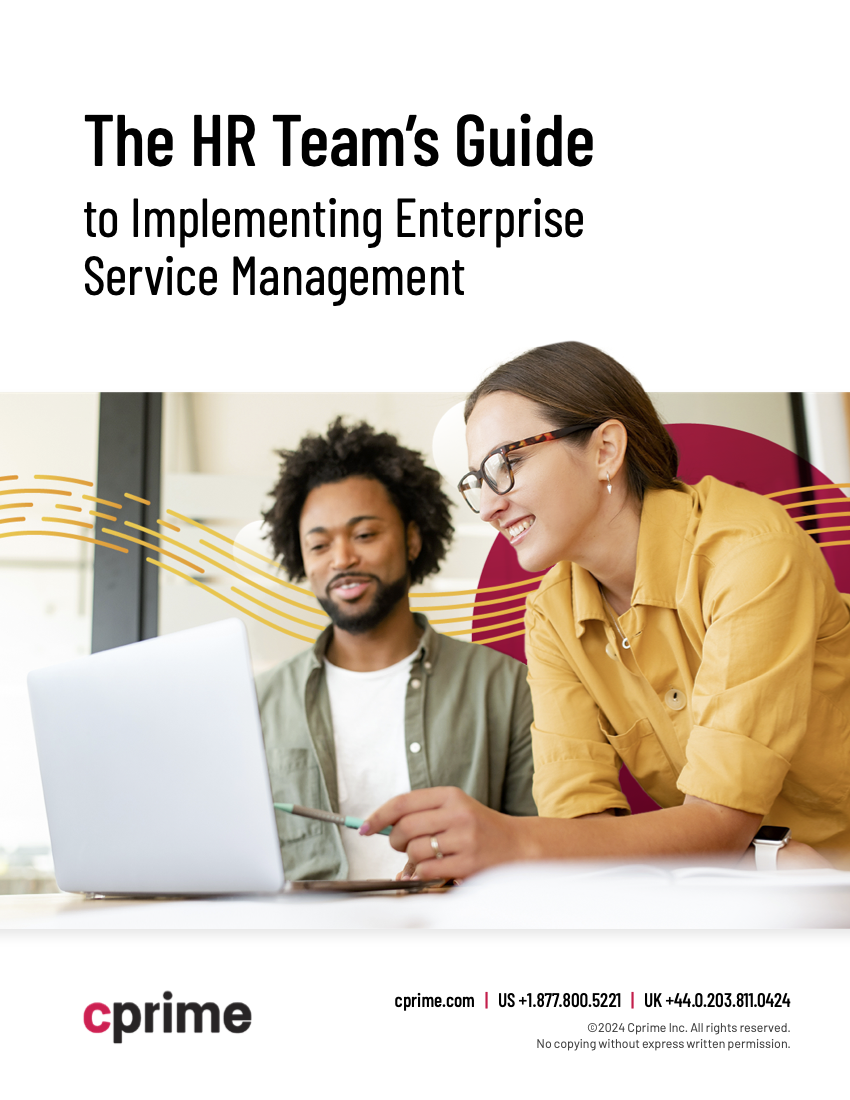
The HR Team’s Guide to Implementing Enterprise Service Management

Introduction

Like nearly all organizations today, you’re struggling to streamline internal processes even as the speed and complexity of the market keeps requiring you to change. Success depends on clear communication, smooth collaboration, and alignment across business units. But this isn’t easy, considering the variety of processes, metrics, and tools various teams use across the organization.

Many companies have discovered that a relatively new concept, Enterprise Service Management (ESM), offers significant benefits. It’s proving to be a healthy step toward the optimal state of enterprise agility the modern organization must strive for.

One of the most important aspects of ESM is the fact that it unites and aligns departments across the organization with one tool stack and one set of processes. So, if your Human Resources team could benefit from streamlining and alignment of your internal and external service offerings, ESM should be high on your priority list.

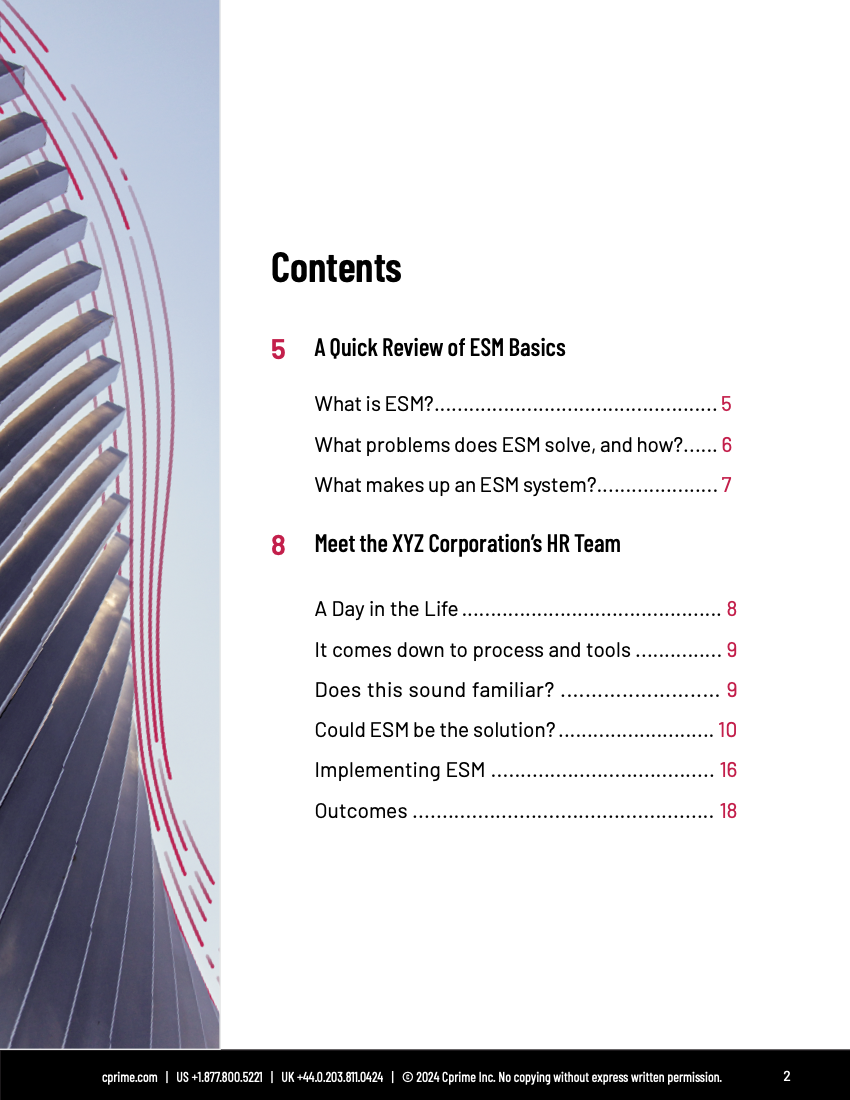
In the first white paper in this series, Your Practical Guide to Enterprise Service Management, we provided a primer explaining:

  • What Enterprise Service Management is
  • What is required to craft a basic ESM system
  • Why your company should consider pursuing this program, and
  • A simple three-step process for successful implementation

In this white paper, we’ll:

  • Introduce you to the hard-working HR team at XYZ Corporation
  • Describe their current situation (which you may find very familiar)
  • Consider why and how they decided to pursue ESM
  • Lay out how they prepared for implementation, what challenges they faced, how these were overcome, and the outcomes they achieved
  • Reveal how you can follow suit in your own organization

Download the full white paper now to keep reading! –>

How to Structure Your Lean Portfolio For LPM Success

Executive Summary

Business agility: The ability to pivot quickly and efficiently based on customer feedback and changes in the market with a focus on delivering value to the customer.

This is—or certainly should be—leadership’s goal in every modern organization. The market simply moves too fast to succeed with any other aim. 

For smaller organizations with one or a small handful of related products, learning and applying some basic Lean and Agile principles can accomplish this goal. That’s why startups are traditionally so much more nimble than large enterprises. But business agility is well within the grasp of even the largest organizations when they establish and maintain a strong but flexible structure for maintaining strategic alignment and supporting Lean and Agile practices at all levels of the enterprise.

Lean Portfolio Management (LPM) is a proven method for doing just that.

What you will learn in this white paper

The first white paper in this series offered a primer for those new to the concept of Lean Portfolio Management. It covered what it is, why it’s vital for enterprises today, and the fundamentals required to set up a new LPM program.

If you haven’t already read it, and think you’d benefit from that information, download it here.

In this white paper, we take you beyond the fundamentals into a discussion of how to best structure your portfolio so that it’s optimized for your unique situation and business goals. We’ll be looking at it through the lens of how a strategic coach would analyze and prioritize your setup and get your teams and portfolios aligned effectively.

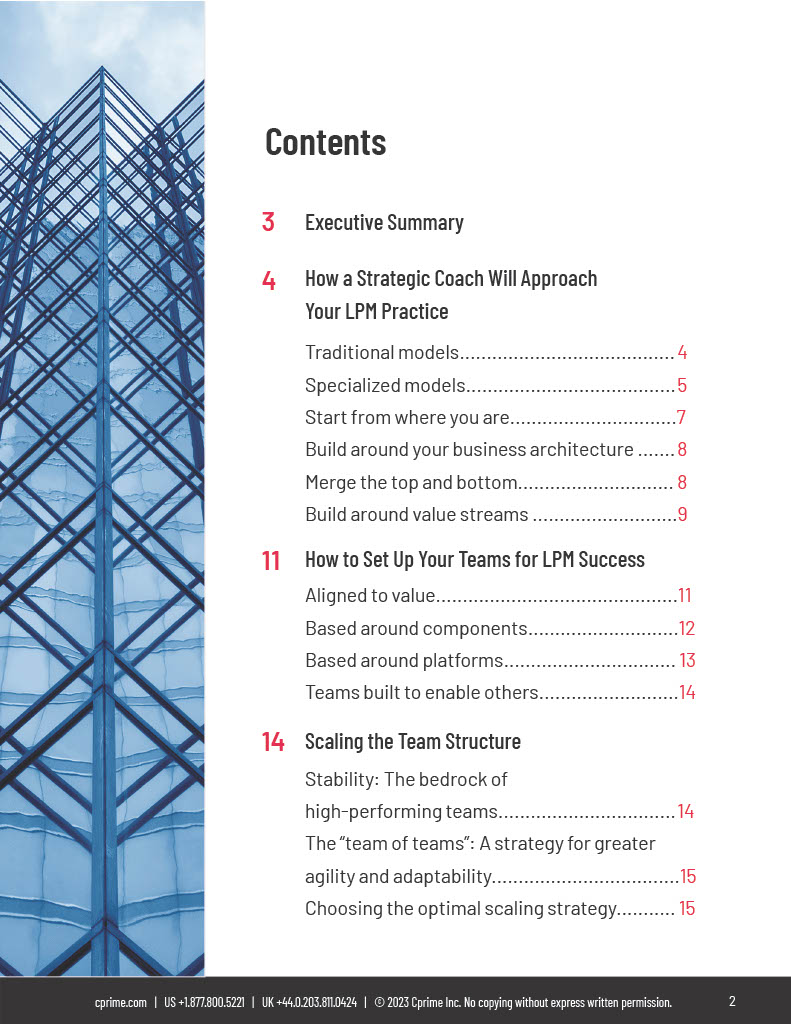
We’ll cover:

  • Four approaches to quickly establishing an optimal LPM structure
  • How to set up and upskill your teams for LPM success
  • How to best scale your team setup to work at the enterprise level

By the end, you’ll understand how to best structure a portfolio to help boost your speed to market, strategic alignment, and overall value delivery across the enterprise.

How a Strategic Coach Will Approach Your LPM Practice

No two companies are exactly the same. There are countless nuances involved in structuring the optimal LPM practice for each organization. So, if a consultant comes in and recommends some cookie-cutter plan they’ve used a thousand times, don’t be fooled. However, there are some basic approaches that can be used, combined, and customized to unique circumstances. 

Download the full white paper now to keep reading! –>

The AI Revolution in Financial Services: Which Side of History Are You On?

In an era where technology is the cornerstone of business innovation, the financial services industry is undergoing a transformative shift. The market is going to look significantly different in three years, and the survival of key players in the industry hangs in the balance.

Three catalysts for this change are Artificial Intelligence (AI), machine learning, and generative AI. This article aims to provide an in-depth look into how these technologies are not just buzzwords but essential tools for financial institutions.

Download this white paper now to explore their applications, the advantages they offer, the challenges that come with them, and a roadmap for organizations looking to integrate AI into their operations.

When the dust settles, where will YOUR organization be?

Brochure: Adopting a Product-Led Approach

Maximize product impact to surpass customer expectations and adapt to market demands

Prioritizing what matters is hard. Translating priorities into outcomes is even harder. Enter the Product-led Approach—a new way of working that empowers organizations to break free from traditional project-oriented thinking and embrace the dynamic world of product-focused strategy.

Think of your organization as a hub of valuable products that drive long-term growth. You need to balance the importance of technical health and constraints with innovative strategies that move your business forward. By bringing these together, you’re not just responding to current demands. You’re architecting a future where your products lead the way.

A Product-led Approach is all about adopting a new way of thinking about how you deliver value to your customers, recognizing the differences between Projects and Products, and adapting to best support that. It brings together all aspects of Agility (product, technology, process, and tools) into a unified whole, eliminating fragmented effort and creating a culture of innovation, collaboration, and results.

Download this brochure today to learn more.

The Agile Insurer: AI Strategies for Accelerating Operational Transformation

Executive Summary

To stay competitive in today’s fast-changing business landscape, large enterprises across all industries face mounting pressures to become more nimble, creative, and responsive. The insurance industry is no exception. The accelerating pace of innovation, rapidly evolving consumer behaviors, and intensifying competition mean companies can no longer rely on their scale and existing business models to sustain success.

The stakes could not be higher: 

  • AI has the potential to generate over $1 trillion of additional value for insurance by 2030 according to McKinsey.
  • PwC estimates it could cut insurers’ combined ratio by up to 13.5%. 
  • According to Accenture, 78% of carriers are already piloting AI initiatives.
  • 83% of insurers believe AI will enable them to expand services and value for customers, according to CapGemini.

However, transforming established companies with ingrained legacy processes and siloed departments presents significant challenges. Entrenched ways of working, organizational complexity, and deeply embedded company cultures create inertia and resistance to change initiatives. As a result, many industry-leading incumbents struggle to keep pace with younger, more agile competitors.

Artificial intelligence offers a potentially transformative solution to help large enterprises overcome these challenges and reinvent themselves. Technologies such as AI-powered BI for analytics, machine learning, and natural language processing can provide the tools and capabilities required to break down silos, automate processes, and enable data-driven innovation and decision making. By taking advantage of the scalability, efficiency and predictive powers of AI, legacy organizations can inject new levels of speed, agility, and cost-effectiveness into their operations.

To really capitalize on AI, organizations need to work in an agile way and ensure the work being executed aligns to org initiatives. It’s transformational tech, but layering it onto outdated ways of working won’t help. Agility helps align investments and build the right solutions the right way. Agility is how AI reaches its full potential. – Zubin Irani, CEO, Cprime

This white paper examines the urgent need for change, the barriers faced by established enterprises, and the solutions enabled by artificial intelligence. It provides a blueprint for how AI can be leveraged by large companies to gain a competitive edge, successfully manage digital transformation, and position themselves for success in the future.

The transformative impact of AI in insurance

  • AI will increase productivity in insurance processes and reduce operational expenses by up to 40% by 2030. (McKinsey)
  • AI in the insurance industry generated $2.74 billion in 2021, and is anticipated to generate $45.74 billion by 2031. (Allied Market Research)
  • Claims regulation costs can be reduced with the adoption of AI by 20-30%. (Imaginovation)
  • Processing costs can be cut by 50-65% (Imaginovation)
  • Processing time can be expedited by 50-90% while improving the customer service experience. (Imaginovation)
  • 87% of customers say claims processing effectiveness influences their decision to renew the insurance with the same insurer. (EY)

Improving Operational Agility

Large companies often struggle with ingrained processes, organizational silos, and slow-moving decision making. This makes it difficult to react quickly to market changes and new customer demands. AI can help insurers become more operationally agile in the following ways:

  • Automating processes with robotic process automation (RPA) – Software bots can be trained to handle high volume, repetitive tasks like claims processing, paperwork, and customer onboarding. This frees up employees to focus on higher value work. An example is Japan-based Fukoku Mutual Life Insurance which uses IBM’s Watson AI to automate 30% of its workloads including payout calculations and policy amendments.
  • Breaking down data silos – Insurers often have customer data trapped in different legacy systems and departmental silos. Using AI for enterprise-wide data integration and analytics helps break down barriers and provide a 360-degree view of the customer. Allianz Germany leveraged AI to integrate disparate datasets and gain a more holistic understanding of its retail banking customers.
  • Enabling faster decisions – AI can rapidly analyze both structured and unstructured data to uncover insights that human analysts might miss. This augments human judgment and allows quicker responses to emerging trends and issues. Geico uses AI and machine learning to rapidly process claims and accelerate payouts to customers.
  • Supporting Agile practices – AI capabilities can optimize Agile processes like rapid application development, iterative product testing, and continuous delivery pipelines. This allows insurers to bring new products and features to market faster. Lemonade built an AI-driven insurance platform and underwriting process from scratch, enabling greater agility than legacy competitors.

By leveraging AI’s data processing and analytical strengths, insurance companies can gain operational speed, flexibility, and responsiveness to outpace competitors. But it requires coupling technology investments with cultural change towards cross-functional collaboration and flatter organizational structures.

Download the full white paper now to keep reading! –>

The Non-Technical Product Manager’s Guide to Technical Product Management

Technical Product Management Table of Contents

Executive Summary

  • Why is everything moving so slow?
  • Why are the engineers not finishing the work that’s planned? (Only five stories in a week? Really?!)
  • Why can’t they answer these questions without resorting to a bunch of technical mumbo jumbo?

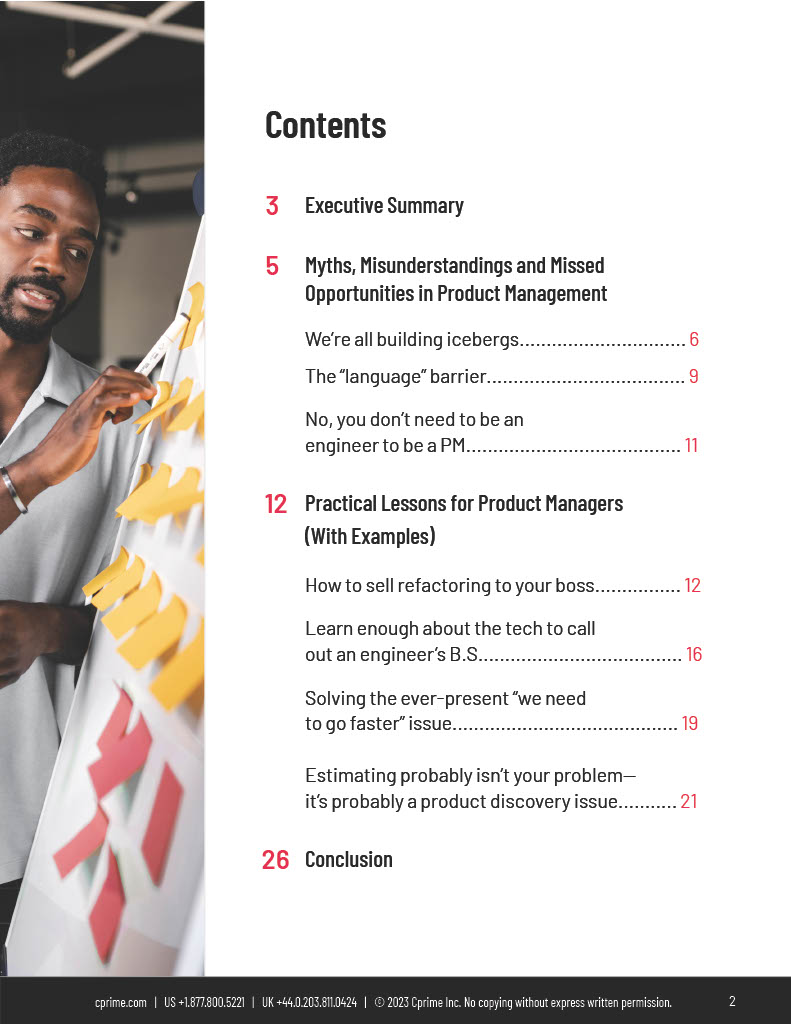
This paper is geared toward Product Managers (PMs) in the software space who want to maximize the value their teams are delivering across the whole product. That’s you, right? That’s all of us, really. It seems simplistic and obvious, but if you’re like me, you routinely run into roadblocks keeping you from achieving this basic and necessary goal. 

The issue is especially difficult when the product isn’t a sexy mobile app with a gorgeous UI. In fact, your product may not have a UI at all. How do you go about effectively managing a product when you’re changing spark plugs (refactoring, for example) instead of applying a shiny new coat of paint (exciting new features)?

It took some time and some tough learning experiences (aka failing hard), but I’ve compiled some practical tips that I think will help you face and overcome these challenges so you can really bring your product management practice to the next level. I’ll be covering some myths, misunderstandings, and missed opportunities that are probably plaguing you daily. Then, I’ll drill down to some specific lessons and examples from my experience as a product manager and product agility consultant.

When you finish this paper, I hope you’ll:

  1. Understand why PMs must own the entire product—we need to understand how the tech affects the product and impacts the customer experience
  2. Learn how to converse with engineers intelligently and collaboratively about the technology (even if you’re not a former coder), and with executives about the business strategy 
  3. Have a better grasp on product discovery, creating optimal backlogs for technical work, and organizing the full product development workflow around customer value

It should take you about 20 minutes to read the whole thing. But, I know you’re busy. Feel free to take it in chunks. So, let’s get started!

Download the white paper to keep reading! –>

Modern Learning for Modern Learners

Why Companies Need to Adapt, and How to Do It

The traditional two-, three-, or four-day Instructor Led Training (ILT) course has served us well. It still will; it is not going away because it has many advantages.

However, methods that worked in the past aren’t always the best option in the modern world of work. Changes in technology, learning needs, and the preferences of learners all necessitate taking a fresh approach to learning in the workplace.

In this white paper, we’ll consider:

  • Why we need to change learning for our people
  • Why we need to change learning for our organizations
  • When to incorporate models and techniques in modern learning
  • How Learning Academies embrace modern learning

Decentralizing Authority for Successful Digital Transformations

One of the most fundamental but overlooked aspects of effective digital transformation is the extent to which decision-making authority is decentralized. Decentralization of decision-making authority involves the greater distribution of power and accountability to teams, enabling faster and more effective decision-making, increased innovation, better engagement, and improved organizational agility.

Can your teams make the necessary decisions to pivot to maximize value when they have enough data that tells them to do so?

In the first half of this paper, we will cover why decentralization of decision making is vital in today’s business environment, and some fundamentals around how to prepare for and execute decentralization. Then, in the second half of this paper, we will explore key concepts about how organizations can effectively test, implement, and scale a decentralized structure while tracking and evaluating its success to maximize potential impact and mitigate risks early and often.

To learn more, download this whitepaper today!

The Future of IT Service Management

Stay ahead of the curve in IT automation, security, and ITSM processes.

As technology evolves, the demands placed on IT service management processes are constantly changing.

In this unique research report conducted by enterprise software provider Appfire and global consulting firm Cprime, in partnership with the market research experts at Adience, we’ll dive into pressing ITSM topics like:

  • Automation for ITSM processes
  • SLA management and improvement of KPIs
  • Why aren’t more organizations automating?
  • The benefits and challenges of distributed teams, and security in an increasingly remote world
  • Migrations from self-hosted servers to the cloud and other options
  • Unlocking business opportunities for growth with ITSM