
Author: Justin Lambert

Atlassian Rovo FAQ

PLEASE NOTE: Atlassian Rovo is evolving rapidly as Atlassian expands AI capabilities across Jira, Confluence, and connected enterprise tools. Features, integrations, availability, and workflows may vary based on your Atlassian products, subscription tier, admin configuration, and current Atlassian releases. 

Getting started with Atlassian Rovo 

What is Atlassian Rovo? 

Atlassian Rovo is Atlassian’s AI solution for enterprise search, chat, agents, and workflow assistance. It helps teams find knowledge across Atlassian and connected third-party tools, ask questions in natural language, summarize information, and use AI agents to support work inside tools like Jira and Confluence. 

How do I access Atlassian Rovo in my Atlassian Cloud instance? 

Users can access Atlassian Rovo through supported Atlassian Cloud products when Rovo is available and activated for their site. Once enabled, users can open Rovo Chat via the chat icon in the bottom-right corner, search from the top navigation bar, or utilize Rovo Studio. Access depends on your organization’s Atlassian plan, admin settings, product availability, and permissions. 

Is Atlassian Rovo included in my Jira or Confluence subscription plan? 

Yes. Rovo in all its forms is automatically included in every paid Cloud plan, including Jira, Confluence, and Jira Service Management. The range of features depends on your Atlassian Cloud plan, product configuration, and Atlassian’s current packaging. Organizations should verify eligibility through Atlassian Administration or current Atlassian documentation. 

What is the difference between Rovo AI Search, Rovo Chat, and Rovo Agents? 

Rovo AI Search helps users find information across Atlassian and connected third-party tools. Rovo Chat lets users ask natural-language questions, summarize information, and get contextual assistance. Rovo Agents are configurable AI teammates designed to help users complete specific tasks, support workflows, and take action based on defined instructions and knowledge sources. 

What is the difference between Atlassian Intelligence and Atlassian Rovo? 

Atlassian Intelligence and Atlassian Rovo are closely related, but they are not the same thing. Atlassian Intelligence is the underlying AI capability embedded within Jira, Confluence, and other Atlassian products, while Rovo is Atlassian’s broader AI solution for enterprise search, chat, agents, and cross-platform workflow assistance across both Atlassian and connected third-party tools. 

Rovo AI Search and knowledge discovery 

How does Rovo AI Search work? 

Rovo AI Search uses natural-language search to help users find information across Atlassian products and connected third-party apps. It draws from indexed sources, permissions, relevance signals, and work context to surface results that are more useful than keyword matching alone. 

Jira and Confluence search are primarily focused on content within those individual products, and will generally locate exact text matches with limited search operators. Atlassian Rovo uses natural language and semantic understanding to provide a broader AI-powered search experience that can connect knowledge across Jira, Confluence, and approved third-party tools, helping users find information across a larger work context. 

Rovo AI Search only surfaces information the user is allowed to access and that has been indexed or connected properly. Missing results may be caused by permissions, connector configuration, indexing delays, product availability, deleted content, or content that is outside the connected knowledge sources. 

How does Atlassian Rovo decide what content appears in search results? 

Atlassian Rovo uses factors such as search intent, content relevance, user permissions, available connectors, and indexed knowledge sources to determine which results appear. It leverages the Teamwork Graph—Atlassian’s proprietary data layer—to surface the most relevant information based on context. Users should only see content they are authorized to access under existing Atlassian and connected-app permissions. 

How often does Atlassian Rovo refresh or index content? 

Atlassian Rovo continuously indexes content across Atlassian tools like Jira and Confluence. For connected third-party platforms such as Google Drive, SharePoint, and Slack, Rovo uses admin-configured connectors to regularly sync and update searchable content. 

Can Atlassian Rovo connect to Slack, Google Drive, SharePoint, or other external tools? 

Yes. Atlassian Rovo can connect to approved third-party tools through Rovo connectors and the Atlassian Teamwork Graph. Supported connections include tools such as Google Drive, SharePoint, Slack, GitHub, Microsoft Teams, and other enterprise apps. If you find that a connector is available from Atlassian, but not in your instance, check with your Atlassian Cloud admin. 

Rovo security, permissions, and governance 

Does Atlassian Rovo respect Jira and Confluence permissions? 

Yes. Atlassian Rovo is designed to respect existing permissions in Jira, Confluence, and connected tools. Users should only see content they already have permission to access, which makes permissions hygiene an important part of any Rovo rollout. 

Is company data used to train Atlassian Rovo or Atlassian Intelligence models? 

Atlassian states that customer data sent to AI models through Rovo is used to generate a response, not to train third-party AI models. Organizations should still review Atlassian’s current data handling, privacy, and residency documentation to confirm how their data is processed in their specific environment. 

What security and compliance considerations should organizations understand before using Atlassian Rovo? 

Organizations should review permissions, connected data sources, admin controls, AI usage policies, data residency requirements, and compliance obligations before deploying Rovo broadly. Rovo respects existing permissions, and customer data is never used to train LLMs. It’s important to note that the Atlassian Cloud Platform complies with SOC 2 and ISO 27001, but is not HIPAA compliant at this time. 

How can enterprises govern AI usage in Atlassian Rovo? 

Enterprises can govern Atlassian Rovo through admin controls, permissions management, and AI governance settings within Atlassian Administration and Rovo Studio. Organizations can control access to AI features, manage who can create Rovo Agents, and align Rovo usage with existing security and compliance policies. 

Rovo Chat, AI responses, and reliability 

What is Rovo Chat and how does it work? 

Rovo Chat is an AI assistant built into Atlassian tools that functions like other popular GenAI chatbots like ChatGPT and Claude, so the learning curve should be short. Rovo Chat uses available work context from Atlassian and connected third-party apps. Users can ask questions, summarize information, draft content, find relevant work, and get help based on content they are permitted to access. 

How accurate are Atlassian Rovo responses? 

Rovo responses depend on the quality, freshness, and completeness of the information it can access. While useful for fast discovery and drafting, Rovo struggles with complex counting tasks and deterministic, multi-step workflows. Like other AI systems, Rovo should be used with human review, especially for business-critical, compliance-sensitive, or customer-facing decisions. 

Why does Atlassian Rovo sometimes generate incomplete or outdated information? 

Rovo may generate incomplete or outdated answers when source content is incomplete, stale, poorly structured, not yet indexed, or unavailable because of permissions or connector limitations. Better knowledge hygiene, current documentation, and well-managed permissions can improve answer quality. And, Atlassian Rovo is subject to the same occasional issues other natural language AI engines face, including hallucinations. 

Can Atlassian Rovo execute actions in Jira or only provide answers? 

Rovo can support actions and workflow assistance in Jira through supported agents, automations, and configured workflows. Depending on your organization’s security and governance requirements, Rovo Agents can either operate autonomously or require human approval before executing sensitive or irreversible actions. 

How does Jira Intelligence work with Atlassian Rovo? 

Rovo extends AI-powered capabilities inside Jira (Jira Intelligence) by going beyond immediate issue-level tasks to help users search across systems, summarize information, automate routine tasks, and connect work across Jira, Confluence, and other integrated tools. 

How does Confluence Intelligence work with Atlassian Rovo? 

Atlassian Rovo powers many of the AI capabilities within Confluence, including intelligent search, content generation, and workflow assistance. By connecting knowledge across Confluence, Jira, and integrated third-party tools, Rovo helps teams surface relevant information and act on it more efficiently. 

Rovo Agents and automation 

What are Atlassian Rovo Agents? 

Rovo Agents are configurable AI teammates that help teams reduce repetitive work, automate tasks, and move work forward more efficiently. They can assist with activities like summarizing information, creating or updating Jira issues and Confluence pages, supporting workflows, and surfacing insights across Atlassian and connected third-party tools. 

How do I create a Rovo Agent? 

Users with the right permissions can create a Rovo Agent by opening Atlassian Studio from the app switcher, selecting Agents, and choosing Create Agent. From there, define the agent’s purpose, configure its instructions and knowledge sources, and add skills to support specific workflows and tasks. 

What are the best real-world use cases for Rovo Agents? 

Common Rovo Agent use cases include summarizing Jira issues, generating Confluence updates, assisting with support triage, preparing release notes, analyzing customer feedback, creating test cases, answering internal knowledge questions, and helping teams reduce repetitive coordination work. 

Can Rovo Agents take actions in Jira or only provide recommendations? 

Rovo Agents can support actions in Jira when configured through supported workflows, skills, plugins, or Atlassian Automation. These can include organizing backlogs, creating epics, updating trackers, and logging work, for example. The specific actions available depend on agent configuration, permissions, product capabilities, and admin settings. 

How does Rovo Automation work in Jira Service Management and Jira Software? 

Rovo Automation connects AI capabilities to Jira Software and Jira Service Management workflows, helping teams reduce repetitive work and automate common tasks. Organizations can use Rovo actions and AI agents to summarize issues, support ticket workflows, generate updates, assist with software delivery, and build automation rules using natural-language prompts. 

What are the current limitations of Atlassian Rovo and Rovo Agents? 

Atlassian Rovo and Rovo Agents are designed to improve search, automation, and workflow efficiency across the Atlassian ecosystem, but they still require human oversight and well-structured data. Organizations may encounter limitations around complex cross-platform automations, large-scale data processing, advanced customization, and governance as AI usage expands across teams. 

Atlassian Rovo adoption and enterprise use cases 

What are the best Atlassian Rovo use cases for software development teams? 

Software development teams can use Atlassian Rovo to accelerate planning, reduce repetitive engineering work, lessen costly context switching, and surface knowledge across tools like Jira, Confluence, Bitbucket, and VS Code. Common use cases include implementation planning, code generation assistance, automated pull request reviews, release note creation, backlog organization, and contextual search across connected systems. 

How are organizations using Atlassian Rovo for IT support or incident management? 

Organizations can use Atlassian Rovo to summarize incidents, support ticket triage, surface relevant knowledge articles, assist service agents, automate repetitive updates, and help teams connect support activity with related Jira, Confluence, and third-party information. 

How can organizations improve adoption of Atlassian Rovo across teams? 

Organizations can improve Atlassian Rovo adoption by integrating AI into existing workflows, establishing clear governance, and focusing on practical, high-value use cases. Successful rollouts typically combine executive support, hands-on Rovo onboarding training, clean and well-structured data, internal AI champions, and ongoing feedback to help teams use Rovo effectively in their daily work. 

What does a successful Atlassian Rovo rollout look like? 

A successful Atlassian Rovo rollout typically starts with targeted, high-value use cases before expanding across teams and workflows. The most effective deployments combine executive sponsorship, practical training, clear governance, measurable adoption goals, and ongoing feedback to help teams integrate Rovo naturally into their daily work. Working with an experienced Atlassian Partner can make for a quick and successful Rovo rollout.  

Business capability management in the age of AI: from static models to decision intelligence 

Business capability management has long relied on enterprise capability models to describe how an organization works, forming a core pillar of enterprise architecture in AI-enabled environments.  

These models provide a shared view of business capabilities, support investment planning, and align transformation efforts. They are typically owned by centralized enterprise architecture teams and updated through structured cycles. As enterprise architecture AI capabilities mature, these models are becoming more central to how organizations interpret performance and guide decision-making. 

That foundation still matters. What changes in the age of AI is how those models behave, how often they evolve, and how they inform decisions. 

Capability models evolve into AI-enabled capability mapping 

Traditional capability models are built through workshops, curated manually, and revisited periodically. They reflect a point-in-time understanding of the enterprise. 

AI introduces a different operating dynamic. 

This shift enables a form of AI capability mapping, where capabilities are continuously inferred, updated, and connected to real execution data. 

By drawing on process telemetry, system interactions, financial data, customer behavior, and workforce signals, capability models can be continuously informed by how the business actually operates. Instead of relying on periodic interpretation, the model reflects live conditions. 

This shift changes how leaders use enterprise architecture in decision-making. 

  • Capability gaps become visible as they emerge 
  • Redundancy across business units can be identified in real time 
  • Performance degradation surfaces through measurable signals 
  • Automation opportunities become easier to prioritize 
  • Investment scenarios can be explored with greater confidence 

The model becomes a continuously updated representation of enterprise capability, grounded in execution rather than documentation. 

For enterprise architecture, this changes the work itself. The role moves from building and maintaining diagrams to governing how capability intelligence is generated, validated, and used. 

From qualitative assessment to measurable performance 

Capability maturity has often been assessed through qualitative methods. Stakeholder interviews and workshop-based scoring produce heatmaps that reflect perception as much as performance. 

Enterprise architecture AI capabilities enable a different level of precision. 

Capability health can be measured using operational data such as cycle time, error rates, cost-to-serve, automation ratios, and risk exposure. These signals provide a direct view into how capabilities perform under real conditions. 

This changes the questions leadership can ask. 

Instead of relying on subjective assessment, leaders can evaluate the impact of specific changes. 

  • What happens to margin if automation increases in a key process? 
  • Where does performance degrade when demand spikes? 
  • Which capabilities constrain enterprise outcomes today? 

Business capability management begins to support predictive and prescriptive decision-making, not just descriptive modeling. 

New capabilities reshape the enterprise model 

AI does not only improve visibility into existing capabilities. It introduces entirely new ones that must be treated as first-class elements of the enterprise. 

These include areas such as: 

  • Model lifecycle governance 
  • AI risk and ethics management 
  • Data product management 
  • Prompt engineering and human–AI interaction design 
  • Autonomous operations oversight 

These capabilities influence how decisions are made, how risk is managed, and how work is executed. These emerging capabilities also introduce the need for structured AI adoption governance, ensuring that new capabilities are used responsibly, consistently, and at scale across the enterprise. Treating them as technical sub-functions limits their impact. They operate at the level of enterprise capability and require the same clarity, ownership, and investment discipline as any other strategic function. 

The role of enterprise architecture shifts toward governance and decision enablement 

Enterprise architecture does not lose relevance as AI becomes more embedded in the enterprise. Its scope expands. 

The focus shifts toward governing how the organization understands itself and how that understanding informs decisions. 

This includes: 

  • Defining and maintaining a consistent capability ontology 
  • Ensuring semantic alignment across systems and data sources 
  • Clarifying decision rights between human and AI-supported processes 
  • Connecting capability performance to measurable business outcomes 

Architecture becomes a mechanism for decision clarity, not just structural alignment. 

This aligns directly with how modern operating models must function. Enterprise performance depends on how decisions move, how work flows, and how signals translate into action across the organization. 

Why this shift matters for enterprise performance 

Most organizations have already invested in digital platforms, agile delivery models, and AI experimentation. Yet outcomes often lag behind expectations. 

The constraint is rarely the absence of capability. It is the lack of connection between capabilities, decisions, and execution. 

When business capability management remains static, leaders operate with delayed or incomplete insight. Investment decisions rely on interpretation rather than signal. Execution teams absorb the consequences through rework, delays, and misalignment. 

When capability models evolve into continuously informed systems: 

  • Decision-making becomes faster and more grounded in evidence 
  • Investment aligns more directly with measurable outcomes 
  • Execution improves as constraints are identified earlier 
  • AI can support human judgment with relevant, contextual insight 

This is where enterprise architecture connects directly to enterprise value. 

The emerging model: architecture as enterprise cognition governance 

As capability models become continuously informed and decision-oriented, business architecture takes on a new role. 

It governs how the organization understands itself in real time and how that understanding shapes action. 

This includes: 

  • Integrating data, systems, and workflows into a coherent view of capability 
  • Embedding insight into decision flow across leadership layers 
  • Ensuring that AI-generated signals support, rather than replace, human judgment 
  • Maintaining continuity as the organization evolves its operating model 

Architecture becomes part of the enterprise’s execution system. 

When capability models become decision systems 

Business capability management remains essential. What changes is how they are used. 

They move from static representations of structure to continuously informed systems that support decision-making. 

Organizations that make this shift gain the ability to understand, simulate, and adjust how the business operates as conditions change. 

That changes how decisions are made, how work is executed, and how value is realized over time. 

It also marks a broader transition already underway across enterprises. As AI capabilities expand, the limiting factor becomes the operating model that surrounds them. Organizations that adapt how they structure decisions, workflows, and governance convert capability into sustained performance. Those that connect business capability management with enterprise architecture AI, operating model redesign, and AI adoption governance create the conditions for sustained, scalable performance. 


See how your operating model supports AI-enabled execution

Most organizations introduce AI capabilities before they understand whether their operating model can support them at scale. The result is uneven adoption, unclear decision ownership, and stalled outcomes. 

The AIFirst Operating Model Design Assessment helps you identify where decision flow, governance, and workflows constrain performance, and where targeted changes will unlock measurable impact. You gain a clear view of how work, decisions, and accountability need to evolve to support AI-enabled execution. 


Frequently asked questions about business capability management

What is business capability management? 

Business capability management is the practice of defining and organizing what an organization does into structured capabilities. It provides a shared view of how work is performed, enabling leaders to align strategy, investment, and execution across the enterprise. 

How does AI change business capability management? 

AI enables capability models to be continuously updated using real operational data. Instead of static diagrams, organizations can monitor performance, detect gaps, and explore improvement scenarios in real time, making capability management more actionable and decision-focused. 

What is AI capability mapping? 

AI capability mapping uses data from systems, processes, and workflows to dynamically identify and update business capabilities. It connects how work is actually performed to how capabilities are structured, improving visibility into performance, redundancy, and opportunities for automation. 

Why is enterprise architecture important for AI? 

Enterprise architecture ensures that AI capabilities align with how the organization operates. It governs data, systems, and decision structures so AI supports real workflows, improves decision quality, and scales consistently across teams. 

What is AI adoption governance? 

AI adoption governance defines how AI is used responsibly and consistently across the enterprise. It includes policies, decision rights, and oversight mechanisms that ensure AI supports human judgment, reduces risk, and delivers measurable outcomes. 

How does operating model redesign support AI adoption? 

Operating model redesign aligns decision flow, governance, and workflows with AI-enabled execution. Without these changes, AI initiatives often remain isolated or underused, limiting their impact on performance and value realization. 


AI governance at operating speed: resolving the control vs speed gap in AI execution 

AI governance failures rarely begin with model quality. Most begin when execution starts moving faster than governance systems can respond. 

Enterprise AI initiatives are accelerating decision cycles, workflow automation, and operational execution across business functions. At the same time, governance models in many organizations still depend on layered approvals, disconnected oversight structures, and review cycles designed for slower operating environments. 

This creates a structural conflict between speed and control. 

Some organizations accelerate execution at the expense of consistency, accountability, and visibility. Others apply governance controls so heavily that adoption slows and enterprise value fails to scale. 

The central challenge is whether governance systems can operate at the same speed as AI-enabled execution. 

That tension is becoming increasingly visible as enterprise AI investment accelerates faster than operating model readiness. According to Gartner’s 2026 AI spending forecast, global AI spending is expected to reach $2.5 trillion in 2026. Meanwhile, the BCG AI Radar 2026 report shows that most enterprises remain early in scaling AI operationally, while only a small percentage report measurable enterprise value realization. 

For enterprise leaders responsible for operational performance, transformation outcomes, and risk management, this tension is becoming increasingly difficult to ignore. 

Why traditional AI governance models break under execution pressure at scale 

Most enterprise governance systems were designed for environments where operational changes occurred in controlled cycles and decisions moved more slowly across the organization. 

AI changes that cadence. 

Workflows now adapt continuously. Decisions move faster across systems, teams, and channels. Execution no longer pauses for governance reviews to catch up. 

Many organizations still govern AI through structures that sit outside operational workflows, including approval boards, manual escalation paths, disconnected audit processes, and periodic reporting cycles. 

These controls create visibility, but they also introduce latency into execution. 

As AI adoption expands, governance teams often respond by adding more checkpoints and approvals. Operational teams respond by bypassing those controls to maintain delivery speed. 

The result is a governance gap where execution accelerates while accountability becomes fragmented. 

This breakdown appears in several common patterns. 

Governance lags behind execution cadence 

AI-enabled workflows generate decisions continuously, yet governance reviews often occur weekly, monthly, or after deployment. 

By the time issues surface, operational conditions have already changed. 

Recent reporting on enterprise governance readiness highlights how widespread this problem has become. Axios noted that nearly 80% of executives believe their organizations would struggle to pass an AI governance audit despite widespread AI deployment activity. 

AI pilots operate without operational ownership 

Many organizations still treat AI initiatives as isolated innovation efforts instead of operational capabilities embedded into workflows. 

Ownership becomes distributed across technology, data, risk, and business teams without clear accountability for outcomes. 

Execution continues while governance remains fragmented. 

This pattern frequently appears when organizations focus on AI usage without redesigning workflow accountability or governance structures. Internal operating model assessments repeatedly show that enterprises struggle when AI remains a “tool layer” rather than becoming part of how workflows execute and how operational ownership functions across teams. 

Decision flow becomes increasingly complex 

As workflows expand across departments, approval structures multiply. 

Operational teams encounter duplicated approvals, unclear escalation paths, inconsistent policy interpretation, and conflicting governance priorities. Work slows at handoffs instead of progressing continuously. 

Activity replaces outcome measurement 

Organizations frequently measure pilot volume, adoption counts, automation activity, and deployment metrics while overlooking whether operational performance is actually improving. 

Without workflow-level measurement, organizations struggle to determine whether AI is increasing efficiency or simply increasing system complexity. 

How embedded governance changes AI execution 

Effective AI governance requires controls that operate within workflows themselves. 

Governance must function as part of execution itself. 

Embedded governance changes how control operates across workflows, decisions, and operational systems. Instead of relying on delayed oversight, governance becomes part of how work moves in real time. 

This shift affects the operating model itself, not just the supporting technology. 

An AI operating model defines how work flows, how decisions move, how accountability functions, and how escalation paths operate across teams and systems at scale. 

When governance is embedded into workflows, control no longer depends on slowing execution. 

Controls operate continuously during execution itself through mechanisms such as automated policy validation, workflow-level monitoring, real-time audit capture, threshold-based escalation, exception routing, and role-aware approvals. 

Most operational decisions move without delay. Exceptions route immediately to designated owners. 

This structure allows organizations to maintain consistency without creating operational bottlenecks. 

The shift toward embedded governance is increasingly reflected in enterprise governance models. BigID’s analysis of agentic AI governance trends notes that organizations are moving away from periodic oversight toward real-time governance approaches where monitoring, auditability, and operational controls function continuously during execution. 

Within this model, AI supports execution by accelerating workflow coordination, surfacing recommendations, identifying anomalies, reducing manual friction, and improving operational consistency. 

Human accountability remains explicit. 

Operational leaders still own escalation decisions, policy interpretation, workflow governance, exception handling, and performance outcomes. 

AI improves execution speed. Governance ensures that speed remains controlled, visible, and accountable. 

How a decision rights framework determines whether governance enables or constrains execution 

Many governance failures are not caused by insufficient controls. They are caused by unclear decision authority. 

As AI expands across workflows, organizations must define: 

  • what systems can execute automatically 
  • when human intervention is required 
  • who owns operational outcomes 
  • how escalation paths function 
  • where accountability resides 

Without clear decision rights, organizations experience both control and speed failures simultaneously. 

Some workflows accumulate excessive governance friction. Low-risk operational decisions require multiple approvals across compliance, operations, and management layers. Teams wait for authorization while execution slows and workarounds emerge. 

Other workflows operate without clearly defined operational controls. AI-enabled systems operate without clearly defined operational boundaries, which creates inconsistency, policy risk, and reduced trust in execution. 

Both conditions weaken adoption. 

A decision rights framework aligns governance with execution by clarifying ownership around outcomes instead of isolated tasks. This creates faster operational decisions, fewer duplicated approvals, clearer escalation paths, stronger accountability, and more predictable execution. 

The importance of operational ownership is becoming more pronounced as organizations move toward human-plus-agent execution models. Deloitte’s research on operating models for humans and AI agents identifies workforce redesign, role clarity, and operating structure adaptation as major barriers to scaling AI effectively. 

For enterprise transformation leaders, this clarity becomes essential as workflows increasingly span business, technology, data, and risk functions simultaneously. 

AI governance at scale depends less on centralized oversight and more on clearly defined operational authority inside workflows. 

The KPI spine ensures speed produces operational value 

Execution speed alone does not create enterprise value. 

Organizations still need visibility into whether faster execution improves operational outcomes. 

Many AI governance programs fail because measurement remains disconnected from workflow performance. 

Organizations often track automation activity while overlooking indicators such as cycle time, throughput, quality consistency, rework rates, escalation frequency, cost-to-serve, and compliance variance. 

A KPI spine connects governance directly to operational performance across workflows. 

This measurement structure aligns workflow execution, governance controls, operational outcomes, and enterprise priorities around measurable performance improvement. 

For example, an AI-enabled workflow may reduce approval cycle times significantly. If quality declines or escalation rates increase, operational value deteriorates despite higher speed. 

Strong governance systems reinforce execution consistency, operational transparency, measurable outcomes, and accountability visibility. 

This creates a more sustainable path for AI adoption at scale because teams gain confidence that workflows can accelerate without creating uncontrolled operational variability. 

AI governance at operating speed changes how enterprises scale AI 

Traditional governance operates through periodic intervention. 

AI governance at operating speed functions continuously inside execution. 

This changes how organizations monitor performance, manage risk, and adapt workflows over time. 

Continuous governance models rely on: 

  • real-time observability 
  • embedded controls 
  • operational telemetry 
  • predefined escalation paths 
  • workflow-level accountability 
  • continuous feedback loops 

Instead of waiting for retrospective audits or quarterly reviews, governance systems identify issues during execution itself. 

Recent governance research increasingly supports this runtime approach. Emerging frameworks on runtime AI governance argue that static governance structures and retrospective review cycles cannot adequately govern continuously adaptive AI systems operating inside production workflows. 

Research into AI governance control stack models also highlights the growing importance of runtime auditability, drift detection, escalation systems, explainability logging, and workflow-level monitoring to maintain execution stability at scale. 

For example, a workflow can identify anomalous behavior immediately, pause high-risk actions automatically, escalate exceptions to designated owners, and maintain continuity across unaffected processes. 

Governance operates directly within execution workflows through continuous monitoring, escalation, and operational controls. 

This model also strengthens adoption. 

Operational teams are more likely to trust AI-enabled workflows when accountability is visible, escalation paths are clear, controls remain consistent, and governance does not create unnecessary friction. 

The organizations scaling AI most effectively integrate governance directly into execution workflows. 

They are redesigning governance so it operates at the same speed as execution itself. 

Governance becomes a performance capability 

The enterprise challenge is no longer whether AI can accelerate execution. 

The challenge is whether organizations can maintain accountability, operational consistency, governance visibility, decision clarity, and measurable outcomes while operating at significantly higher execution speed. 

Organizations that continue treating governance as a separate oversight function will struggle to scale AI across operational workflows. 

Execution will either become constrained by excessive control or destabilized by insufficient oversight. 

Organizations succeeding with AI at scale are redesigning operating models where governance, workflows, decisions, and accountability operate together continuously. 

This changes the role governance plays inside the enterprise. 

AI governance becomes an execution capability that strengthens coordination, improves operational consistency, reinforces accountability, and enables scalable performance. 

Organizations now need operating models where speed and control function together in real time. 


Build the operating model AI governance requires

AI governance does not scale through policies alone. It scales through operating models that align workflows, decision rights, accountability, and execution around how work actually moves across the enterprise. 

Cprime’s AI-First Operating Model Design engagement helps organizations redesign governance, workflow execution, and operational coordination for AI-enabled environments. The result is a more adaptive operating structure capable of scaling AI execution without sacrificing accountability, visibility, or performance. 


Frequently asked questions about AI governance 

What is AI governance? 

AI governance refers to the policies, controls, workflows, and accountability structures organizations use to ensure AI systems operate safely, consistently, and in alignment with business objectives. Effective AI governance extends beyond compliance documentation and becomes part of how operational workflows execute in real time. 

Why do traditional AI governance models struggle at scale? 

Traditional governance models were designed for slower operational environments built around periodic reviews, manual approvals, and retrospective audits. AI-enabled workflows move continuously, which creates delays, fragmented accountability, and operational bottlenecks when governance remains disconnected from execution. 

What is embedded governance in AI operations? 

Embedded governance integrates controls directly into workflows and operational systems instead of relying on oversight after execution occurs. This can include automated policy validation, workflow monitoring, audit visibility, escalation routing, and real-time controls that operate continuously during execution. 

How does a decision rights framework support AI governance? 

A decision rights framework defines who owns operational outcomes, when human intervention is required, and which actions AI-enabled systems can execute autonomously within approved boundaries. Clear decision authority reduces governance bottlenecks while preserving accountability, consistency, and operational trust. 

What is an AI operating model? 

An AI operating model defines how work flows, decisions move, accountability functions, and governance supports execution across the enterprise. It provides the operational structure organizations need to scale AI consistently across workflows, teams, systems, and business functions. 

Why is governance important for scaling enterprise AI? 

Organizations struggle to scale AI when governance slows execution or fails to maintain operational visibility and accountability. Strong AI governance helps enterprises accelerate workflows, manage risk, maintain consistency, and improve trust in AI-enabled execution without creating unnecessary friction. 

What metrics should organizations track in AI governance programs? 

Organizations should measure operational outcomes rather than focusing only on adoption activity or deployment volume. Useful indicators often include cycle time, throughput, quality consistency, escalation frequency, rework rates, compliance variance, and cost-to-serve across workflows.


What Atlassian Team ’26 revealed about the future of AI-native execution 

Many enterprises already possess significant AI capability. 

Across the enterprise, the larger barrier to scalable AI value is disconnected execution. 

Work still moves through disconnected systems, fragmented workflows, siloed teams, duplicated processes, and operational handoffs that slow decisions long before AI enters the equation. Knowledge sits inside tools, threads, recordings, pages, tickets, and dashboards that rarely function as one operational system. 

Atlassian Team 2026 made that problem strategically important. 

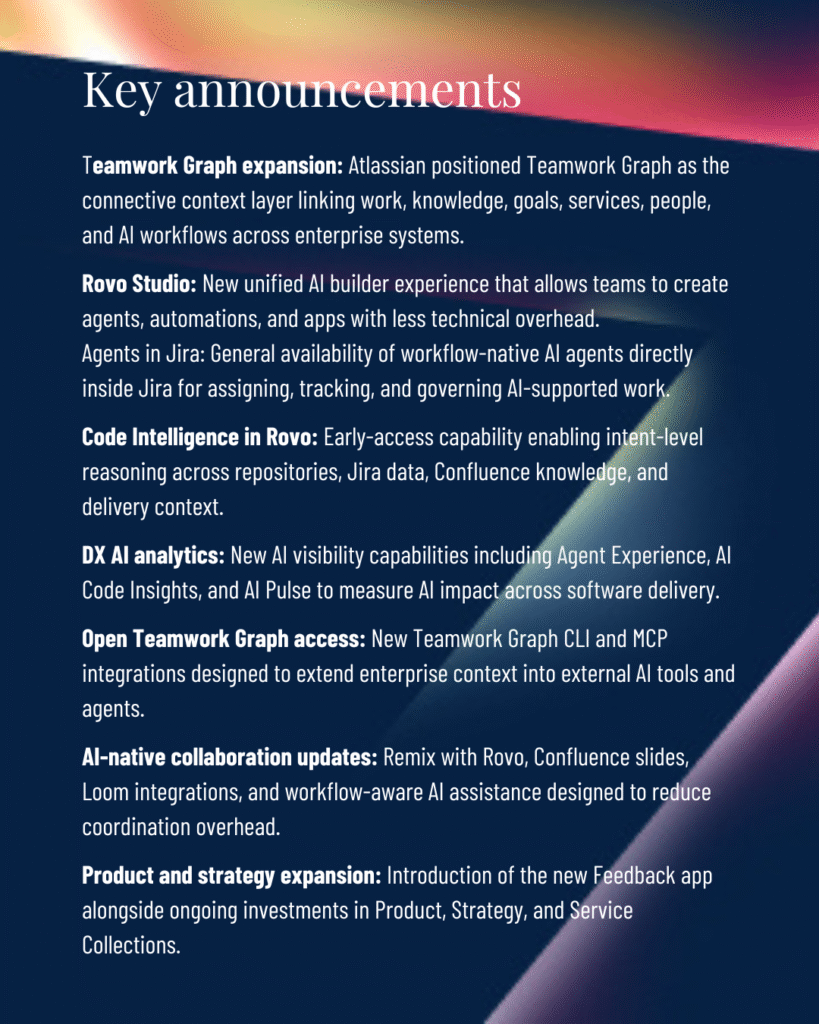
The strongest signal from the event centered on connected operational context, workflow-native AI, and execution visibility grounded in real enterprise work. 

That is why Teamwork Graph deserves executive attention. Operationally, it functions as an enterprise context layer connecting work, knowledge, teams, goals, services, dependencies, decisions, and delivery history so people and AI can operate with clearer visibility across the business. 

Nearly every major theme at Team ’26 pointed back to the same idea: AI becomes more useful when enterprise work becomes more connected. 

Teamwork Graph revealed the next competitive layer in enterprise AI 

Most enterprise AI conversations still focus on models, copilots, agents, prompts, and automation. Those capabilities matter, but Atlassian Team 2026 emphasized a different layer: the relationships between work. 

Why context quality matters 

The event repeatedly reinforced a broader operational reality. AI becomes substantially more useful when it can operate within connected, high-quality context. 

AI tools can generate responses, summarize activity, recommend next steps, and automate repetitive tasks. But in enterprise environments, the usefulness of those outputs depends on the quality of the surrounding context. An AI assistant that cannot understand how a Jira ticket connects to a Confluence decision, how that decision connects to a product goal, how that goal connects to a service dependency, or how that dependency affects delivery risk will remain limited. It may still save time, but it will struggle to support execution at scale. 

Teamwork Graph points to a broader answer. Operationally, it attempts to connect projects, tickets, documentation, conversations, goals, services, decisions, people, dependencies, and work history into a usable enterprise context layer. That context layer matters because work rarely breaks down inside one tool. It breaks down between teams, systems, decisions, and handoffs. 

AI systems struggle when work is disconnected, context is incomplete, and operational relationships remain invisible. Teamwork Graph represents Atlassian’s attempt to address that fragmentation problem at the level where enterprise work actually happens. 

From tools to operational systems 

This direction also reflects a broader platform shift. Jira, Confluence, Loom, Rovo, Atlas, Focus, and Service Collection are increasingly positioned as connected operational systems rather than isolated tools

Each product still serves a clear function, but the larger value emerges when work, knowledge, communication, planning, service delivery, and AI assistance reinforce each other. 

Conversations and demonstrations surrounding Team ’26 reinforced the same pattern. Teamwork Graph repeatedly surfaced as more than an abstract platform concept. Customers responded strongly to practical workflow demonstrations because they could see connected work functioning in real time. The strongest moments were often the moments when attendees connected the demonstration back to familiar visibility gaps inside their own organizations. 

The same pattern appeared around the System of Work Accelerator. When customers saw outputs connected to workflow maturity, collaboration patterns, and operational visibility, the discussion moved quickly from product interest to organizational diagnosis. The question became less about what Atlassian can do in theory and more about where disconnected execution is already limiting the enterprise today. 

One of the clearest shifts emerging from Team ’26 is the market conversation moving beyond the rise of AI agents alone. Enterprise AI value increasingly depends on connected operational context. 

Why disconnected execution is limiting enterprise AI value 

Many enterprises already struggle with: 

  • disconnected workflows 
  • duplicated effort 
  • inconsistent documentation 
  • fragmented service operations 
  • siloed delivery teams 
  • weak execution visibility 

These problems create friction before AI enters the workflow. 

AI does not automatically remove that friction. In many cases, it exposes and amplifies it. 

Connected workflows give AI better operational context. Fragmented workflows force AI to operate around gaps, incomplete relationships, and inconsistent knowledge. That affects trust, usefulness, and adoption scalability

The core challenge now centers on whether the operating environment gives AI enough context to support meaningful work. 

Why Rovo reflects the broader shift 

The shift toward connected execution also explains why Rovo generated so much attention throughout Team ’26. 

Rovo is often discussed in relation to enterprise search, agents, summarization, and workflow support. But its strategic relevance is broader than chatbot-style interaction. Rovo becomes more important when it functions as a context-aware workflow layer that helps people find knowledge, understand activity, coordinate execution, and move through work with less friction. 

The highest-value use cases are not limited to individual productivity. They emerge when AI supports the way teams coordinate, plan, deliver, resolve issues, and make decisions across shared systems of work. 

The customer conversations at Team ’26 reinforced this point. Attendees asked practical questions about Rovo usage, adoption, governance, and workflow fit. Interest centered less on AI novelty and more on operational applicability. Demonstrations resonated when they showed AI functioning inside real workflows rather than sitting beside them as another disconnected tool. 

The “make AI real in 90 days” message appears to have resonated for the same reason. It translated AI from an abstract ambition into a near-term operational challenge. Leaders want to know where to start, what workflows to prioritize, what governance must be in place, and how to connect AI to work people already do. 

The organizations that realize the most value from enterprise AI will likely be the organizations that reduce operational fragmentation first. That makes workflow visibility and connected execution increasingly strategic. 

Atlassian is shifting from work management toward execution visibility 

Atlassian began as a platform for organizing and tracking work. Team ’26 revealed how far that positioning has evolved. 

That shift changes the executive conversation. The company is increasingly focused on connecting strategic goals, project delivery, service operations, documentation, communication, AI assistance, and workflow coordination into a more visible operational system. 

The cost of coordination overhead 

That shift reflects a broader enterprise problem: organizations lose significant execution capacity to coordination overhead. Teams spend time searching for information, reconstructing decisions, reconciling reports, and managing dependencies across fragmented systems. Leaders often lack consistent visibility into how work connects across the business. 

Atlassian’s broader System of Work narrative speaks directly to that challenge. The emphasis on connected teamwork, shared visibility, and alignment between strategy and execution reflects where enterprise platform value is moving. 

The same pattern appeared in booth and theater conversations as well. The System of Work Accelerator generated strong engagement because it gave teams a concrete way to examine the maturity of their Atlassian environment. Customers related quickly to identified workflow gaps because those gaps reflected known operating challenges: unclear ownership, fragmented visibility, disconnected workstreams, inconsistent collaboration patterns, and difficulty translating platform usage into business value. 

Theater conversations around operationalizing connected execution also pointed to a broader market need. Leaders are trying to understand how AI fits into real workflows without creating more complexity. They want AI to reduce coordination friction, improve visibility, and support better decisions. They do not want another layer of disconnected experimentation. 

The strongest response at Team ’26 often came from conversations that translated AI into workflow visibility, coordination improvement, and connected execution. This appears to reflect where the market conversation is heading next. 

The next evolution of enterprise platforms will likely center on making enterprise execution more visible, connected, and context-aware. 

Why cloud modernization is becoming a connected execution decision 

Cloud modernization has often been framed as an infrastructure decision. For many Atlassian customers, that framing is becoming too narrow. 

At Team ’26, cloud conversations increasingly centered on: 

  • operational interoperability 
  • governance continuity 
  • AI scalability 
  • ecosystem readiness 
  • execution visibility 

Those concerns extend well beyond hosting. 

For organizations still operating in legacy or highly customized environments, operational fragmentation often persists through outdated integrations, inconsistent workflows, local workarounds, and limited visibility across systems. As AI-enabled workflows become more important, those limitations become harder to ignore. 

Why AI increases modernization pressure 

Rovo and broader AI adoption may accelerate cloud decision-making because AI value depends on connected, governed, and current operational context. If work remains fragmented across outdated systems, AI adoption becomes more difficult to scale and govern effectively. 

This is especially important in regulated industries, where leaders must evaluate accountability, transparency, permissions, data access, human oversight, and operational continuity alongside technical readiness. 

The cloud discussion increasingly centers on operational connectivity, AI-enabled workflows, scalable execution visibility, enterprise interoperability, and future operational capability. 

For many enterprises, cloud modernization increasingly reflects a decision about how connected and operationally visible the organization can become. 

What enterprise leaders should focus on next 

Enterprise leaders should avoid treating AI adoption as a standalone technology initiative. The more strategic move is to improve the operational systems surrounding execution itself. 

Enterprise leaders should focus on: 

  • visibility across execution 
  • coordination friction 
  • workflow governance 
  • operational connectivity 

Atlassian Team 2026 made that priority clearer. AI-native execution requires workflows, knowledge, teams, services, goals, and governance to operate with enough connection for AI to support human judgment inside real work. 

1. Identify visibility gaps across execution 

Leaders should begin by assessing where work loses visibility across the organization. 

Disconnected workflows, siloed operational data, fragmented knowledge systems, duplicated work, and dependency blind spots directly affect AI usefulness, workflow efficiency, operational trust, and adoption scalability. 

The priority is to identify where the organization lacks shared context. Which teams cannot see related work? Which decisions are difficult to trace? Which reports require manual reconciliation before leaders can trust them? 

AI will inherit the quality of the environment around it. If operational visibility remains inconsistent, AI-supported execution will remain inconsistent as well. 

2. Reduce coordination friction inside high-impact workflows 

Enterprise leaders should prioritize workflows where coordination friction slows meaningful work. 

These are often workflows where cross-functional dependencies create delays, visibility is inconsistent, operational handoffs slow execution, or coordination overhead remains high. Product delivery, service operations, onboarding, portfolio planning, and enterprise change initiatives are common examples. 

The objective is to connect work in ways that reduce unnecessary effort and improve decision flow. Leaders should look beyond tool adoption alone and focus on whether teams and AI systems can clearly understand the relationships between goals, decisions, dependencies, risks, and outcomes. 

When those relationships become clearer, AI can support execution with greater reliability and context awareness. 

3. Build governance into connected workflows early 

AI governance cannot remain separate from the workflows where AI will be used. It must be built into the way work moves. 

This requires organizations to define accountability, workflow transparency, operational governance, adoption enablement, human oversight, and sustainable operating practices early. 

Leaders need clear guidance on where AI can support work, where human judgment remains required, and how AI-enabled workflows will be reviewed and measured over time. 

When governance is embedded into connected workflows, adoption becomes more scalable, trustworthy, and sustainable. 

The enterprises that realize the greatest value from AI-native execution will likely be the organizations that build the clearest operational visibility and strongest workflow connectivity first. 

The clearest signal from Atlassian Team 2026 

Atlassian Team 2026 reinforced a broader shift toward connected execution and AI systems grounded in real operational work. 

The next competitive advantage in enterprise AI may come from building operational environments where work, knowledge, decisions, goals, and workflows are connected clearly enough for AI to participate meaningfully inside execution. 

That was the clearest strategic signal emerging from Atlassian Team ’26. 


See where disconnected work is limiting execution visibility

The System of Work Accelerator helps organizations uncover workflow fragmentation, identify operational visibility gaps, evaluate collaboration maturity, and prepare Atlassian Cloud environments for AI-native workflows. 

Use the free assessment to understand how connected your Atlassian workflows really are and where better visibility could improve execution. 


Frequently asked questions about Atlassian Team 2026 

What happened at Atlassian Team 2026? 

Atlassian Team 2026 focused heavily on AI-native execution, connected workflows, and operational visibility. Major announcements highlighted Teamwork Graph, Atlassian Rovo, workflow-native AI agents, and new approaches for connecting enterprise knowledge, services, goals, and delivery workflows into a shared operational context. 

What is Atlassian Teamwork Graph? 

Teamwork Graph is Atlassian’s connected enterprise context layer that links work, people, knowledge, goals, services, and operational history across systems. It helps AI and human teams operate with better context, visibility, and relationship awareness across enterprise workflows. 

Why is Teamwork Graph important for enterprise AI? 

Enterprise AI systems perform better when they can access connected operational context. Teamwork Graph helps AI tools understand relationships between projects, documentation, goals, dependencies, and workflows, which improves coordination, search, summarization, governance, and execution support. 

What is Atlassian Rovo? 

Atlassian Rovo is an AI-powered enterprise search and workflow assistance platform designed to help teams find knowledge, summarize activity, coordinate work, and support execution across Atlassian products and connected enterprise systems. 

How does Atlassian Rovo support enterprise workflows? 

Rovo supports enterprise workflows by helping teams retrieve operational knowledge, surface relevant context, summarize activity, identify relationships between work items, and coordinate execution more efficiently across connected systems and teams. 

Why are connected workflows important for AI adoption? 

Connected workflows improve AI usefulness by giving AI systems access to more complete operational context. Fragmented systems, inconsistent documentation, and disconnected workflows reduce trust, limit visibility, and make enterprise AI harder to scale effectively. 

How is Atlassian changing from work management to execution visibility? 

Atlassian is increasingly positioning its platform around connected execution, shared operational visibility, workflow coordination, and alignment between strategy and delivery. The focus is shifting toward helping enterprises understand how work connects across teams, systems, services, and goals. 

Why does cloud modernization matter for AI-native execution? 

Cloud modernization increasingly affects operational connectivity, interoperability, governance, and AI readiness. Organizations operating in fragmented or heavily customized environments may struggle to scale AI-enabled workflows because disconnected systems limit visibility, context quality, and governance continuity. 


What Knowledge 2026 revealed about the next enterprise AI operating model 

Most events like this are all about announcing new features. And there were some exciting ones, no doubt. But ServiceNow Knowledge 2026 centered on much more important topics: enterprise execution systems, orchestration, governance, and AI-enabled operational coordination across the business. 

The most important conversations in Las Vegas focused on how AI moves through real work: how requests become action, how systems coordinate across platforms, how governance operates inside workflows, and how leaders scale AI without creating more fragmentation than value. 

That marks a meaningful shift. Enterprise AI has moved beyond the stage where isolated copilots, productivity demos, and disconnected experiments can carry the strategy. Leaders now face a more complex question: how do they turn AI capability into governed execution at scale? 

Many organizations already have multiple LLM investments, growing portfolios of AI pilots, and increasing pressure to prove value

They also have legacy systems, fragmented knowledge environments, inconsistent employee experiences, and governance models that were designed for slower technology cycles. As agentic AI moves closer to business execution, those operating gaps become harder to ignore. 

Knowledge 2026 brought that reality into focus. The event reflected a market shift toward execution architecture, orchestration, and governance as the foundation for enterprise-scale AI adoption

For enterprise leaders, that shift carries a clear implication. The next phase of AI value will depend on how well organizations redesign workflows, decision paths, accountability structures, and adoption systems around AI-enabled execution

Enterprise AI is moving from assistance to execution 

The dominant signal from Knowledge 2026 was the movement from AI as an assistance layer to AI as part of the enterprise execution layer. 

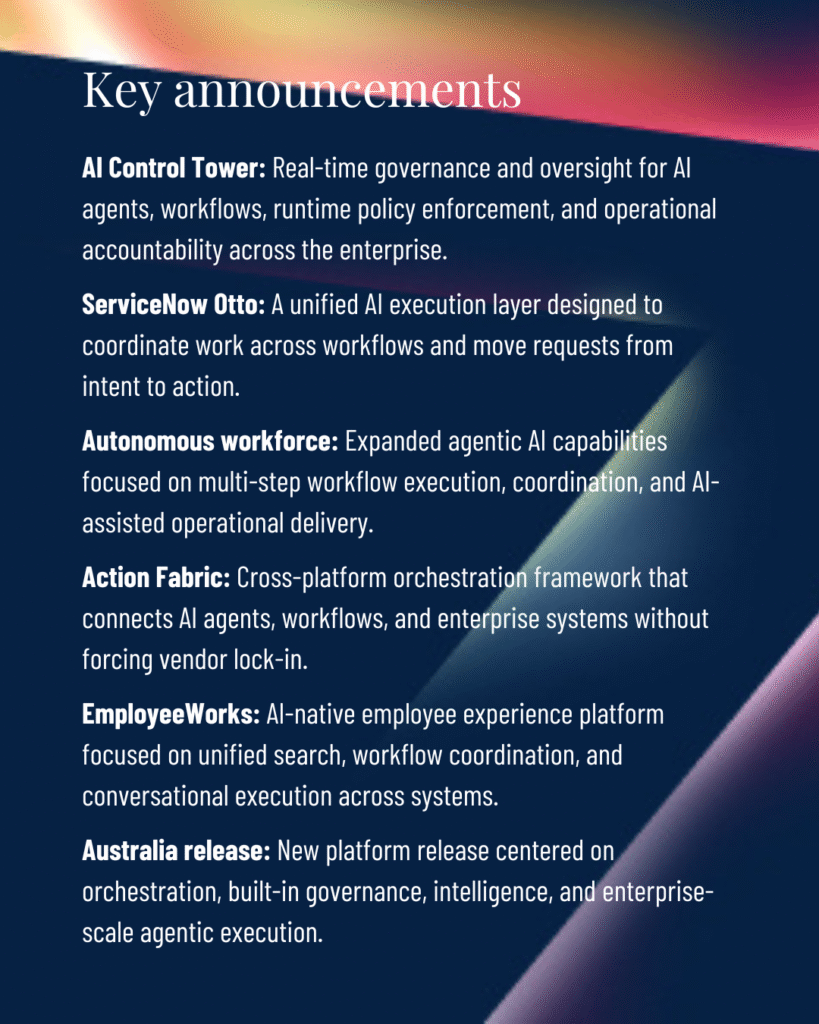
ServiceNow’s messaging around the “system of action,” autonomous workforce concepts, agentic business, Action Fabric, AI specialists, and workflow agents all pointed in the same direction. Taken together, these announcements reflected a larger market shift: AI is moving deeper into the systems where work happens. 

That shift matters because the first wave of enterprise AI largely focused on helping individuals move faster. 

Employees could summarize information, draft content, search knowledge, or complete isolated tasks with less manual effort. Those capabilities created useful gains, but they left the larger operating model mostly intact. 

The next wave changes the pattern. AI now sits closer to workflows, approvals, service delivery, employee interactions, and cross-functional coordination. It can move work from request to resolution, guide decisions across systems, and connect intent to action in ways that reshape how organizations operate. 

That shift creates a different standard for enterprise AI maturity. Success increasingly depends on whether AI capabilities function effectively inside the execution systems that determine speed, quality, accountability, and business outcomes. 

That reality showed up clearly in customer conversations at Knowledge 2026. Leaders asked fewer exploratory questions about theoretical AI capability and focused more heavily on operational execution challenges. 

Questions increasingly centered on: 

  • orchestration across systems 
  • governance at runtime 
  • interoperability across AI ecosystems 
  • responsible execution at scale 

Those questions reveal where the market is going. Enterprise buyers increasingly understand that AI value comes from coordinated execution. They want to know how AI fits into the architecture of work and how it interacts with existing platforms. 

The interface is becoming secondary to the execution layer 

The interface also becomes less important in this model. Conversational experiences still matter, especially when they simplify access to information and action. But the more strategic question sits underneath the interface: what execution layer receives the request, interprets the intent, coordinates systems, applies policy, and moves the work forward? 

That is where operating model transformation begins. Organizations seeing the most value are redesigning execution systems around AI-enabled workflows. They are clarifying where automation applies, where human judgment remains essential, how approvals change, how escalation works, and how adoption becomes part of the workflow rather than a separate change effort. 

As enterprises scale AI-enabled execution, another challenge becomes more visible: fragmented AI ecosystems are creating operational complexity. 

Orchestration is becoming the enterprise AI control layer 

One of the most important post-Knowledge 2026 issues is the growing complexity of multi-LLM environments. 

Many organizations now operate in a fragmented AI landscape. They may have investments in OpenAI, Claude, Gemini, embedded AI features inside major enterprise platforms, internally developed agents, and emerging use cases owned by different functions. 

Each capability may create value in isolation. Together, they can create architecture uncertainty, integration fatigue, inconsistent user experiences, and governance gaps. 

Enterprises are accumulating AI capabilities faster than they are building operational coordination around them. 

That creates a strategic problem. Leaders want flexibility, continuity, and coordinated employee experiences across increasingly fragmented AI environments. They also want to preserve existing investments without rebuilding workflows every time the model market changes. 

Why orchestration is becoming strategic infrastructure 

ServiceNow’s orchestration direction speaks directly to this pressure. Action Fabric, workflow orchestration, execution coordination, and platform-of-platforms architecture all point toward a model where ServiceNow helps coordinate action across systems rather than forcing every piece of work into one isolated environment. 

That idea resonated because many organizations have learned that modernization cannot depend on endless migration projects. Large enterprises already have valuable content, data, workflows, and knowledge stored across environments such as SharePoint, Confluence, ServiceNow, HR systems, IT systems, and other business platforms. Moving everything into one place can create disruption, cost, and resistance. 

A more practical model is emerging: 

  • preserve existing systems that still create value 
  • orchestrate workflows across environments 
  • leave knowledge where it already lives 
  • reduce unnecessary migration friction 
  • create more unified employee experiences 

In this model, organizations can modernize execution without forcing large-scale reconstruction projects that disrupt users, workflows, and operational continuity. 

This is a critical implementation insight. AI operating model maturity will increasingly depend on orchestration layers that support flexible model integration, federated knowledge architectures, and long-term operational adaptability. 

Organizations that coordinate orchestration strategically can reduce integration risk, preserve architectural flexibility, and create more durable foundations for AI-enabled execution. Organizations that deploy AI initiatives independently across functions often create rising complexity, duplicative effort, uneven adoption, and weaker governance. 

The next enterprise AI advantage may come less from the models organizations buy and more from how effectively they orchestrate execution around them. A strong orchestration layer stabilizes how work gets done across changing AI ecosystems, allowing organizations to integrate multiple models, connect existing platforms, apply governance consistently, and preserve operational continuity as underlying technologies evolve. 

That orchestration challenge naturally raises a second-order issue. As AI systems begin acting inside workflows, governance must move closer to execution. 

Governance is becoming operational infrastructure 

Governance emerged as one of the defining enterprise AI themes at Knowledge 2026 because agentic AI changes the risk profile of AI adoption. 

When AI primarily generated content or surfaced insights, governance could focus heavily on acceptable use, data handling, model access, and review processes. Those controls remain important. But AI-enabled execution introduces a broader challenge: how do organizations govern systems that can trigger actions, route work, recommend decisions, escalate issues, and coordinate across business processes? 

That question moves governance from policy documentation into operational infrastructure. 

Governance now operates inside workflows 

ServiceNow’s emphasis on Control Tower, runtime governance, AI oversight, policy enforcement, auditability, operational controls, and governed autonomy reflects this shift. 

Enterprise AI governance now needs to operate directly in the flow of work. 

That includes: 

  • defining when humans intervene 
  • clarifying escalation paths 
  • logging decisions and actions 
  • enforcing operational policy 
  • maintaining accountability for outcomes 

That requires organizations to extend governance across compliance, risk, legal, data, workflow design, platform architecture, role definition, service delivery, and adoption planning so operational controls function inside the execution system itself. 

The reason is simple: autonomous and semi-autonomous systems can create operational risk when accountability remains unclear. A workflow agent may accelerate work, but leaders still need to know what decisions it can make, what evidence it uses, when it stops, when it escalates, and who owns the business result. 

Conversational interfaces may improve employee access and workflow speed, but enterprises still need controls around sensitive data, role-based access, approved actions, and escalation paths. 

Governance and orchestration therefore become inseparable. Orchestration determines how work moves. Governance determines how that movement remains safe, accountable, transparent, and aligned to enterprise policy. 

Human accountability remains essential 

Human judgment remains central to this model. AI can support decision flow, reduce manual effort, surface context, and coordinate action, but organizations still need people to define priorities, resolve ambiguity, manage exceptions, and own business accountability. Effective governance clarifies that relationship rather than treating automation as a substitute for responsibility. 

This also has direct implications for adoption. Employees need to understand where AI fits, when to trust it, when to intervene, and how their roles change as workflows become more AI-enabled. Leaders need enablement systems that help people use AI with confidence while maintaining the judgment and accountability their work requires. 

AI is changing how enterprises think about operating capacity 

Knowledge 2026 also reflected a more direct conversation about operating capacity. Executives are increasingly evaluating AI through the lens of scalability, productivity economics, service demand, and workforce leverage. In many functions, the question is becoming more concrete: how can the organization handle more work, faster response expectations, and greater complexity without expanding headcount at the same rate? 

That shift requires careful leadership. AI-enabled execution can reduce repetitive work, improve service speed, and help teams focus human effort where judgment matters most. It can also reshape job design, staffing assumptions, governance expectations, and workforce adaptation priorities as enterprises redesign workflows around AI-supported execution. 

The market is competing on execution systems 

This is why ServiceNow’s Knowledge 2026 direction matters. The announcements collectively pointed toward execution coordination, governed AI systems, workflow integration, and enterprise-scale orchestration. The strategic message was larger than any one product feature: the enterprise AI market is moving from isolated AI experiences toward coordinated systems of action. 

That shift changes how leaders should think about competitive advantage. Enterprise value will increasingly depend on the operating systems that turn AI capability into coordinated execution. Organizations that build governance into execution systems can move faster with more control, scale AI use cases with clearer accountability, and adapt operating models without destabilizing the business. 

This is the emerging AI operating model: flexible at the model layer, stable at the orchestration layer, governed at runtime, and grounded in human accountability. 

Enterprises increasingly need implementation partners who understand orchestration strategy, workflow integration, governance architecture, operating model design, and adoption support as interconnected parts of the same transformation. 

That shift creates practical priorities for leaders now. 

What enterprise leaders should prepare for now 

Knowledge 2026 gave enterprise leaders a clear view of what comes next. The organizations that move effectively will prepare their architecture, governance, workflows, and workforce for AI-enabled execution rather than treating agentic AI as another application rollout. 

CIOs and technology leaders: build for orchestration early 

Technology leaders should assume multi-LLM environments will become the norm. A durable AI strategy needs room for multiple models, embedded AI capabilities, changing vendor relationships, and evolving enterprise platforms. 

That means orchestration strategy should begin early. 

Technology leaders should prioritize: 

  • interoperable workflow infrastructure 
  • multi-LLM flexibility 
  • governance embedded into execution systems 
  • scalable integration patterns 
  • architecture that supports operational adaptability 

Leaders also need to identify where AI-enabled work will cross systems, where existing architecture creates friction, and where fragmented AI deployments could create inconsistent experiences and disconnected governance. The goal is to establish architecture patterns that can scale across business functions as AI ecosystems continue evolving. 

Operations and delivery leaders: redesign workflows around human-AI collaboration 

Operations and delivery leaders should focus on how AI changes the movement of work. 

Agentic AI creates value when it reduces decision friction, accelerates resolution, improves service consistency, and helps teams act with better context. That requires workflow redesign. Leaders need to examine where work stalls, where handoffs break down, where approvals create delay, and where employees lack the information needed to act confidently. 

Modern execution systems should clarify the relationship between human and AI work. AI can route, summarize, recommend, retrieve, trigger, and coordinate. People still guide priorities, resolve exceptions, apply judgment, and own outcomes. That division of responsibility must be designed intentionally rather than left to informal adoption. 

Operationalizing governance also becomes part of workflow modernization. Controls, escalation paths, audit trails, and approval logic should live inside the execution flow so teams can move faster without creating unmanaged risk. 

Transformation and workforce leaders: make adoption part of the operating model 

Transformation and workforce leaders have a central role in this next phase because AI-enabled execution changes behavior, roles, decision patterns, and trust. 

Adoption requires practical enablement that helps people understand how AI fits into their work, what decisions remain human-led, and how accountability evolves as workflows become more automated. Leaders should prepare operating models for continuous adaptation through updated role definitions, governance participation, feedback loops, and measurement systems tied to business outcomes. 

Across all leadership roles, the direction is consistent: AI value now depends on implementation discipline. Organizations need orchestration expertise, governance frameworks, workflow redesign, and operating model support to operationalize these changes successfully. 

Knowledge 2026 pointed to a new operational phase of enterprise AI 

Knowledge 2026 revealed an enterprise AI market moving toward operational systems built around orchestration, workflow integration, governance, and execution architecture. 

That shift changes the competitive landscape. Enterprises will increasingly differentiate through their ability to coordinate AI-enabled execution across systems, govern workflows responsibly, and adapt operating models without disrupting the business. 

For many organizations, that will require practical guidance across orchestration strategy, governance design, workflow modernization, and enterprise adoption. The next competitive advantage may come from how effectively enterprises orchestrate execution around AI. 


Prepare your enterprise AI operating model for what comes next

/imagServiceNow Knowledge 2026 made one thing clear: enterprise AI value now depends on more than deploying new capabilities. Leaders need orchestration strategies, governance models, workflow integration, and operating models that support AI-enabled execution at scale. 

The AI Strategy and Transformation Workshop helps enterprise leaders assess readiness, identify high-value opportunities, and define a practical path for responsible AI transformation across real workflows. 


Frequently asked questions about ServiceNow Knowledge 2026 

What happened at ServiceNow Knowledge 2026? 

ServiceNow Knowledge 2026 focused heavily on agentic AI, orchestration, governance, and AI-enabled execution systems. The event highlighted how enterprises are moving beyond isolated AI tools toward coordinated workflows, runtime governance, and operational models designed to support AI at enterprise scale. 

What is agentic AI in ServiceNow? 

Agentic AI refers to AI systems that can coordinate actions, complete multi-step workflows, retrieve information, and support execution across enterprise systems. At Knowledge 2026, ServiceNow positioned agentic AI as part of a broader operational framework focused on orchestration, governance, and workflow integration. 

Why is orchestration becoming important in enterprise AI? 

Enterprises increasingly operate across multiple AI models, platforms, workflows, and data environments. Orchestration helps coordinate those systems so organizations can maintain operational continuity, reduce fragmentation, apply governance consistently, and support AI-enabled execution without rebuilding workflows around every technology change. 

What is ServiceNow Action Fabric? 

ServiceNow Action Fabric is an orchestration framework designed to connect AI agents, workflows, and enterprise systems across different platforms. It supports coordinated execution and interoperability without requiring organizations to migrate every workflow or knowledge source into a single environment. 

Why are enterprises concerned about multi-LLM environments? 

Many organizations already use multiple AI providers such as OpenAI, Claude, and Gemini alongside embedded AI capabilities inside enterprise platforms. That creates concerns around interoperability, governance, architecture complexity, employee experience consistency, and long-term operational adaptability. 

What is AI Control Tower in ServiceNow? 

AI Control Tower is ServiceNow’s governance and oversight framework for enterprise AI operations. It focuses on runtime governance, policy enforcement, operational visibility, auditability, and accountability across AI-enabled workflows, agents, and execution systems. 

How is AI changing enterprise operating models? 

AI is changing how enterprises design workflows, coordinate decisions, manage governance, and scale execution across the organization. Many leaders are redesigning operating models around AI-enabled workflows, orchestration layers, and governance structures that support responsible automation and human accountability. 

What should enterprise leaders prioritize after Knowledge 2026? 

Enterprise leaders should prioritize orchestration strategy, governance integration, interoperable workflow infrastructure, and operating model readiness. Organizations that prepare early for AI-enabled execution can adapt more effectively as enterprise AI ecosystems continue evolving. 


AI adoption ROI: why adoption determines enterprise performance 

AI adoption ROI is under scrutiny as investment accelerates, yet enterprise performance is not improving at the same rate. The gap is structural. Organizations are investing in AI, but they are not changing how work executes. 

AI has moved from experimentation to executive accountability. CEOs and CFOs now expect measurable returns tied to operational KPIs and financial outcomes. At the same time, most organizations continue to treat AI as a tool layer rather than an execution capability embedded within workflows. 

The result is a persistent disconnect between spend and outcomes. 

Across client environments, a consistent pattern emerges. Significant investment is in place, but leadership cannot tie that investment to cycle time, cost efficiency, quality, or revenue impact. 

Consider a global insurer deploying AI copilots across underwriting teams. Usage is high. Activity increases. Underwriting cycle time and loss ratios remain unchanged. The system absorbs AI without changing how decisions are made or how work flows. 

The issue centers on how success is defined and measured. 

AI usage vs business outcomes: the measurement problem 

Most organizations rely on usage metrics to signal progress: 

  • Licenses deployed 
  • Frequency of AI use 
  • Number of pilots or use cases 

These indicators measure activity. They do not show whether work executes faster, better, or more reliably, or how it connects to enterprise performance and financial outcomes. 

This creates a false signal of progress. High usage is interpreted as success even when operating performance remains unchanged. This gap between AI usage vs business outcomes distorts how progress is understood at the executive level. 

A SaaS company may report 80 percent adoption of AI coding assistants. Release frequency, defect rates, and cycle time remain unchanged. Leadership cannot attribute measurable business value to AI. 

This misalignment distorts decision-making. Investment continues to scale without clear evidence of impact. This is where most enterprise AI adoption strategies begin to break down. 

If usage does not determine value, behavior becomes the constraint. 

Behavior change as the driver of AI adoption ROI 

AI adoption ROI depends on how work changes, not how tools are deployed. 

The primary constraint is behavioral, not technical. 

Common failure patterns reinforce this: 

  • Teams use AI as a search tool rather than embedding it into workflows 
  • Managers maintain legacy performance expectations 
  • Pilots remain isolated and fail to scale 
  • AI is layered onto existing processes, accelerating inefficiency 

Behavior change must be defined operationally. 

  • Decisions are made faster and with better information. 
  • Workflows are redesigned to reduce handoffs and ambiguity. 
  • Roles evolve so that humans focus on judgment while AI handles repeatable execution. 

Organizations often invest in enablement and tooling while leaving workflows unchanged. In that scenario, AI increases activity but does not improve performance. 

A healthcare provider may introduce AI into patient intake. Staff continue to validate and re-enter data manually. Cycle time and administrative cost remain constant because the workflow itself has not changed. 

AI implementation best practices consistently point to redesigning how work executes as the starting point for value realization. Without that, adoption cannot translate into measurable outcomes. 

Trust, literacy, and reinforcement: the conditions for adoption 

Behavior change does not occur through exposure or training alone. It depends on three conditions: trust, literacy, and reinforcement. 

Trust: reliability and control 

AI must be reliable enough to influence decisions. When outputs are inconsistent or opaque, teams disengage quickly. 

Trust is built through: 

  • Accuracy validation against real scenarios 
  • Clear articulation of limitations 
  • Human-in-the-loop controls for oversight 

Literacy: role-based capability 

Surface-level familiarity does not translate into execution. Teams need role-specific clarity on where AI fits within their workflows. 

Generic training does not change behavior. Context-specific application does. 

Reinforcement: system alignment 

Behavior change persists only when the system reinforces it. 

KPIs, incentives, and management cadence must align with AI-enabled execution. When legacy metrics remain in place, teams revert to previous ways of working. 

A bank may deploy AI for fraud detection support. Analysts distrust outputs and revert to manual review. The system lacks transparency and reinforcement, so behavior does not change. 

These conditions must be designed into how the organization operates. 

Designing an enterprise AI adoption strategy into the operating model 

Adoption is not a training outcome. It is a function of the operating model. 

How work flows, how decisions are made, and how performance is measured determine whether AI changes execution. 

In many organizations: 

  • Governance sits outside execution 
  • Decision rights are unclear 
  • Workflows are not redesigned for AI 
  • Performance systems emphasize activity rather than outcomes 

An effective enterprise AI adoption strategy addresses these gaps. 

  • Human and AI roles are clearly defined 
  • End-to-end workflows are redesigned for integrated execution 
  • Governance is embedded within daily operations 
  • KPIs are tied to outcomes rather than activity 

Organizations that succeed treat adoption as a system design problem. They redesign workflows and decision systems rather than expanding tooling. 

A retail organization embedding AI into demand forecasting may clarify decision rights and connect forecasts directly to inventory actions. Forecast accuracy improves and stockouts decline because the system supports the behavior change. 

This alignment between operating model and execution is central to AI governance and risk management. Controls must exist within workflows, not outside them. 

Measuring what actually drives AI adoption ROI 

AI adoption ROI is determined by operating performance, not activation. 

A structured measurement model clarifies how value is created and where it breaks down. 

Enterprise outcomes 

These are the metrics leadership ultimately cares about: 

  • Revenue growth and margin expansion 
  • Cost efficiency 
  • Customer experience and retention 
  • Workforce productivity 
  • Risk posture 

These outcomes anchor AI investment to CFO- and CEO-level priorities. If AI cannot be tied to one or more of these dimensions, it remains a cost center rather than a performance driver. 

Operating performance drivers 

These metrics explain how outcomes are produced: 

  • Capacity across workflows 
  • Cost-to-serve 
  • Cycle time from intent to outcome 
  • Quality and rework levels 
  • Risk and operational reliability 

These are the levers through which AI creates value. Capacity reflects how much work can be completed. Cost-to-serve reflects efficiency at the unit level. Cycle time reveals how quickly decisions translate into outcomes. Quality and risk determine whether speed creates value or instability. 

These metrics apply across all functions, not only product development. They define how the business operates. 

For example, reducing onboarding cycle time in HR improves productivity and accelerates revenue contribution per employee. The value comes from faster integration into productive work, not from the use of AI itself. 

Adoption and execution signals 

These are leading indicators of behavior change: 

  • Adoption within workflows rather than tool usage 
  • Time reinvestment into higher-value work 
  • Degree of workflow integration 
  • Scale across teams and functions 

These signals indicate whether AI is changing how work executes. Workflow-level adoption shows whether AI is embedded into real processes. Time reinvestment shows whether capacity is being redirected toward higher-value work. Scale reveals whether success is repeatable or isolated. 

Without these signals, organizations cannot distinguish between experimentation and operational change. 

Trust and governance signals 

These metrics support AI governance and risk management: 

  • Accuracy and success rates 
  • Escalation frequency to human intervention 
  • Variance over time 
  • Auditability and control coverage 

These determine whether AI can be relied on in execution. Accuracy and success rates indicate whether outputs are usable. Escalation rates show where human judgment remains necessary. Variance highlights instability. Auditability ensures decisions can be traced and governed. 

Together, these signals define whether AI can operate safely at scale. 

Behavioral diagnostics 

These explain root causes: 

  • Literacy 
  • Attitude 
  • Aptitude 
  • Compliance 

These factors explain why adoption is progressing or stalling. Literacy determines whether teams know how to use AI in context. Attitude reflects willingness to change. Aptitude reflects the ability to redesign workflows. Compliance ensures usage remains safe and governed. 

Without diagnosing these layers, organizations treat symptoms rather than causes. 

Clarifying risk 

AI introduces three interconnected risk dimensions: 

  • Operational risk through execution failure or rework 
  • Governance risk through compliance gaps or unsafe usage 
  • Strategic risk through slower adoption relative to competitors 

AI amplifies existing weaknesses in execution systems. Poor workflows create more errors at higher speed. Weak governance increases exposure. Slow adoption compounds competitive disadvantage. 

Organizations that measure across these layers manage AI as a performance system rather than a technology initiative. 

Activation metrics are transient. Capability metrics reflect durable change in how work executes. 

Measuring sustained capability, not activation 

AI adoption ROI emerges from sustained capability, not initial activation. 

Capability reflects durable change: 

  • Repeatable execution across workflows 
  • Reliable outcomes at scale 
  • Continuous improvement through feedback loops 

Sustained capability requires: 

  • Ongoing measurement embedded in workflows 
  • Continuous learning cycles 
  • Active optimization of workflows and decision systems 

A logistics company may initially improve routing efficiency with AI. Without reinforcement, teams revert to manual overrides. Gains erode because capability was not institutionalized. 

Executives should frame the distinction clearly: 

Adoption reflects repeatability of outcomes. 
Capability reflects reliability at scale. 

Adoption as the determinant of AI ROI 

Technology is increasingly accessible. Execution is the differentiator. 

Organizations that redesign work and embed AI into workflows create compounding advantages. Those that rely on usage metrics remain stalled regardless of investment levels. 

Across client environments, a consistent pattern holds. Organizations that integrate AI into workflows, reinforce behavior through operating models, and measure performance outcomes realize value. Others remain in pilot cycles, reporting activity without impact. 

AI adoption ROI is determined by whether the enterprise can execute differently, consistently, and at scale. 

AI ROI is a performance system design problem. 

Adoption determines whether value is realized, sustained, and scaled. 


See where your AI adoption ROI is breaking down

If your organization reports strong AI usage but cannot connect it to business outcomes, the constraint likely sits within workflows, decision systems, or operating model design. 

Our AI in the Workplace Assessment identifies where adoption is stalling across literacy, behavior, workflow integration, and governance, giving you a clear view of what is limiting ROI and where to act first. 


Frequently asked questions about AI adoption ROI 

What is AI adoption ROI? 

AI adoption ROI refers to the measurable business value created when AI changes how work executes. It focuses on outcomes such as cycle time, cost efficiency, and quality rather than tool usage. The concept emphasizes performance improvement, not just deployment or experimentation. 

Why is AI adoption ROI difficult to measure? 

AI adoption ROI is difficult to measure because most organizations track activity instead of outcomes. Metrics like usage rates and number of pilots do not reflect operational performance. Without linking AI to cycle time, cost, and quality, leaders lack a clear view of impact. 

What is the difference between AI usage and business outcomes? 

AI usage measures how often tools are used, while business outcomes measure how work improves. High usage can exist without better performance. Outcomes such as faster delivery, reduced cost, and improved quality determine whether AI is creating real value. 

What are AI implementation best practices for driving ROI? 

AI implementation best practices focus on redesigning workflows, not just deploying tools. This includes embedding AI into decision-making, defining roles clearly, and aligning KPIs to outcomes. Without these changes, AI increases activity but does not improve performance. 

How does an enterprise AI adoption strategy improve results? 

An enterprise AI adoption strategy improves results by aligning workflows, decision rights, and performance systems around AI-enabled execution. It ensures adoption occurs within real processes, making outcomes repeatable and scalable across teams rather than isolated in pilots. 

What role does AI governance and risk management play in adoption? 

AI governance and risk management ensure AI can be used safely and consistently at scale. They provide controls, auditability, and oversight within workflows. Without embedded governance, organizations face higher operational, compliance, and strategic risk as AI usage increases. 

How can organizations tell if AI is actually improving performance? 

Organizations can assess AI impact by tracking operating metrics such as cycle time, capacity, cost-to-serve, quality, and risk. Improvements in these areas indicate that AI is changing how work executes, rather than simply increasing activity. 

Why do AI initiatives stall after initial success? 

AI initiatives often stall because behavior does not change or is not reinforced. Teams revert to legacy workflows when trust, incentives, and governance are not aligned. Without sustained capability, early gains fade and performance returns to baseline. 

AI implementation challenges: Why AI pilots fail to scale 

AI investment is accelerating across every industry. Pilots are everywhere. Early wins are easy to find. Yet measurable enterprise impact remains inconsistent. 

According to PwC’s 2026 Global CEO Survey, 56% of CEOs report no revenue or cost benefits from AI despite increased investment. 

This gap defines the current moment. AI is working in pockets, but it is not translating into enterprise performance. 

The core challenge is turning isolated AI success into repeatable value across the enterprise. 

The pilot paradox: proof of concept is not proof of value 

Most organizations treat pilot success as evidence that scaling is simply a matter of replication. That assumption breaks down quickly. 

Only 12% of CEOs report both revenue growth and cost reduction from AI

Pilots operate in controlled conditions. They bypass the constraints that define real execution. Governance is simplified. Dependencies are minimized. Decision latency is reduced. Success criteria are narrow and often tied to speed or output rather than outcomes. 

Enterprise value operates under different conditions. 

Enterprise value is the measurable, repeatable improvement in how an organization performs across its operating system. It shows up in financial outcomes, execution speed, decision quality, and sustained adoption across teams. 

A pilot proves that AI can work. It does not prove that the organization can produce these outcomes consistently. 

Local wins vs enterprise constraints 

Teams can achieve meaningful gains within their own scope. They reduce manual work. They accelerate tasks. They improve individual productivity. 

These are local wins. 

Enterprise outcomes depend on how work flows across teams, how decisions move through the organization, and how systems interact. When those structures remain unchanged, local improvements do not scale. 

Research shows that up to 95% of AI projects fail to deliver measurable ROI at scale. 

This reflects a systems-level issue rather than a capability gap. 

AI amplifies the environment it enters. When workflows are fragmented and decision paths are unclear, AI increases the speed of fragmentation rather than resolving it. 

Portfolio sprawl and lack of prioritization discipline 

As pilots multiply, a new constraint emerges. Organizations accumulate use cases faster than they can evaluate or scale them. 

Leaders report difficulty moving beyond pilots into enterprise-wide deployment. This creates portfolio sprawl. 

Multiple teams pursue similar initiatives without coordination. Funding spreads across too many efforts. Success metrics vary by team. Low-value pilots persist because there is no clear mechanism to stop them. 

Without prioritization discipline, AI remains a collection of experiments rather than a coordinated system of value creation. 

Enterprise value requires clear sequencing, shared criteria for success, and active governance of the portfolio. 

Missing runbooks and operational governance 

Even when organizations identify promising use cases, scaling exposes another gap. There is no defined way of working for human and AI execution. 

Governance is often external to execution. Controls, monitoring, and accountability sit outside the workflow instead of being embedded within it. 

Organizations that embed AI into workflows, products, and services are two to three times more likely to see returns. 

This difference is operational. 

Scaling requires clear decision rights, defined escalation paths, validation mechanisms, and runbooks that guide how AI is used in daily work. Without these, trust erodes, adoption slows, and outcomes remain inconsistent. 

Failure patterns: why pilots stall at scale 

Across industries, the same patterns appear. 

  • Pilots remain isolated and never reach production workflows. 
  • Initial adoption fades as teams revert to familiar ways of working. 
  • Governance slows progress rather than enabling it. 
  • Trust declines when outputs are inconsistent or difficult to validate. 
  • Portfolios expand without focus, diluting impact. 

These issues follow predictable patterns within operating systems that have not evolved to support AI-enabled execution. 

What scaling actually requires 

Organizations that scale AI successfully shift their focus from experimentation to execution systems. 

  • They move from pilots to coordinated programs. 
  • They redesign workflows so AI is embedded in how work gets done. 
  • They clarify decision flow so insights translate into action. 
  • They embed governance into execution rather than layering it on afterward. 
  • They establish prioritization discipline so resources concentrate on the highest-value opportunities. 

Companies that build these foundations are significantly more likely to generate returns from AI. Then value begins to compound. 

The real constraint 

The limiting factor in AI value is the way the organization operates. 

AI exposes the gaps in decision flow, governance, workflow design, and adoption systems. When those gaps remain, pilots succeed but value does not scale. 

The organizations that move ahead are not those with the most pilots. They are the ones that redesign how work, decisions, and adoption operate together. 

They turn isolated success into repeatable performance. 

That is what separates experimentation from enterprise value. 


See where AI breaks down in your operating model

Most AI implementation challenges do not start with the technology. They emerge from how work flows, how decisions are made, and how governance is applied in daily execution. 

The AI-first operating model design assessment identifies where your current operating model limits scale, surfaces gaps in workflow, governance, and decision flow, and shows how to move from isolated pilots to coordinated execution. 


Frequently asked questions about AI implementation

What are the most common AI implementation challenges? 

The most common AI implementation challenges include unclear ownership of outcomes, weak governance, fragmented workflows, and lack of prioritization. Organizations often deploy AI without redesigning how work flows, which limits impact and prevents consistent value from scaling across teams. 

Why do AI projects fail to scale in enterprises? 

AI projects fail to scale in enterprises because pilots operate in isolation from real operating conditions. When expanded, they encounter governance gaps, cross-team dependencies, and unclear decision structures, which prevent repeatable execution and reduce overall business impact. 

What is the difference between an AI pilot and enterprise AI value? 

An AI pilot demonstrates that a use case can work under controlled conditions. Enterprise AI value requires repeatable performance across workflows, with measurable outcomes in cost, speed, quality, and adoption sustained over time across multiple teams and functions. 

What are AI scaling challenges in large organizations? 

AI scaling challenges in large organizations include portfolio sprawl, inconsistent workflows, lack of governance embedded in execution, and low adoption. These challenges prevent organizations from moving beyond isolated successes to coordinated, enterprise-wide impact. 

How do you scale AI in enterprise environments? 

Scaling AI in enterprise environments requires redesigning workflows, clarifying decision rights, embedding governance into execution, and prioritizing high-value use cases. Organizations must align operating models to support consistent, repeatable execution rather than relying on isolated experimentation. 

What is an AI governance framework and why does it matter? 

An AI governance framework defines how AI is controlled, monitored, and used within workflows. It matters because governance ensures trust, accountability, and consistency, enabling organizations to scale AI safely while maintaining performance, compliance, and decision integrity. 

How can organizations overcome AI implementation challenges? 

Organizations overcome AI implementation challenges by aligning their operating model to AI-enabled execution. This includes embedding governance, redesigning workflows, establishing clear ownership, and building adoption systems that reinforce new ways of working across teams. 

Why is AI adoption important for scaling value? 

AI adoption is critical because value only materializes when people consistently use AI within real workflows. Without sustained adoption, even well-designed solutions fail to deliver impact, and organizations remain stuck in pilot stages without achieving enterprise outcomes. 

AI transformation strategy: why programs outperform projects 

Why AI transformation strategy needs programs, not projects 

Enterprise AI investment continues to climb. The returns remain uneven. Even when experimentation succeeds, enterprise scale often remains elusive. 

The primary constraint is structural. Model quality continues to improve, but most organizations still run AI as a series of discrete projects. Discrete projects can deliver useful outputs, but they rarely create the continuity required for compounding enterprise value. The unit of execution is misaligned with how AI value is created. 

An effective AI transformation strategy needs a program model built for continuity, adoption, and sustained performance. The distinction matters because AI value depends less on whether a capability launches and more on whether the organization keeps improving how people use it, govern it, and measure it. 

Projects optimize scope. Programs optimize sustained outcomes A project is bounded by scope, timeline, and deliverables. That model can work for a warehouse build or a payroll rollout. It breaks down when leaders use it as the default structure for AI transformation

AI value rarely lives inside a single deliverable. 

Analysts need to trust the output. Governance needs to keep pace with model updates. Adoption needs to hold after the launch team moves on. None of those conditions closes on a delivery date. 

Programs are built to persist. They ask a better question: “Did performance improve, and is it still improving?” That question changes how leaders fund, govern, and measure AI work. A project-based AI rollout often tracks deployment milestones and usage counts. 

A program tracks performance metrics: cycle time reduction, cost-to-serve improvement, quality variation, risk exposure, and depth of role-based adoption. The inputs may look similar, but the operating discipline is different. 

That distinction is central to program management vs. project management in AI work. 

Why AI value realization stalls between funding cycles 

When AI is funded as a series of projects, momentum often resets every cycle. Each new funding cycle requires a new justification. Learning often stays with the team that ran the last initiative. 

Adoption gets treated as a post-delivery activity rather than a design requirement. Governance often trails capability deployment, creating a widening gap between what AI can do and what the organization is prepared to govern. 

The issue is not simply that individual projects end. The issue is that their learning, governance, adoption patterns, and value measures often end with them. 

MIT’s Project NANDA research shows a similar pattern. The research points to a deeper operating constraint: many enterprise AI systems do not learn, retain context, or adapt over time. 

For enterprise leaders, that is a continuity problem expressed through technical symptoms. AI initiatives can run long enough to consume budget, but still fail to build sustained confidence. Long enough to consume budget, but short enough to weaken confidence in the next AI initiative. 

For finance and portfolio leaders, this is a familiar governance problem showing up in a new context. Board conversations return to the same issue: funded initiatives that cannot be traced to measurable outcomes. 

Without continuity, leaders lack a reliable way to see which investments are compounding and which have stalled. The CFO lacks defensible value visibility. The CIO lacks a credible basis for prioritizing the next round of AI investment. 

Continuity as a structural design principle 

Continuity is the missing design element in many AI execution models. Leaders create continuity when strategy, execution, adoption, and measurement connect across initiatives instead of resetting with each one. 

In practice, continuity means the right elements persist between cycles: 

  • Outcome definitions tied to business performance 
  • Measurement frameworks that track performance over time 
  • Adoption models that reinforce how work actually gets done 
  • Governance cadence that supports decisions to scale, pause, or retire a capability 

Other elements evolve as the program matures: 

  • The model version or AI capability in use 
  • The workflows where AI is applied 
  • The specific teams and roles involved 

When they are absent, each cycle starts cold. Workflow changes get reopened. Metrics change definitions. Teams relearn what the last group already knew. 

McKinsey’s State of AI research helps illustrate the gap. Adoption is broad, while enterprise-scale continuity remains much less common. 

How continuous improvement in AI compounds performance 

Programs improve outcomes because they give insight a place to accumulate. 

Every cycle generates signals about what works, where users push back, which workflows absorb AI cleanly, and which workflows need redesign first. 

A project often leaves that learning in a closeout report after the team has moved on. A program carries it forward. 

That is continuous improvement in AI as an operating discipline. 

  • The compounding should show up in operational measures. 
  • Cycle time for AI-assisted decisions can drop as workflows are refined. 
  • Cost-to-serve can decrease as manual effort is removed. 
  • Quality can improve as variation is identified and reduced. 

Adoption can stabilize at higher levels when role-based enablement is built into execution from the start. 

McKinsey data suggests that organizations with higher AI maturity are nearly three times more likely to redesign workflows around AI instead of placing AI on top of existing processes. 

That redesign creates durable value only when it is sustained. One-time workflow changes tend to decay. Continuous improvement allows the gains to compound. That compounding effect requires an execution model designed to preserve what the organization learns. 

What program-based AI execution looks like in practice 

Program-based AI execution has observable properties that distinguish it from project-based work: 

Outcomes define the work 
The program is built around a measurable business outcome. AI capabilities are selected because they support that outcome. 

Measurement is continuous 
Investment, work, and results connect through one measurement spine. 

Execution is integrated 
Execution connects workflows, teams, and platforms. AI is embedded into real work instead of added as a separate layer. Product, operations, and governance stay coordinated throughout the program. 

Adoption is designed from the start 
Role-based enablement, behavior change, and reinforcement are part of the program plan from the beginning. McKinsey’s March 2026 analysis reinforces this point. The highest-performing organizations focus less on isolated AI deployment and more on embedding AI into how work actually runs. 

Governance operates within the cadence of the work 
Decision rights, escalation paths, and review cadences are defined early and adjusted as the work evolves. 

Learning loops are embedded 
Learning loops are embedded into the workflow. The program captures those signals as part of normal execution. 

What enterprise leaders need to change 

The leadership implication is specific. 

Leaders need to organize the portfolio around sustained outcomes instead of isolated initiatives: 

  • Funding should follow sustained outcomes rather than discrete initiatives 
  • Stage gates should carry learning into the next cycle 
  • Governance should sustain continuity across cycles 
  • Metrics should track sustained performance rather than delivery milestones 
  • Adoption and enablement should be embedded into execution 

AI should be treated as part of operating model evolution rather than a series of capability deployments. That shift creates the foundation for a durable AI transformation strategy

Closing the gap 

AI often stalls because the execution model was built for delivery completion rather than sustained adoption, governance, and performance improvement. 

The organizations pulling ahead are organizing AI around programs that sustain learning, adoption, and value realization across cycles. They design for continuity so results can compound. 


AI adoption is where value either compounds or stalls

AI value breaks down when teams do not change how work gets done. Adoption and change coaching embeds new behaviors into real workflows so results can scale and hold. 

Start with clarity before you scale.


Frequently asked questions about AI transformation strategy 

What is the difference between program management and project management in AI? 

Project management focuses on delivering defined outputs within a fixed scope and timeline. Program management focuses on sustained outcomes over time, connecting multiple initiatives, governance, and adoption into a continuous system that improves performance rather than resetting after each delivery cycle. 

Why do AI projects fail to deliver long-term value? 

AI projects often fail because they treat deployment as the finish line. Without sustained adoption, governance, and performance tracking, value does not persist. Learning is lost between cycles, and organizations struggle to connect AI capabilities to measurable business outcomes over time. 

What is an AI program and how does it work? 

An AI program is a structured, ongoing approach to embedding AI into workflows, governance, and decision-making. It connects strategy, execution, and measurement across cycles so improvements compound, enabling organizations to continuously refine performance and sustain value rather than restarting with each initiative. 

How do you measure AI value at scale? 

AI value at scale is measured through operational outcomes such as cycle time, cost-to-serve, quality, risk, and adoption depth. These metrics are tracked continuously across workflows, allowing leaders to see whether performance is improving over time rather than relying on one-time delivery milestones. 

Why is AI adoption critical to ROI? 

AI adoption determines whether capabilities translate into real performance improvements. If teams do not change how they work, AI remains underutilized. Embedding adoption into workflows ensures that tools are used consistently, enabling organizations to realize and sustain measurable business value. 

What does continuous improvement in AI mean? 

Continuous improvement in AI refers to using each execution cycle to refine workflows, models, and behaviors. Instead of treating AI as a one-time deployment, organizations build feedback loops into daily work so insights accumulate and performance improves steadily over time. 

How should leaders fund AI initiatives? 

Leaders should fund AI initiatives based on sustained outcomes rather than isolated projects. This means aligning funding with measurable performance improvements, maintaining continuity across cycles, and ensuring that learning, governance, and adoption persist instead of resetting with each new investment. 

What role does governance play in AI programs? 

Governance ensures AI operates safely and effectively within real workflows. In program-based execution, governance is embedded into daily operations, with clear decision rights, escalation paths, and review cadences that evolve alongside the work to support continuous performance improvement. 

How do you move from AI pilots to enterprise scale? 

Moving from pilots to scale requires shifting from isolated experiments to program-based execution. Organizations must connect workflows, embed adoption, track outcomes continuously, and carry learning forward so each cycle builds on the last rather than starting from scratch. 

Atlassian System of Work Accelerator FAQs

The Atlassian System of Work Accelerator is a data-driven AI-powered assessment that analyzes how work actually flows across your Atlassian Cloud environment, identifying where value is being lost and what to do about it. 

It connects directly to your platform, measures real usage and behavior across key system of work pillars, and translates those insights into a prioritized path to improve alignment, delivery intelligence, knowledge, and AI readiness. Then, going forward, it serves as a health check as you work through the recommended improvements. 

The questions below address how the Accelerator works, what it measures, and how organizations use it to move from cloud adoption to measurable business outcomes.

Security and data access

How is my data accessed, and what security measures are in place?

The Accelerator connects to your Atlassian instance using read-only API tokens, the same credential mechanism used by any Marketplace app. No data is stored, exported, or retained after the assessment session. All signal collection happens in-memory and the output is delivered as a structured report. We do not request admin-level access, write to your instance, or access individual user credentials or personally identifiable information.

What level of access is required to run the Atlassian System of Work Accelerator?

A read-only API token with access to your Jira, Confluence, and Atlas instances is sufficient. No admin access is required. The token needs standard user-level read permissions: issue data, project metadata, space content, and Atlas goal structures. Your Atlassian administrator can generate this token in under five minutes, and it can be revoked immediately after the assessment is complete.

Scope and coverage

What tools and data sources does the Atlassian System of Work Accelerator analyze?

The Accelerator analyzes four interconnected parts of the Atlassian platform as part of a structured Atlassian system of work assessment: Jira (work item quality, workflow health, WIP, blockers, epic linkage), Confluence (content freshness, discoverability, space structure, label usage), Atlas (goal linkage, goal freshness, strategic alignment across projects), and AI Readiness signals (description richness, automation adoption, Rovo usage patterns). In total, 97 discrete signals are measured across these four pillars.

Does this work across multiple teams, products, or business units?

Yes. The Accelerator operates at the instance level, which means it captures signals across all teams, projects, and spaces within your Atlassian environment, not just a single team or product area, giving you a complete view across the Atlassian platform. This is one of its primary strengths: it surfaces systemic patterns (like low goal alignment or stale content) that only become visible when you look across the whole platform rather than project by project.

Can it assess both technical delivery and strategic alignment?

Yes. This is what distinguishes it from standard platform reporting. The Accelerator measures both dimensions simultaneously: technical delivery health (work item hygiene, WIP, blocker age, dependency tracking) and strategic alignment (whether work connects to goals, whether goals are time-bound and measurable, whether roadmap items are linked to in-progress work). Most organizations find the strategic alignment gaps more surprising and more expensive.

For information about Rovo-augmented product delivery

Process and timing

How long does it take to run the Atlassian System of Work Accelerator?

The assessment runs in approximately 20 minutes once an API token is connected. No team involvement is required during this time. The readout and discussion of findings typically takes 30–60 minutes depending on the depth of issues surfaced. From first conversation to delivered report, the entire process can be completed in a single half-day session.

What is required from our team to get started?

Very little. You need to provide a read-only API token for your Atlassian instance and a site URL. An Atlassian administrator can generate the token in under five minutes. No team preparation, no surveys, no stakeholder interviews, and no workshop facilitation is required. The assessment runs entirely from platform data.

Will this disrupt our current workflows or operations?

No. The Accelerator is entirely read-only and runs in the background. Teams will not be notified, no tickets will be created or modified, and no configurations will change. Your instance continues to operate normally throughout the assessment. There is no perceptible impact on platform performance.

Who should be involved from our side?

At minimum: an Atlassian administrator (to provide the API token) and a sponsor or stakeholder who will receive and act on the findings. This typically includes a VP of Engineering, IT Director, PMO Director, or platform owner. We recommend including whoever owns the conversation about AI readiness, delivery velocity, or Atlassian ROI, as the findings speak directly to those priorities.

Insights and interpretation

How accurate are the insights and recommendations provided by the Atlassian System of Work Accelerator?

All findings are derived directly from your platform data, not estimates, surveys, or interviews, giving you an accurate baseline for Atlassian ROI and adoption. If the assessment reports that 68% of in-progress work is unlinked to goals, that figure reflects the actual state of your Jira and Atlas instance at the time of assessment. Recommendations follow a consistent diagnostic framework applied across dozens of Atlassian Cloud environments, which means the patterns we flag are well-understood and the service recommendations are calibrated to real-world impact, not theory.

How should I interpret the insights and scores from the assessment?

Each of the four pillars is scored on a 0–100 scale based on how your platform data compares against healthy adoption thresholds and overall platform maturity. Scores below 40 typically indicate systemic issues requiring structured intervention. Scores between 40–70 reflect partial adoption with clear improvement paths. Scores above 70 indicate strong foundations. The focus then shifts to optimization and AI readiness. The report will highlight your top-priority issues by business impact, not just the lowest scores.

How are findings presented and to whom?

Findings are delivered as a structured report with an executive summary (suitable for VP or C-suite presentation), a detailed issue list ranked by business impact, and a service roadmap with specific recommendations. The executive summary is designed to be shared upward without requiring the recipient to understand Atlassian internals. It speaks in terms of strategic leakage, cycle time, AI readiness, and cost of inaction.

How is the scoring or benchmarking determined?

Scoring thresholds are calibrated against healthy Atlassian Cloud adoption patterns observed across enterprise deployments. We do not compare you against other clients or industries. The benchmark is what ‘good’ looks like on an Atlassian platform that is functioning as a connected delivery system rather than a collection of individual tools. Each signal has a defined threshold (e.g., >80% of work items linked to an epic, <20% stale content in active spaces) and the pillar score reflects how many signals are above or below their respective thresholds.

Deliverables and outputs

What deliverables will I receive after the Atlassian System of Work Accelerator is completed?

Six concrete deliverables are produced from every assessment: (1) Platform Scorecard — a 0–100 score across all four pillars; (2) Ranked Issue List — 25+ issues ordered by business impact, all evidence-based; (3) Solution Map — one specific fix defined per issue, framed as outcomes not features; (4) Service Roadmap — which of 14 Cprime services address your highest-priority gaps, sequenced and ready to scope; (5) AI Readiness Score — a dedicated 0–100 score with a 90-day action plan; (6) Executive Summary — top 3–5 findings with quantified business impact, ready to present to leadership.

Do you provide benchmarks or comparisons as part of the output?

The report includes industry benchmarks for the outcomes associated with closing each gap. For example, 15–25% cycle time reduction from process alignment improvements, or 40% reduction in expert interruptions from better knowledge management. These benchmarks are drawn from DORA research, VSM research, and Lean methodologies. We do not compare you against other Cprime clients or provide competitive benchmarking. The focus is on your specific gaps and the value of closing them.

Value and outcomes

What business problems does the Atlassian System of Work Accelerator solve?

The Accelerator quantifies three categories of hidden cost that accumulate silently in Atlassian environments, helping quantify gaps in Atlassian ROI: strategic leakage (work not connected to goals, typically 30–40% of effort), delivery drag (stale WIP, untracked dependencies, missing escalation paths), and AI inaccessibility (data quality gaps that prevent Atlassian Intelligence and Rovo from functioning). Organizations don’t typically know the scale of these problems because the data exists in the platform but is never surfaced in this way.

What kind of results or ROI can we expect after running the Atlassian System of Work Accelerator?

Based on industry research and Cprime engagement outcomes: 15–25% reduction in delivery cycle time from process alignment work; 30–40% reduction in strategic leakage from goal-to-work linking; 40% reduction in expert interruptions from knowledge management improvements; 40–60% reduction in blocked time through dependency tracking and escalation workflows. These are the ranges we use in conversations. Actual results depend on the severity of gaps identified and the scope of remediation.

How is this different from standard reporting in Atlassian?

Standard Atlassian reporting (including Admin Insights) measures usage: logins, page views, issue throughput, active users, rather than effectiveness or adoption quality. The Accelerator measures effectiveness: is work connected to strategy? Is Confluence content trustworthy? Are teams using the platform in ways that make AI viable? Usage and effectiveness are different questions, and most organizations score well on usage while having significant effectiveness gaps. That is where the unrealized value sits.

How does this tie to executive priorities like cost, speed, and productivity?

Each finding in the assessment is mapped to one of four executive-facing business drivers, helping prioritize Atlassian Cloud optimization: faster cycle times (delivery speed and flow efficiency), team productivity (search time, rework reduction, expert load), AI readiness (whether the platform can support Atlassian Intelligence and Rovo), and strategic alignment (whether investment is going to the right work). The executive summary is structured around these drivers so findings land in terms leadership already uses.

Recommendations and next steps

What types of remediation frameworks or recommendations are typically provided?

Recommendations are mapped to 14 named Cprime services across two categories: Product Utilization services (coaching, SPM, VSM, process alignment, Rovo usage, Jira delivery) and Operating Model Transformation services (AI-first OM design, cloud optimization, AI adoption coaching, AI workflow orchestration, and enterprise AI learning). Each recommendation is tied to specific issues from the assessment, not a generic best-practice list.

How do you prioritize what to fix first?

Issues are ranked by business impact, specifically how much cost or risk the gap is generating, and how tractable it is to resolve. We weight strategic alignment gaps and AI readiness blockers heavily because they compound over time. The report groups recommendations into three horizons: Quick Wins (4–8 weeks, high impact, low complexity), Foundation Building (2–4 months), and Transformation (3–6 months).

What happens after we receive the results?

The assessment output is designed to flow directly into a scoping conversation. Each recommended service has defined deliverables, timelines, and expected outcomes. The report is not a slide deck, it is a scoped starting point. Most clients move from assessment to signed SOW within 2–4 weeks. For clients who want to validate findings before committing, we can scope a targeted pilot engagement against one or two high-priority issues.

Can this lead into a larger transformation or implementation effort?

Yes. The Accelerator is a diagnostic that establishes a data-driven baseline, identifies the highest-value interventions, and sequences them in a way that builds on each other. Clients who start with a Quick Win engagement and see results typically expand into Foundation and Transformation services within 6–12 months. The assessment makes every subsequent conversation evidence-based.

Adoption and ownership

Can we implement the recommendations on our own, or do we need support?

Some Quick Win recommendations — particularly around workflow standards, work item hygiene, and Confluence governance — can be implemented internally if you have experienced Atlassian administrators and delivery leads. Most organizations find that interpreting findings, sequencing interventions, and managing change to sustain improvements exceeds what internal teams can absorb alongside existing delivery commitments. Cprime services are scoped to accelerate and de-risk that process.

Why not just build this analysis internally?

You could write the JQL queries, CQL queries, and Atlas GraphQL calls that collect the underlying signals. The gap appears in two areas: knowing which signals matter and what thresholds indicate a real problem, and having a structured framework that maps findings to outcomes and services. Organizations that try to build this analysis internally typically spend 4–8 weeks producing a report that tells them less than the Accelerator produces in 20 minutes.

What makes this different from other assessments or audits?

Most Atlassian assessments focus on configuration: permissions, schemes, and project structure. Those questions matter for platform stability. The Accelerator focuses on adoption effectiveness — whether people are using the platform in ways that deliver business value. This produces findings that are directly actionable by business leaders.

AI and future readiness

How does the Atlassian System of Work Accelerator assess our readiness for AI capabilities like Rovo?

The AI Readiness pillar measures 28 signals related to whether your platform data and adoption patterns can support Atlassian Intelligence and Rovo. This includes description richness on work items, automation adoption rate, Rovo usage patterns, and data quality metrics that affect AI suggestion accuracy. The output is a 0–100 AI Readiness score with specific blockers called out.

What happens if our data is not ready for AI?

The assessment identifies what is blocking AI readiness and in what order to address it. Common blockers include sparse work item descriptions, inconsistent project structures, and low automation adoption. Targeted remediation services, typically 4–8 week engagements, address these blockers directly.

How does this help us get more value from our Atlassian investment?

Most organizations on Atlassian Premium or Enterprise are paying for capabilities that are underutilized. This System of Work assessment quantifies which features are delivering value and which are idle. For organizations with Rovo included, the AI Readiness score explains why AI outputs are not useful and identifies specific, fixable gaps.

Ongoing use

How often should the Atlassian System of Work Accelerator be run to track progress and improvement?

We recommend running the Accelerator quarterly for organizations actively improving platform maturity and post-migration performance. This typically occurs once before a service engagement, once at the midpoint, and once at completion to establish a measurable baseline. For steady-state organizations, a biannual cadence is sufficient to catch drift before it becomes systemic.

Physician onboarding workflow: why clinicians wait months to start work 

Physician onboarding delays create compounding operational, financial, and experience-level consequences that extend well beyond HR. Each delayed start date reduces patient access, limits revenue generation, and disrupts service line growth plans within the broader clinical onboarding process timeline. Specialty roles amplify this impact due to their contribution to high-value care delivery. 

Capacity pressure intensifies as onboarding timelines extend. Existing clinicians absorb additional workload, which increases burnout risk and places retention under strain. Organizations often rely on temporary staffing to maintain coverage, which raises cost and reduces continuity of care. 

The experience breakdown begins before day one. Clinicians encounter fragmented communication, unclear expectations, and administrative friction during onboarding. This early experience shapes long-term engagement, trust, and performance. 

Administrative cost continues to accumulate throughout the process. Teams coordinate across HR, credentialing, IT, compliance, and clinical leadership using disconnected systems and manual workflows. Redundant data entry, rework, and escalations consume time that leaders expect to invest in strategic priorities. 

Why traditional onboarding processes break down 

Physician onboarding spans multiple systems, teams, and decision points that were never designed to operate as a coordinated workflow, which is why healthcare provider onboarding challenges persist across organizations. The issue is structural rather than effort-driven. 

Fragmented systems create disconnected execution and limit effective healthcare onboarding system integration. HR platforms, credentialing tools, EMR access processes, and compliance systems operate independently. No single system governs the full onboarding journey, which leads to duplicated information, lost context, and inconsistent execution. 

Manual verification introduces delay and variability within the physician credentialing workflow automation process. Credentialing, licensing, and background checks rely on external entities and manual follow-up. Timelines vary based on responsiveness rather than process design. Bottlenecks emerge when approvals depend on individual action without clear escalation paths. 

Decision flow remains unclear and slow. Ownership is distributed across departments, and accountability for progress becomes difficult to track. Work stalls at handoffs instead of progressing continuously. 

Limited visibility forces reactive management. Leaders lack real-time insight into onboarding progress and risks. Issues surface after delays have already occurred, and reporting relies on manual updates that lag behind actual status. 

Local optimization further constrains outcomes and reinforces common healthcare provider onboarding challenges. Individual teams improve their portion of the process, yet overall onboarding timelines remain unchanged because coordination across the system does not improve. 

How ServiceNow transforms the physician onboarding workflow 

ServiceNow enables organizations to redesign onboarding as a coordinated workflow that connects teams, decisions, and systems into a unified execution model. 

Workflow orchestration aligns departments around a shared process and improves healthcare onboarding system integration across functions. HR, credentialing, IT, compliance, and clinical leadership operate within a single coordinated system. Task sequencing becomes standardized while allowing for role-specific variation. Handoffs follow defined paths, which reduces friction and delays. 

Automated credentialing and verification workflows accelerate progress. Credentialing steps trigger based on role and location, strengthening physician credentialing workflow automation while keeping dependencies visible throughout the process. Automated notifications reduce manual follow-up and keep work moving. 

Integrated task management establishes clear ownership. Tasks include defined accountability and timelines, which allows teams to identify and resolve bottlenecks early. Execution becomes coordinated rather than siloed. 

End-to-end visibility gives leaders real-time insight into onboarding progress across the clinical onboarding process timeline. Dashboards track status across all stages, which enables proactive intervention when delays emerge. 

Experience-centered design improves engagement for clinicians. A single interface provides visibility into tasks, requirements, and next steps. Clarity replaces confusion, which strengthens confidence before day one. 

Technology enables this coordination, yet outcomes depend on workflow design and adoption. Organizations achieve sustained improvement when teams align around shared execution patterns and decision flow. 

What organizations gain 

When onboarding operates as a coordinated workflow, organizations improve speed, reduce cost, and strengthen clinician experience simultaneously. 

Time-to-start accelerates. Clinicians gain faster access to patient care environments, and organizations align onboarding timelines with hiring and staffing plans. 

Administrative overhead decreases. Manual coordination, redundant tasks, and rework decline as workflows become structured and visible. 

Decision flow improves. Ownership and accountability remain clear across tasks, which enables faster resolution of bottlenecks and more predictable timelines. 

Clinician experience strengthens. Clear communication and structured workflows reduce uncertainty and frustration, which supports early engagement and long-term retention. 

Experience and execution align. Improvements in workflow design translate directly into better clinician experiences, which reinforces trust in organizational effectiveness. 

Why this matters now for healthcare leaders 

Healthcare organizations face sustained workforce shortages, rising demand, and increasing regulatory complexity. These pressures increase the cost of onboarding delays and elevate the importance of coordinated execution. 

Organizations must scale onboarding without increasing administrative burden. Improving onboarding workflows offers a high-leverage opportunity to expand capacity and improve experience without additional hiring. 

Leaders who address onboarding as a workflow and operating model challenge position their organizations to respond more effectively to demand, retain clinical talent, and deliver consistent patient care. 

What we’ll showcase at Knowledge 

Physician onboarding provides a practical example of how workflow transformation improves real outcomes across healthcare organizations. 

A live demonstration will show how onboarding workflows connect tasks, decisions, and systems in real time. Leaders will see how coordinated execution replaces fragmented processes and how visibility supports faster, more reliable onboarding. 

Attendees will leave with clear guidance on where onboarding delays originate, how to redesign workflows for speed and visibility, and how to align departments around shared outcomes. 

This example connects to a broader shift in how organizations operate. Workflow transformation establishes the foundation for improved experience, stronger execution, and human-first AI embedded into everyday decision-making. 

Healthcare onboarding represents a visible starting point for improving how work flows across the organization. When onboarding improves, capacity expands, experience strengthens, and performance becomes more predictable. 


See how leading healthcare organizations are accelerating onboarding

Join us at ServiceNow Knowledge 2026 to see how coordinated workflows improve clinician onboarding timelines, reduce friction across teams, and strengthen early experience. Explore real-world examples, practical workflow designs, and the decisions that enable faster, more reliable execution. 


FAQs about the physician onboarding workflow

What is a physician onboarding workflow? 

A physician onboarding workflow is the coordinated sequence of tasks, decisions, and approvals required to prepare a clinician to begin patient care. It connects HR, credentialing, IT, and compliance activities into a structured process that ensures readiness, reduces delays, and improves visibility across the onboarding journey. 

Why does the clinical onboarding process timeline take so long? 

The clinical onboarding process timeline often extends due to fragmented systems, manual credentialing steps, and unclear ownership across departments. Delays occur when work stalls at handoffs, approvals rely on individual follow-up, and leaders lack real-time visibility into progress and bottlenecks. 

What are the most common healthcare provider onboarding challenges? 

Healthcare provider onboarding challenges typically include disconnected systems, inconsistent workflows, manual verification processes, and limited visibility into progress. These issues create delays, increase administrative effort, and lead to poor early experiences for clinicians before they begin their roles. 

How does physician credentialing workflow automation improve onboarding? 

Physician credentialing workflow automation reduces manual follow-up by triggering tasks based on role and requirements, tracking dependencies in real time, and providing automated status updates. This approach accelerates verification, reduces variability in timelines, and helps teams resolve bottlenecks before they delay onboarding. 

How does healthcare onboarding system integration improve outcomes? 

Healthcare onboarding system integration connects HR, credentialing, IT, and compliance systems into a unified workflow. This coordination improves data accuracy, reduces duplication, and enables real-time visibility into onboarding progress, which supports faster decision-making and more predictable timelines. 

How can organizations improve their physician onboarding workflow? 

Organizations improve their physician onboarding workflow by redesigning processes as coordinated systems rather than isolated tasks. This includes clarifying ownership, standardizing workflows, enabling real-time visibility, and embedding automation where appropriate to reduce friction and improve execution reliability.