Resource Type: Video

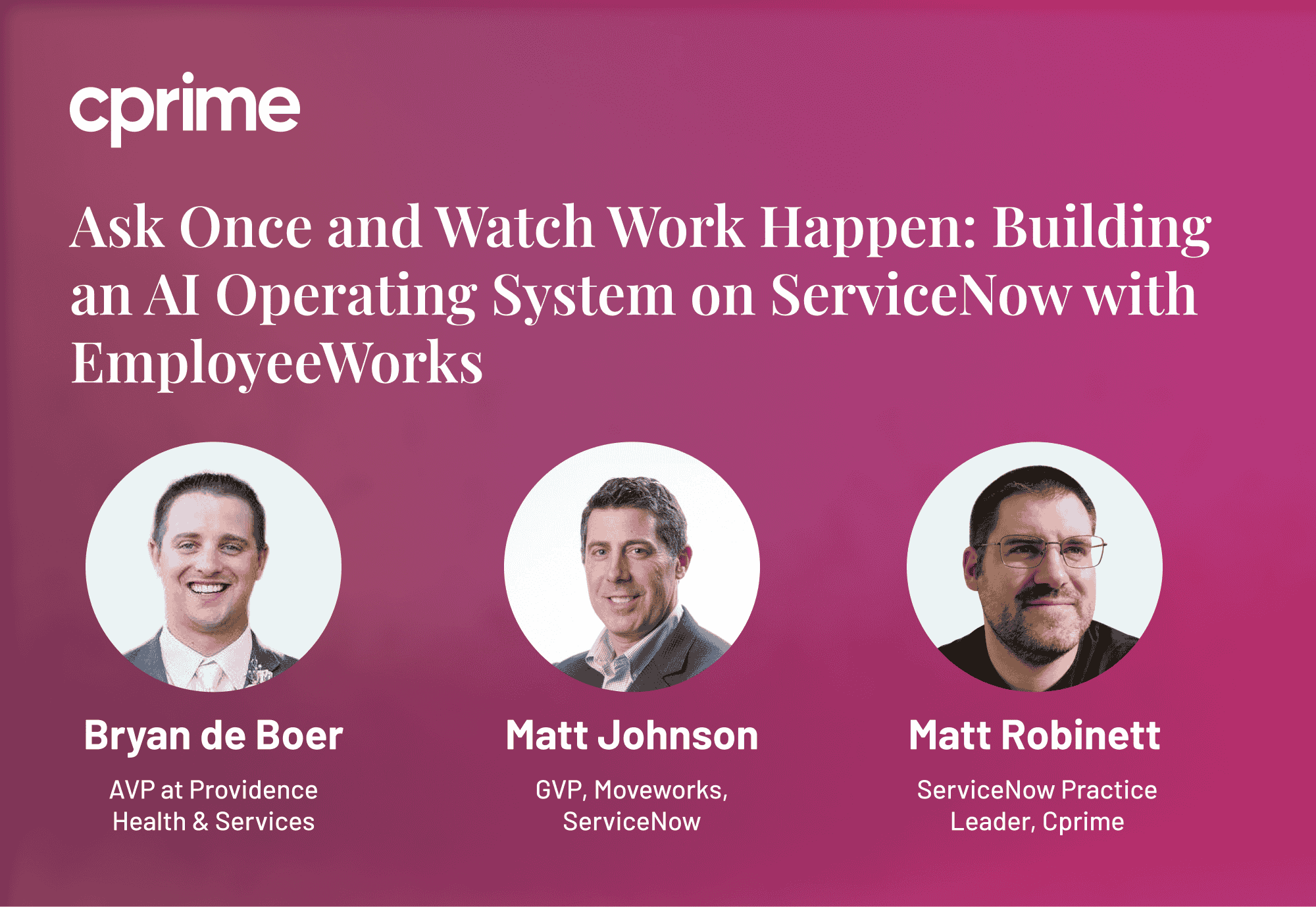
Ask Once and Watch Work Happen: Building an AI Operating System on ServiceNow with EmployeeWorks

ServiceNow-Webinar-1

A nurse finishes a 12-hour shift with three minutes to solve a problem. She opens a portal, scrolls past 200 request types, picks one, and hopes it reaches the right team. Weeks later, she might get an answer. Multiply that across 150,000 caregivers, and the cost of fragmented employee support becomes clear.

Providence found a faster way, but only after learning what didn’t work.

In this webinar, Bryan de Boer of Providence, Matt Johnson of Moveworks, ServiceNow, and Matt Robinett of Cprime share how Providence built an AI front door for employee experience with ServiceNow EmployeeWorks. Bryan explains how caregiver feedback produced a list of 100 support needs. Custom-building them took 18 months and delivered 35. With EmployeeWorks’ out-of-the-box capabilities, Providence covered 95 of the 100 in just 90 days. The panel also covers vertical versus horizontal AI, the foundations AI depends on, and where AI orchestration is headed.

The key insight: the return goes beyond faster tickets. When caregivers spend less time chasing help, they spend more time with patients. An employee experience investment becomes a patient experience investment.

Key Takeaways

  • Weigh the hidden day-two cost of maintaining custom AI before choosing build over buy.
  • Connect horizontal AI for everyday productivity with the vertical AI inside platforms like ServiceNow and Workday.
  • Clean up knowledge and data before launch, because AI repeats whatever your content says.
  • Bring HR, IT, legal, and risk into the decision early to create a true enterprise front door.
  • Keep AI costs predictable by routing everyday work to a governed enterprise assistant instead of open-ended token spend.
  • Prepare for what’s next, including voice support, employee-built assistants, and agent-to-agent orchestration.

Watch the video
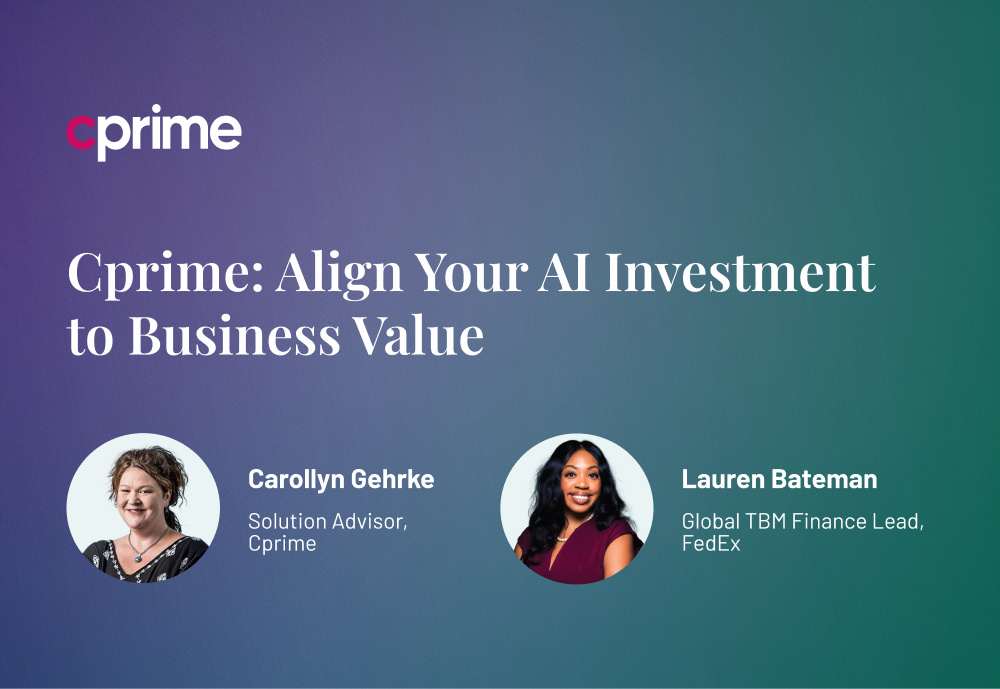
Align Your AI Investment to Business Value: How to Prove Your AI Spend to the Board

Align your AI.. (1)

IT asks the board for $5 million to expand AI. The board asks why. The answer comes back technical: unit costs are falling and productivity should rise. But AI spend, project costs, and budgets sit in different systems, and business outcomes aren’t tracked anywhere. The board hears cost, not value.

There’s a better way forward, and it doesn’t mean starting over.

In this webinar, TBM practitioners Carollyn Gehrke of Cprime and Lauren Bateman of FedEx show how to apply Technology Business Management (TBM) to AI investments. You’ll learn how to connect AI cost and consumption to strategy, ownership, and measurable outcomes, then put it into practice with a four-step roadmap. The session closes with a live Q&A answering the questions finance and IT leaders ask most.

The key insight: a token count isn’t a business outcome. Rising AI spend can be a smart investment, and falling unit costs can still mean wasted money. The difference is whether you can show the board what the spend is buying.

Key Takeaways

  • Reframe AI investment reviews around what you’re buying, for whom, and why now.
  • Extend your existing TBM practice to AI instead of building a separate cost model.
  • Scale governance as AI matures, from spend-limited experiments to full production visibility.
  • Assign clear accountability so IT runs the platform, finance owns transparency, and the business owns outcomes.
  • Pair FinOps and TBM to link consumption efficiency with investment value.
  • Start with one decision-ready slice and expand as your data matures.

Watch the video

From Configuration Chaos to Strategic Clarity: Restoring Value in Your Targetprocess Environment

Align Your AI Investment to Business Value webinar with Carollyn Gehrke of Cprime and Lauren Bateman of FedEx

Does your Targetprocess environment feel harder to navigate every year? It rarely happens all at once. A new field for an urgent report. A custom workflow for one team. A special view for one leader. Each change made sense at the time, but together they can turn a carefully designed platform into a maze that only a few people know how to get through.

There’s a better way forward, and it doesn’t mean starting over.

In this session, Cprime Solutions Advisor Carollyn Gehrke draws on nearly 30 years of TBM, portfolio, and product management experience to show how to move from supporting a tool to managing a strategic capability. You’ll learn why platform complexity, low adoption, and key-person dependency reinforce one another, and why fixing only one lets the other two recreate the same problems. Carollyn walks through a practical framework to stabilize, standardize, enable, align, and sustain your environment, along with a now, next, and later roadmap for putting it into action. The session closes with a live Q&A covering sources of truth across integrated tools, keeping governance practical, and what separates real strategic portfolio management from project tracking with extra steps.

The key insight: Targetprocess is often where problems become visible, but it’s rarely where they began. Unclear ownership, inconsistent processes, and undocumented decisions show up as a “broken” tool. When configuration is driven by the decisions the business needs to make, rather than by one-off requests, the platform becomes a trusted map of where the organization is, where it wants to go, and how to get there.

Key Takeaways

  • Diagnose the three connected challenges draining your platform’s value: configuration complexity, adoption friction, and key-person dependency.
  • Apply a five-part framework to stabilize, standardize, enable, align, and sustain your Targetprocess environment.
  • Turn individual expertise into organizational capability by documenting the intent behind configuration, not just the settings.
  • Manage Targetprocess as a product, starting with the business decisions it needs to support rather than what the tool can do.
  • Build a phased roadmap, from a 30-day risk inventory to an operating model and ongoing platform health metrics.
  • Make the case for stabilization by exposing the hidden costs of complexity, from untrusted reporting to workarounds and system drift.

Watch the video

From Idea to Impact: Getting Immediate Value from Atlassian Intelligence 

ATL-Idea-to-Impact_Ft-image-3-1

Getting disappointing results from AI? It could be because AI is often used like a vending machine — type a prompt, hope something usable comes back. 

There’s a better approach. 

This session demonstrates a repeatable, human-guided AI loop where curated discovery inputs turn Atlassian Intelligence into a true teammate that delivers actionable, high-quality work. You’ll learn a framework for improving Atlassian AI performance by providing the right context through the Teamwork Graph, a pattern that works across teams and workflows. We’ll make it real with a live product discovery-to-development example, showing how better inputs turn rough ideas into clear, buildable work. 

The key insight: AI is only as good as the context it’s given. Curation drives quality. Verification drives confidence. When humans invest in the right inputs up front and confirm the output, AI starts producing work that’s genuinely useful, and speed to value follows. 

Key Takeaways 

  • Learn a repeatable framework for improving Atlassian AI outcomes by providing the right context through the Teamwork Graph. 
  • See how curated context, not clever prompts, determines AI output quality. 
  • Build reusable context assets using pattern pages and agent configuration. 
  • Brief an AI agent the same way you’d brief a new team member. 
  • Apply the iterative loop: human curates context, AI drafts and improves, human verifies. 
  • Compress idea-to-ready timelines without sacrificing clarity or rigor 

The Work Behind the Work: Building Measurable, Compounding Value from Atlassian Cloud

Atlassian TechTalk Webinar

As Atlassian Data Center approaches end of life, organizations face a critical inflection point. Some are planning their move to cloud. Others already in cloud are asking a different question: how do we realize the value we expected?

In both cases, the challenge is the same. Moving platforms does not change how teams work. Without an intentional approach, migrations carry forward existing behaviors, adoption slows, and AI capabilities remain underused.

In this webinar, Cprime presents a clear view of what drives value in Atlassian Cloud and introduces a proven path for turning migration or existing cloud investments into measurable outcomes. We show how to redesign ways of working, govern change with discipline, and embed intelligence across Jira and Confluence so cloud supports better decisions, faster execution, and sustained improvement.

What you will gain:

  • What drives value realization in Atlassian Cloud, whether you are migrating or already live
  • The risks of moving to cloud or operating in cloud without a clear path
  • How leading organizations turn migration and cloud investments into measurable, compounding ROI
  • Why most teams capture only a fraction of Atlassian Cloud’s potential
  • How to close adoption gaps and embed AI into real workflows
  • The core elements of a path from migration to sustained performance
  • The operating model behind aligned, high-velocity teams
  • How to measure and improve Atlassian value over time

Fill out the form to watch now

Beyond AI applications: Building enterprise intelligence that actually scales

Screenshot 2025-11-13 at 5.22.56 PM

In this TBM Conference session, Konstantin Popov explains why enterprise intelligence emerges only when AI is embedded into the operating model itself. He walks through how connected decision flow, value visibility, and economic modeling create the foundation AI needs to support human judgment at scale.

You will see how enterprises move from siloed optimization to coordinated execution, where investments, work, and outcomes stay linked over time. And why that shift changes how leaders govern, prioritize, and act.

Fill out the form to watch the full session and see what changes when AI is designed into how the enterprise runs.

What is Technology Business Management?

tbm-webinar copy

Watch this lively discussion today.

Join us for this introductory webinar to explore what TBM is, why it matters, and how it enables organizations to align IT investments with business goals. Whether you’re in IT, finance, or business leadership, this session will help you understand the fundamentals of TBM and how it drives smarter decision-making, cost transparency, and strategic alignment.

Fill out the form to watch now.

See how real organizations are reshaping the way work gets done

Video_Cloud Currency_ Using FinOps to Fund Innovation

Today’s enterprises face constant pressure to move faster, prioritize smarter, and deliver value with precision. Modern operating models, product-aligned teams, and portfolio-level clarity are now essential.

This fireside conversation reveals how leaders confront cultural inertia, redesign funding models, stand up product-centric ways of working, and use tools like Targetprocess and TBM to expose bottlenecks and accelerate outcomes. The discussion surfaces practical insights on transforming mindsets, aligning teams to strategy, and preparing for AI-driven portfolio management.

Featuring:

  • Darren Wilmshurst – Managing Director, Cprime EMEA (serving as facilitator and question master)
  • Greg Holmes – Field CTO for Apptio, IBM (EMEA)
  • Dominic Kirkby – Acting Portfolio and Tooling Product Owner, Skipton Building Society

Learn what actually works inside organizations navigating this shift, including the lessons they would repeat and the ones they wouldn’t.

Cprime Conversations Podcast, Episode 1

podcast-ep1

Your operating model isn’t broken… it’s disconnected.

Join Oona Ziegler and Konstantin Popov from Cprime’s Enterprise Technology and Financial Management practice as they unpack the critical shift that separates thriving enterprises from struggling ones. In this inaugural episode of Cprime Conversations, you’ll learn why well-intentioned transformation initiatives keep falling short, and discover the proven framework that leading companies are using to navigate disruption, optimize costs, and unlock sustainable growth. 

Key Learnings:

  • Learn why successful companies moved from cost-center waterfall models to capacity-based, product-platform operating models, and how this single change is driving breakthrough results
  • Discover how deploying “best-of-breed” tools without integration creates organizational bias and process fragmentation that sabotages transformation efforts before they even begin
  • Understand why documenting business processes and getting your data model right today is essential preparation for the AI-first operating model of tomorrow