
Author: Elizabeth Walsh

Enabling ITSM Change Management Using Jira Service Management

In the fast-paced world of IT and software development, changes are inevitable. From software updates to infrastructure modifications, transitions can often lead to challenges and frustrations within an organization. But what if there was a way to manage these changes effectively, reducing the impact and scope of disruptions? Enter Jira Service Management (JSM), a powerful tool for enabling ITSM change management.

This is the first in a three-part series covering ITSM principles and applying them using JSM:

  • Enabling ITSM Change Management With JSM
  • Streamline Your ITSM—Service Catalog and CMDB Powered by JSM 
  • Perfecting Customer Management Using JSM

Change management is crucial in any organization. Without it, companies run the risk of encountering server downtimes, leading to confusion, stress, and frustration among employees and users alike. These downtimes not only affect productivity but can also tarnish a company’s reputation.

This article is based on the webinar, How to Enable Change Management With Jira Service Management. Watch the recording now to learn more about what’s discussed here and to see a thorough demo of JSM reflecting the key learning points. 

Unpacking the basic change management concepts 

The webinar linked above covered some important concepts every IT professional should know:

Change Management and Change Enablement

At the core of any IT operation lies the ability to manage and enable change effectively. But, what do these terms mean in the context of IT services and software development?

Change management, as defined by ITIL, is an Information Technology Service Management (ITSM) practice designed to minimize risks and disruptions. It ensures that critical systems and services remain functional amidst changes. This could mean anything from updating API documentation to deploying code to different environments. Any addition, modification, or removal that directly impacts services, processes, configurations, or documentation falls under this umbrella.

On the other hand, change enablement is a term used in Atlassian documentation. It refers to team standards that permit users to handle change requests effectively. Unlike change management, which is often associated with processing changes from outside, change enablement facilitates changes originating from within the organization.

Implementing change using ITIL 

It’s important not to rush the implementation of change. As counterintuitive as it might sound, taking extra time to set up and stick to a change management program can actually improve the process. It might seem to slow down work initially, but embracing ITIL patterns and automation will improve efficiency and reduce the heavy costs associated with botched tasks. The mantra here is to slow down to go fast.

Automation is a valuable tool for minimizing the burden of heavier tasks like documentation. Traditional tools may have complex, manual components that slow down processes and increase the chance of error. In contrast, tool automation can alleviate this heaviness. For example, automating ticket creation and linking various components can significantly reduce the time and effort required for these tasks.

Explore how AI-powered service management can take automation to a whole new level!

Roles and responsibilities in change management

Two key roles in change management are the Change Advisory Board (CAB) and the Release Manager.

Change Advisory Board (CAB)

The CAB plays a pivotal role in overseeing changes within an organization. Composed of senior individuals knowledgeable about the area undergoing change, the CAB provides a holistic perspective on the implications and potential impacts of proposed changes.

Release Manager

Working closely with the CAB is the Release Manager. This role involves reviewing content submitted by the development team, ensuring all aspects of a change request are in place, from documentation to testing assurances. The Release Manager serves as an agent to the CAB, mitigating risk through standardization and completion of requests.

In addition to their review responsibilities, the Release Manager coordinates the personnel involved in implementing changes, checks schedules for conflicts, tracks the process with the CAB, and ensures communication among all stakeholders.

The importance of timing in change management

However, effective change management isn’t just about having the right roles in place. It’s also about timing and planning. 

Respecting the process means submitting changes well before the release date. Common issues like time crunches for development and deployment can pose challenges to the change management process. To alleviate this, sufficient time should be allocated for change management processes during project planning. For example, incorporating an extra sprint for deployments could help manage changes more effectively.

Categorizing changes in a technology organization

Changes are categoric and can be differentiated based on size, risk, and urgency. Understanding these categories is crucial for efficient change management, particularly in a Continuous Integration/Continuous Deployment (CI/CD) setting.

There are three main types of changes:

  1. Standard Change: A low-risk, pre-authorized change that is well understood, fully documented, and proven. Due to CI/CD pipeline practices, standard changes are becoming more frequent.
  2. Normal Change: This refers to non-emergency deployments that must be scheduled and planned. These changes typically require a review from the Change Advisory Board (CAB)
  3. Emergency Change: These are changes that require immediate fixes due to an urgent issue. They often involve a separate procedure with a shorter timescale for approval and implementation.

Regardless of the type, no matter how small the change, it should not bypass the established process for change management. Each change must be properly documented, reviewed, and authorized to ensure minimal disruption to services and operations.

Moreover, understanding the nature of these categories and the associated efforts helps organizations manage changes efficiently. It provides clarity on the level of risk involved, the amount of effort required, and the urgency of the change.
Organizations may need to adjust internal policies based on the perceived risk level of each change. For instance, well-performing teams that have demonstrated their ability to manage risks effectively might be allowed to make production deployments multiple times per day.

Embracing ITSM change management in Jira Service Management

Effective change management strategies create a stable environment and help avoid panic-driven experiences. And at the heart of this strategy lies Jira Service Management.

JSM is a comprehensive tool that assists organizations in planning, controlling, and understanding the impact of changes on their business. It simplifies the change management process, from the initial change request to implementation.

With the ability to provide richer contextual information around changes, JSM empowers IT operations teams to better manage and mitigate potential disruptions. Furthermore, its customizable workflow—designed based on ITIL recommendations—helps service agents learn and adapt to change management processes. By implementing a change management process in JSM, companies can keep track of all changes, ensuring nothing slips through the cracks.

Jira Service Management’s alignment with ITIL 4 is one of its key strengths. This association allows it to offer a comprehensive solution that aligns with software development tools and agile practices, making it a favorite amongst software professionals.

This alignment with ITIL 4 makes ITSM change management in Jira Service Management less bulky than its predecessors and more adaptive to an agile mindset. This adaptivity is further enhanced by the free ITSM template within JSM. It includes change incident, new feature, problem, and service request issue types along with the corresponding request types, giving users a head start in their change management journey.

Additional customizable templates are available as well. 

The ease of use and familiarity of Jira Service Management reduces barriers to entry, making it approachable for professionals from the software side. It’s a tool designed to facilitate and not complicate, making it a go-to for many organizations seeking to streamline their change management processes.

Conclusion

In conclusion, the adoption of change management and change enablement practices, underpinned by ITIL patterns and automation, can bring about significant improvements in the efficiency and effectiveness of tasks within an organization. With tools like Jira Service Management, which aligns with ITIL 4 and supports agile practices, organizations can navigate changes smoothly, reducing the risk of disruptions and costly errors.

The journey towards effective change management may seem slow initially, but remember, slowing down to go fast can lead to long-term benefits. With the right tools and guidance, you can minimize risks, improve efficiency, and foster a culture that embraces change.

To dive deeper into how JSM can revolutionize your change management process, consider watching the recorded webinar, How to Enable Change Management With Jira Service Management. It offers practical insights and a demo that can help you understand the capabilities of Jira Service Management better.

The Pivotal Shift from Projects to Products: A Leader’s Perspective

Organizations today face immense pressure to deliver value faster while remaining agile and responsive to market changes. This requires a fundamental shift from project-centric to product-centric thinking. As leaders, how can we spearhead this transformation?

Defining Projects vs. Products

First, let’s level set on what we mean by “projects” and “products”. Projects are temporary endeavors focused on creating a unique product or service. They have defined start and end dates, scope, budget, and resources.

Products are the ongoing services or capabilities we deliver that create value for customers. Products have a much longer, often indefinite, lifespan focused on enhancing, sustaining and maintaining value.

The core differences

In project management, the emphasis is on managing the “iron triangle” of time, budget and scope. Requirements are defined upfront and success is measured by on-time, on-budget delivery.

With products, we flip the triangle and make scope the variable factor. The focus becomes delivering outcomes iteratively without pre-defining the full solution upfront. Timeframes are shifted from months to years or decades. Success is measured by the product’s impact and ability to continuously adapt.

The leader’s pivotal role

As leaders, we play a crucial role in this transformation in two key ways:

Rethinking how we define and measure success

In addition to delivery progress, we must focus on:

  • Product resilience – the flexibility and recoverability of our products and code
  • Business impact – are we truly solving problems customers want solved

We should frame investments and scope based on priority outcomes, not predefined requirements. And view changes as signs of learning and responsiveness, not failures in planning.

Leading the organizational change

The shift can’t happen through teams alone. As leaders, we must role model new behaviors and ways of working top-down across the organization.

Key steps include:

  • Communicate your commitment to the change and why it matters
  • Implement vertically, not horizontally—transform entire portfolios before moving to the next
  • Change how you ask questions and measure progress
  • Get hands-on and address real obstacles raised by teams

Measure what matters

As leaders, we should focus less on “when will this project be done?” and more on questions like:

  • What are our highest priority outcomes?
  • What can we validate or release next?
  • How much should we invest in this initiative?
  • Are we working on the most valuable thing right now?

By measuring what truly matters—outcomes, customer impact, and ability to change—we can guide our organizations into the product-centric mindset needed to thrive today. It requires commitment, communication, and hands-on leadership. But the payoff can be immense in terms of speed, agility and delivering real value to our customers.

5 must-dos for leaders to pivot from Projects to Products

But fundamental change doesn’t happen bottom-up. It requires committed leadership. Here are five key shifts leaders must make to drive and sustain this transformation:

Know your “Why”

Be able to clearly explain why pivoting to a product focus matters for your specific organization and customers. Is it to increase ROI on product investments? To be more responsive to market needs and competitive threats? Know your reasons for change inside out.

Measure what truly matters

Expand your framing of success beyond delivery progress. Laser-focus on improving product resilience, flexibility, and business impact. Guide teams to validate priorities early through continuous testing and customer feedback.

Invest based on outcomes

Rather than starting with a project plan and budget, first identify the priority outcomes you want to achieve. Then make purposeful, focused investments of time and budget to deliver on those goals. Let scope vary.

Change your questions

One of the most influential things leaders do is ask questions. So consciously change yours to reinforce new behaviors. Ask “What can we validate next?” instead of “When will this be finished?”

Lead the change you want to see

Don’t just talk the talk. Role model the hands-on leadership required to address real adoption barriers raised by teams. Transform entire portfolios, not just teams. Reset organizational norms through your words and actions.

The world has changed, and project thinking is no longer enough. As leaders, the transformation to product starts and ends with us. We can build organizations optimized for the speed and adaptability needed to win today. It won’t be easy, but few things worth doing ever are. The payoff will be delivering far more value to customers when and how they need it.

OKRs vs. KPIs vs. Agile Metrics – Which Do I Really Need?

If you have been working on projects for any amount of time, you will probably have come across a variety of metrics that are required by your organization or chosen on your own to help you track those projects. If you are like me, you have led projects and are familiar with metrics such as CPI or SPI, and may have also dabbled with other metrics, such as velocity or throughput. 

As more organizations try to stay on top of the latest trends for tracking project health, there seems to be a rise in the complexity of the various ways we try to measure organizational or team health, and they seem to get more confusing as well. I wrote this article to dispel some of this confusion so that project workers can decide what makes the most sense in their specific situations.

What are the differences between KPIs, OKRs, and Agile metrics?

Before we can compare the metrics, let’s first clarify the definition for each.

  •       OKR – Objectives and Key Results
  •       KPI – Key Performance Indicators

Summary of key metrics

Attributes OKR KPI Agile Metrics
Sample Use Case Define a high-level objective for the team, project, and/or organization Assess performance of a project or organization Assess performance of a specific team (or a team of teams)
Examples Increase the utilization of office workspace by 50% by Q3 How many employees use their office workspace every day?  How much work did the team complete on average over the past 6 sprints?
Scope of Application Team or Org level Org/Business-level objectives Team or Org level
Key Benefits Provides target to work towards Provides validation/comparison against previous forecasts May be used to forecast future performance
Focus Future Past Past or Future
Periodicity Quarterly or Annually Annually Variable


Which metrics do you need to track?

One of the most challenging aspects of metrics is that it is easy to lose sight of the reasons why your organization is spending money to track this data. There are many reasons for this, and one of the most common behaviors is related to the reward system being used to measure performance at either the team or individual levels. We have all seen situations where metrics are used to give out monetary incentives, which often leads to unintended behaviors and consequences. 

One of the key things I try to remind teams I coach is to measure what matters, because what you measure ultimately influences how people behave. Even if there are no direct financial rewards tied to the measures, people are motivated by achievement and want to feel good about what they do. 

So how do we choose the right metrics to inspire our teams to perform at their highest level, yet not compromise their values or ethics? Here are a few ideas to consider:

  1.     Measure what they do day-to-day
  2.     Ask the team to define what they think “good” looks like
  3.     Inspire the team to focus on continuous improvement

Connecting the dots between different layers of metrics

Even if your team has deployed a sophisticated system for tracking metrics, your work may not be done yet. 

We know that there are multiple levels of metrics within an organization, and team level is only one of those layers. One of the worst things we can do as leaders is to deploy metrics that have no direct relationship to the work that the team is doing. For example, it would not make sense to set a goal for a team of software developers to increase sales by 25%. That said, if you can somehow make a connection between the quality or productivity of their work and sales figures, then you can influence this team to perform differently.

If your organization desires to become the largest provider of a specific service or product, you must define how the individual contributors and teams will make an impact through their daily activities. An example of this might be the defect rate. If a team can improve the organization’s ability to gain more market share or increase revenue by increasing the product quality (i.e. reducing defect rate), this would provide a direct correlation from the team to the end objective.

One method of achieving this is to tie the team metrics to KPIs at the project level. Then, you can align your KPIs to the OKRs at the highest strategic level of your organization. This will probably take a bit of work to implement, especially if your organization is not accustomed to this approach.

How to tell if these metrics are providing benefits?

In terms of the impact that is being made by the use of metrics, typically trending is a good technique to help evaluate the direction of the team’s performance. 

For example, if the defect rate is increasing over a period of several months, that’s clearly not a positive state. However, if this trend is flat, that may signal either a positive (i.e. high predictability and consistency) or a negative (lack of improvement). Trends in your data will tell a story, but you must set the foundation to make sense of this story, determining as early as possible what “good” looks like. 

With all the advancements in software tools and the ability to collect massive amounts of data, it is increasingly important to take time to make sense of the data. This will require analytics and potentially the aid of artificial intelligence to determine the meaning behind the data. If you have a good idea what “good” looks like, you can compare the real data to your desired outcomes and assess how things are going.

For more guidance on how to best measure the efficacy of your Agile practice, dive deeper with the article, Agile Metrics – How Do They Boost Team Performance? 

The Pragmatic Agile Coach’s Approach to Product Thinking and Portfolio Governance

When does a transformation often hit the wall as it looks to make additional progress within an organization that’s seemingly eager to embrace Agile ideals and principals? Look no further than the Program Governance Board.

The Governance Board

Depending on your organization, this board may have different names—a Steering Committee, Oversight Committee or even Board of Directors. Whatever its title, the Governance Board is made up of executive-level stakeholders with strategic insight into the company’s goals and objectives, technical knowledge, functional responsibilities, operational accountability, portfolio management responsibility, and the ability to represent important stakeholder groups. 

In traditional organizations, funding for projects may be via a single source or through multiple Portfolios. The governance of the project will vary to meet the needs of the stakeholders in the project and the lifecycle chosen.

In this way of thinking, all projects require funding in some way. In most situations, money needs to be provided to implement the project. It is the business case that provides the justification for this funding and the Governance Board doles out the money.

My mind always goes to the smoke-filled rooms of the past. With the Governance Board making decisions, in most cases, it is not based on empirical data, but instead heavily influenced by the pervasive organizational culture. If the culture is conservative and risk averse, they allocate funds with an eye dropper. If the organization has an “old boys” network, bargaining goes on – “I’ll give you the money for the infrastructure upgrades you want, if you give me what I need to implement the new CRM tool.”

What is often a detrimental part of this process is the way it denigrates the teams which are the cornerstone of any IT organization by making them “grovel” for funds each year; and more significantly, the colossal waste of time that comes from all parts of the organization having to annually “justify their existence.”

When is a Product a Product?

Make a Wish was an American children’s television series which ran in the 1970s. In it, the host would introduce a word and discuss the many various meanings it might have. “What is a ball? A ball can be something you toss to a friend. A ball could be a dance Cinderella attended. You could ‘have a ball’ meaning a good time. Or a ball could be a type of jar.” As a young child, I remember being utterly confused by the end of the segment and wondering, “so what the heck is a ball?”

The same is true when we as Agile Coaches introduce “Product Thinking”. Exactly what is the Product we are managing? If we are working with a bank, a product could be the “Everyday Checking” product they offer to their customers. A product could be the AI-based loan qualification system. A Product could be the Financial Advisor services they offer as an additional revenue stream.

Weeding through the confusion

My mentor in all things Product Agility, Anne Steiner sums it up this way:

Product Agility is having that ability to get common alignment with what we’re building, why we’re building, who we’re building it for, and then bringing that all the way through that process: shortening those delivery cycles so that we can learn faster by having real code in the market real validation of our assumptions, and then adjusting. Product Agility is unlocking a company’s ability to learn to maneuver and pivot.”

I have had success framing the discussion of Product in this way:

A Product:

  • satisfies a business need
  • delivers value to the stakeholders (internal or external)
  • has a clear boundary and customers
  • achieves some measurable value

These examples might help to provide leaders with a pragmatic way of thinking of their products:

Consumer Products:
Products which satisfy the needs of an end customer
Business Products:
Products which satisfy the needs of internal customers (generally called Businesses)
Services as a Product:
A product could be a service
An Electric Bicycle HR Management system for employees who manufacture the bicycles Coordinated service arrangements for repairs under warranty
Chocolate Chip Cookies ERP system for managing the supply chain of raw material and finished cookies An automated baking process
Commercial Flags CRM system for managing the leads and prospects for flag sales Delivery of the flag to the customer

The next step in having leaders from both the Agile transformation and traditional PMO move forward with a more flexible funding approach is finding a way to help them comprehend how the two seemingly disconnected concepts of Project Funding and Product Agility are intertwined.

The example of the “Website Project”

Something virtually every organization can quickly wrap their head around is their web presence on the Internet. They all will have a website which ‌serves multiple purposes. It falls squarely into the Business Products category we defined for Product Agility. The benefits the website provides will be readily known to these leaders and easily understood:

  1. Create a global presence 
  2. Act as a point of contact 
  3. Sell products
  4. Share the latest news 
  5. Learn about customers
  6. Market your organization to potential employees 

So, if we agree the website should be treated as a Product, we can then move into the more challenging cultural shift of how we budget for the work. 

In a traditional Governance Board model, we would be required to go into that “smoke-filled room” with our funding requirements for the following year. We may be expected to provide any or all of the following:

  • Project Plan
  • Business Case
  • Project Schedule
  • Risk Register
  • Scope Statement
  • Project Budget
  • Business Requirements Document (BRD)
  • Resource / Capacity Plan
  • Project Proposal
  • Project Brief

All of this to justify the existence of a team (or group of teams) who is already acknowledged as providing a technical solution which is integral to the organization. The Project Packet with the aforementioned documents is taken to the Governance Board looking for a Go / No-Go decision.

Is it really in the realm of possibilities that the Website Product will not be funded?

There is a better way—Lean Portfolio Management

In our example, Leadership may come to acknowledge that traditional methods of portfolio management are not aligned with the needs of their Agile website product. An alternative approach is to adopt Lean Portfolio Management practices. Lean Portfolio Management (LPM) describes how senior leadership applies lean principles to connect strategy to execution. Portfolio management teams learn about an enterprise’s strategy and allocate a budget towards the execution of that strategy.

Like any portfolio, an LPM portfolio of investments is creatively determined and actively managed across the investment life cycle. The primary emphasis of LPM is to align Agile development with business strategy, with a focus on driving the delivery of value to customers through the creation of products and solutions. Combining LPM with Agile development practices offers a path to improving business agility.

While traditional Project Portfolio Management focuses on creating a set of tightly structured project plans and building short-lived teams to execute those plans, LPM focuses on:

  • Bringing loosely structured value opportunities to long-standing teams-of-teams
  • Asking teams to define the needed work
  • Monitoring emerging solutions to iterate toward market fit

One of the biggest benefits of moving to a value-based funding model (in our example based on the value the website returns to the organization) is that much of the decision making is pushed down the organizational structure to the team themselves. Your development team has the information to make the best decisions. 

Additionally, value-based funding improves the quality and working environment of your teams. For example, projects often start and stop, and teams get reallocated. But with this value-based product-centric approach, you maintain the same knowledge on the same team and keep development flowing continually. You also eliminate the demoralizing exercise of “justifying one’s existence”. This gives your developers deep subject matter knowledge on their software and lets teams build a natural rhythm based on working with one another over an extended period, thus improving their productivity.

When a budget overrun happens in a project, it can cause major development delays while the entire project is recalibrated. Setting annual budget boundaries for the team, aligned to the value they provide, helps to eliminate such delays.

Achieving an outcome where a traditional organization embraces the concepts of Product Agility and Lean Portfolio Management is no small feat. It will require patience and the ability to “sell” leadership on the value these changes will bring to their organization. But as LPM becomes more pervasive in the marketplace of ideas, it will allow Coaches to focus leaders on the benefits of keeping development teams aligned and working uninterrupted, maintaining an openness to change and empowering development teams while keeping the focus on bringing the greatest amount of business value to your organization.

If you’d like to dive deeper into a solution to the portfolio management conundrum, consider our white paper, “Getting Started with Portfolio Management” or our webinar, “How to Get Started With Lean Portfolio Management”.

Lessons and Warnings from the Original Chatbot – ELIZA

“The thing about an AI is, it’s not human. You can’t get any sense of what it’s like to be one.”
The Finn from William Gibson’s classic Sci-fi novel, “Neuromancer,” published in 1984.

The current generation of AIs is truly remarkable, even from the perspective of a long-ago former AI researcher like me. These AI assistants have evolved from mere research toys to valuable tools in various domains

I extensively use ChatGPT to write blogs, develop course outlines, create examples and quizzes, and summarize data. It has become an invaluable time-saving assistant, akin to having a competent intern. 

Furthermore, it assists in divergent thinking by allowing me to generate and explore many more ideas than I previously could. Exploring a larger solution space enhances my ability to consider more solutions more rapidly. 

However, amidst this remarkable progress, we must also be mindful of the potential pitfalls, such as the loss of human experience and the consequences of built-in bias resulting from blindly accepting computers as decision-makers and conversation partners.

Meet ELIZA

In the fast-paced race towards the remarkable and potentially daunting world of AI assistants, it’s important to pause and recall the lessons learned from one of the pioneers in AI research—Joseph Weizenbaum—and his program ELIZA, often regarded as the first chatbot. 

Joseph Weizenbaum developed the ELIZA program in the mid-1960s while working at the MIT Artificial Intelligence Laboratory. ELIZA garnered attention and popularity with its ability to engage users in text-based conversations. By utilizing pattern matching and scripted responses, ELIZA created the illusion of understanding and empathy, sparking interest in human-computer interaction and the potential of AI in simulating conversation. All while running on an IBM 7094 with 32 kilowords of memory.


Emotional attachments?

To Weizenbaum’s surprise, users began forming emotional attachments to ELIZA and even divulging personal and sensitive information during interactions. Despite being aware of ELIZA’s artificial nature, people projected their own thoughts and emotions onto the program. 

One incident that deeply impacted Weizenbaum was when his secretary asked him to leave the room during an intimate conversation with ELIZA. As an aside, William Gibson explored this topic in his novel Idoru, where a rock star falls in love with an AI, raising questions about the nature of love, identity and the relationship between humans and AI.

ELIZA’s profound impact on users’ perceptions made Weizenbaum realize that humans are susceptible to developing emotional bonds with machines, even without true understanding or awareness. This realization shaped his critical perspective on AI and its limitations, as explored in his book “Computer Power and Human Reason.”

Lessons from ELIZA

“Computer Power and Human Reason” critically examines the impact of computers and AI on human society, particularly in relation to human values, judgment, and the preservation of meaningful human connections. 

Weizenbaum raises concerns about the potential dehumanization and loss of authentic human experiences stemming from an uncritical acceptance of computers as decision-makers and conversational partners. The book cautions against blindly relying on AI without considering its limitations and potential ethical implications. 

Several ethical issues highlighted by Weizenbaum are worth pondering. 

Oversimplification and reduction of complex issues

First, the reliance on AI can lead to the oversimplification and reduction of complex issues, depriving us of the nuance and critical thinking required for deeper understanding and decision-making. 

Dehumanizing human interactions

Second, excessive reliance on technology might dehumanize human interactions, diminishing the authentic emotions, empathy, and understanding that only humans can provide. 

Errors, biases, or undisclosed vulnerabilities

Third, blind dependence on AI systems can create vulnerabilities because of errors, biases, or undisclosed vulnerabilities, which may have far-reaching consequences. 

Undermining human autonomy

Last, relinquishing decision-making power to machines undermines human autonomy and responsibility, as humans should always remain accountable.

Real-world precedent today

These concerns are not merely theoretical, debated in a second-year ethics course. These are real ethics issues with real-world consequences. 

For instance, ChatGPT is known to generate false answers or hallucinate, as evidenced by the viral story of a lawyer who used ChatGPT to draft a brief, only to realize in court that none of the cited precedents were factual (NY Times May 23). 

Using AIs as decision-makers in domains like filtering resumes or granting credit can introduce biases perpetuating social inequalities (Time Magazine).

Finally, AIs can make bizarre choices from a human point of view (Guardian May 1 2023).

Are we doomed to repeat history?

There is a saying: those who fail to learn from history are doomed to repeat it. 

ELIZA was an experiment. A toy. Our chatbots are not mere toys anymore. With 50 years of AI research and six orders of magnitude increase in computer power, they are powerful tools. The consequence of repeating history will also be correspondingly greater. 

Powerful tools can deliver significant benefits but come with powerful consequences. We must learn how to wield them safely. Just like tradespeople spend years mastering tools that could harm them, we should approach AI with a similar mindset. 

Similarly, as we navigate this remarkable future, it’s the wise course to learn from the first chatbot and explore Weizenbaum’s “Computer Power and Human Reason.” 

The world we need to navigate with AI is not about job loss or even killer robots, but the risk of loss of human agency and accountability. By reflecting on the lessons and warnings from ELIZA and other pioneers in AI research, we can navigate the future of AI more thoughtfully and responsibly, ensuring that the human experience remains at the forefront of technological advancements.

Recommended reading

Additionally, you should delve into the two science fiction novels by William Gibson mentioned in this blog that explore the relationships between AIs, virtual reality, and humanity. 

“Neuromancer” (1984) Neuromancer” is a groundbreaking science fiction novel written by William Gibson. Set in a dystopian future, it follows the story of a washed-up computer hacker named Case who is hired for a dangerous heist involving artificial intelligence, virtual reality, and corporate intrigue, ultimately exploring themes of identity, technology, and the blurred boundaries between humans and machines.

“Idoru” (1996), “Idoru” showcases Gibson’s skill in envisioning a future where AI and virtual personalities play significant roles in society, challenging conventional notions of love, intimacy, and personhood

If you are interested in exploring ELIZA, you can access or download various versions of the program from reputable websites and repositories dedicated to preserving and sharing historical software.

Empowering the Future of Business: The Synergy of Agile, Digital, and AI Transformation

Every decade, a transformational wave happens in the world of software. We’ve seen it with Agile, then with the cloud, and now we are riding the currents of AI-powered capabilities. 

To stay competitive, businesses must embrace these new waves of transformational approaches. Agile, digital, and AI transformation are three interconnected pillars that hold immense potential for driving innovation, growth, and success. 

Transformation defined

Agile Transformation: Agile methodologies enable organizations to respond quickly to changing market dynamics and customer needs. By breaking down silos, fostering cross-functional teams, and promoting iterative development, Agile transformation facilitates rapid innovation and reduces time to market.

Digital Transformation: Digital transformation involves integrating digital technologies into all aspects of business operations, processes, and customer experiences. Digital transformation enables organizations to unlock additional revenue streams, optimize processes, and meet the expectations of digitally empowered customers.

AI Transformation: AI transformation is the strategic adoption and integration of artificial intelligence technologies into business operations and decision-making processes. AI transformation empowers businesses to optimize operations, improve customer experiences, and unlock new levels of efficiency, accuracy, and innovation.

The synergy of Agile, digital, and AI transformation

Agile, digital, and AI transformation are mutually reinforcing. Here’s how they synergize:

  • Agile enforces digital transformation by promoting iterative development, rapid prototyping, continuous feedback, and collaborative cross-functional teams, which drive adaptability and responsiveness, essential for successful and evolving digital initiatives.
  • AI accelerates digital transformation by automating processes, providing data-driven insights, enabling predictive analytics, and enhancing customer experiences, leading to greater efficiency, innovation, and competitive advantage in the digital landscape.

Agile mindset for digital and AI adoption 

  • Agile methodologies provide the flexibility and adaptability needed to embrace digital and AI transformation. 
  • Agile practices enable organizations to experiment, iterate, and quickly adopt emerging digital technologies and AI solutions, ensuring that transformation efforts respond to market demands and customer expectations.
Digital enablers for Agile and AI implementation 
  • Digital technologies provide the infrastructure and tools necessary to support agile and AI transformation. 
  • Cloud computing enables scalable and on-demand resources for agile development and AI model training. 
  • IoT devices generate real-time data for AI applications. 
  • Data analytics fuels insights and informs agile decision-making. 
  • Digital enablers lay the foundation for successful agile and AI implementation.

AI for Agile decision-making and automation 

  • AI enhances Agile decision-making by providing data-driven insights, predictive analytics, and intelligent automation capabilities. 
  • AI-powered tools help Agile teams identify patterns, optimize processes, and make informed decisions. 
  • AI-driven automation streamlines Agile workflows, accelerates development cycles, and enables continuous integration and delivery, maximizing the benefits of Agile transformation.

Agile and AI for digital innovation 

  • Agile methodologies facilitate rapid experimentation, iterative development, and customer feedback, essential for driving digital innovation. 
  • AI transformation enhances digital innovation by leveraging advanced analytics, personalization, and intelligent automation. 
  • Agile, combined with AI, enables organizations to create innovative digital products, services, and experiences that meet evolving customer needs and drive competitive advantage.

This is only the beginning

The convergence of Agile, digital, and AI transformation represents a powerful force that drives innovation, efficiency, and growth. 

Agile methodologies enable organizations to embrace change, while digital technologies provide the foundation for seamless digital experiences. AI transformation empowers businesses with intelligent decision-making, automation, and advanced analytics. Together, these pillars form a robust framework for organizations to navigate the digital age, stay ahead of the competition, and create value in an increasingly dynamic and technology-driven landscape.

Cprime has been helping organizations transform for the past twenty years. We’re recognized leaders in the Agile and digital transformation spaces, and will bring the same vast experience to bear on your vital AI transformation too.

Interested in building a sound strategy around AI? Let’s chat through your goals. 

How Do Agile Metrics Actually Boost Team Performance?

The management expert and author Peter Drucker famously said, “You cannot improve what you don’t measure.” Eliyahu Goldratt, author of “The Goal”, said, “Tell me how you will measure me, and I will tell you how I will behave.” Both quotes highlight the importance of metrics in everyday business operations.

Why do metrics matter?

If your team has a desire to improve, you have to first find out where the team stands currently. This simple rule applies to many other domains; from business strategy to personal goals, it is nearly impossible to change our current state unless we know what that is. 

If we wish to lose weight and live a healthier life, we need to know how we are doing against the standards; is our cholesterol or blood pressure too high or too low? The only way to know is to measure it. 

Another critical step towards improving your current state, whatever that might be, is to establish a desired future state. We must define what “good” looks like so that we can work towards it, and be able to assess if we are making progress as well as when we reach that goal.

As Goldratt noted, external forces and perceptions heavily influence us. Whether it’s our management, our partners, or our peers, we are ‌sensitive to how they perceive us; how they evaluate our performance has a tremendous impact on what we do. 

Impact of metrics for your team

So, how do these thoughts relate to Agile metrics for your team? 

We need to be careful about how we measure our teams and their performance, because using the incorrect method of measurement can lead to negative consequences. If we are interested in improving team performance, we must first define what the desired end-state looks like. 

What does “good” look like?

Is achieving a 25% increase in story points what we want? Or, is it a 10% decrease in rework? Alternatively, do we want the team to reduce technical debt by 25% before Release 2.0?

Defining specific measures is a critical step that many teams do poorly. If we want more output, perhaps measuring an increase in story points is the right approach. However, we must consider the possibility that more points completed does not actually translate directly to higher value delivered to the customer. Similarly, a decrease in technical debt, usually a positive, may or may not mean that the team has found a predictable, consistent approach to ensure that technical debt does not grow again in the future.

This may feel somewhat backwards, but to ensure you choose the proper metrics, I recommend you first consider the desired behavior, then select a metric associated with that behavior. 

What metrics make sense for you?

If you want the team to improve their ability to plan and forecast work more consistently, one metric you can track is percentage of work completed versus planned

This metric is easy for the team to calculate and monitor without doing much extra work; most Agile management tools will provide this by default. Percent complete provides direct insight into the team’s ability to plan and execute work, and also adapt to new learnings during a sprint or program increment. Define success as achieving a stable and repeatable completion rate.

Another example: If you wish to improve the quality of the work produced by your team, defect rate would provide great insight into how the team is performing. There are other related metrics that the team may use to achieve this, such as unit test coverage, which is also relatively easy to establish and monitor.

In summary, applying the right metrics for your team is a tricky challenge that requires some experimentation. Often, it makes sense to encourage the team to come up with their own measures to monitor. If you can help them understand the desired behavior and outcomes, and provide the space for them to define their own metrics, your team will take a big step in the right direction towards becoming a high-performing team.


Value-based Planning and Enterprise Agility

In the first article in this series, we discussed three challenges standing in the way of Enterprise Agility:

  • Lack of visibility
  • Not being focused on value delivery
  • Failing to train effectively

Assuming those challenges are being addressed, the next vital factor in the pursuit of Enterprise Agility is the formulation of an effective strategic plan. 

The following content is taken from a webinar entitled, “Enterprise Agility with Jira Align: Planning for Value”. 

Why planning is vital

“If you fail to plan, you’re planning to fail.”

That line is a cliche for a reason — it’s absolutely true and it applies to nearly every aspect of life. Looking at it from a business perspective, planning accomplishes some powerful things:

  • Helps us clearly identify our goals
  • Helps us understand the benefits of various potential actions
  • Improves resource utilization so we can accomplish more
  • Helps us understand the scope of effort required to reach an outcome
  • Helps us identify the risks and roadblocks that may stand in our way

When organizations are pursuing Enterprise Agility, there are some specific aspects of planning that support that effort:

  • A vision to plan against
  • The scope of time in which parts of that vision must be executed
  • A practical sense of how much work can be delivered in that amount of time
  • A backlog of work items to be delivered in that time block
  • The ability to prioritize those items so the most valuable items are completed first
  • A buffer to allow for inevitable change

In some cases, organizations develop annual or quarterly plans without including some or all of these important facets. The resulting plan will certainly not support agility, and may not even support success.

How data drives “pivot or persevere” decision making

As a plan is developed, there are two basic ways to go about it:

  1. Hope and pray
  2. Base it on the data

The preferable method should come as no surprise. But it’s surprising how many companies choose door number one in a practical sense. 

It doesn’t work to set up strategic plans based solely on what you wish you could accomplish in a year or a quarter. Rather, solid strategic plans that are going to guide value delivery and business success must be based realistically on historical data. Then, as you work the plan, real-time data should inform ongoing decision making to ensure you’re always heading in the right direction.

Data collection and radiation is a problem in most organizations

The classic data formats found in large organizations include:

  • Spreadsheets
  • Presentations
  • Shared drives

All of these formats share some important weaknesses that can get in the way of effective data radiation:

  • Human error (data entry, formula creation, inaccurate curation)
  • Time delay (by the time the data is presented to decision makers, it’s already out of date)
  • Confusion (version control issues, mixed formats, erroneous distribution)

When you add to these issues the fact that the modern organization relies on dozens of different apps and systems to collect the data they need, the situation compounds. 

Tool consolidation supports rapid value-based decision making

When data is coming from these imperfect, disparate sources, it becomes very difficult to make effective decisions in a timely manner. Inevitably, the time it takes to properly collect, parse, analyze, and present the data renders it too old to effectively support decision making in a fast-moving environment that demands business agility.

Consolidating and integrating those tools that supply real-time data is absolutely essential for an organization to achieve Enterprise Agility and achieve what’s been laid out in their strategic plans. 

Jira Align has proven to be an excellent tool custom-designed for that job. 

Learn more about Jira Align and how it helps organizations make effective business decisions based on real-time and historical data.

Proper planning breeds predictable value delivery

When an appropriate vision has been established (we know what value we’re delivering and why) and data has shown roughly how many increments it has historically taken to deliver that value, you can achieve predictability.

Importantly, that doesn’t mean being able to perfectly predict productivity so that the teams turn into a factory. Change will still be constant and agility involves the ability to quickly and effectively respond to that change. But predictability does support robust planning within the context of an Agile workflow — at any juncture, the team knows roughly how much it can accomplish within a planning increment. And so, they can confidently commit to a volume of work and leadership can confidently expect that work to be completed. 

Most importantly, predictability supports value delivery because knowing how much work can be done in a given period of time makes it possible to effectively balance prioritization and resource allocation. Every available resource will be working on the most valuable tasks throughout the entire increment. 

If you’d like to learn more about value-based planning and Enterprise Agility — including how a framework and tooling can help — watch our webinar-on-demand, “Enterprise Agility with Jira Align: Planning for Value.”

Also, don’t miss the third and final article in this series, Work the Plan: Enterprise Agility With Jira Align.

Top 5 Sprint Metrics to Report to Your Stakeholders

If you are leading or working on an Agile team, you will most likely need to communicate progress and status to your leadership at some point. Many of the teams I have coached fall into common traps of either sharing erroneous metrics or blindly distributing data without providing context and explanation, which often lead to disastrous consequences. When metrics are misinterpreted and/or misused, it can cause a lot of damage to your team because it can generate a lot of questions, create a lot of anxiety for the leadership team, which ultimately translate into more stress for your team that may feel like they are being unfairly scrutinized or criticized. This outcome is bad for morale and will likely impair your team’s performance. Hence, it is my hope that this article will provide some tips and tricks that will enable you to communicate more effectively with your leaders and help you shape them into supporters rather than critics by deploying a sound approach regarding metrics management.

Why does your management care about metrics?

Before we can choose the appropriate metrics to share with your leaders, we must first understand the reasons behind this desire for data. There may be a number of reasons that motivate the management to ask for metrics, and it is important for you to be prepare to explain the data when you present them so that their needs are met. Here are a few questions that may be beneficial to consider:

  1.     Are the managers accustomed to seeing traditional health status reports (i.e. Red/Yellow/Green status)? 
  2.     Do the leaders need data to feel comfortable with your team’s performance?
  3.     Is there a lack of trust by the management due to previous history?
  4.     Will the data provide an accurate representation of how the team is performing? Is additional context necessary to tell the whole story?

If you are able to answer these questions to yourself, you should be in a good position to start preparing the metrics for broader consumption. While this may feel like a lot of extra work that you did not anticipate, having a sound communication strategy is a key technique that many Agile teams often forget to focus on, and are forced to learn the lessons the hard way.

Which metrics matter most?

Assuming that transparency is appreciated and open communication is the norm in your organization, routinely reporting metrics to your leadership team will usually facilitate a fact-based approach to project delivery, which can be a tremendous asset for your project team. Before we dive into the specific metrics I recommend, let’s first clarify the objective of the metrics.

  1.     Communicate progress to maximize understanding
  2.     Share successes to build confidence
  3.     Clarify value being delivered

Ultimately, what truly matters to most organizations is that value is being generated, and that customer expectations are being met. The metrics you share should the directly connected to these themes so that your leaders will understand the overall impact your team is making. Here are a few basic metrics that you may want to consider as starting points.

  1.     % stories completed vs. planned – Notice that this is a percentage metric, not pure story points (or velocity). This is a nuanced yet important distinction that may teams miss; reporting pure velocity (i.e. 100 story points completed) is not as valuable as percentage completed versus planned because discrete velocity offers no context. What does “100 points” mean? Is that good or bad? There is no basis for comparison, which can often lead to managers comparing Agile teams against each other based purely on story points completed; this is one of the worst uses for this metric that will usually lead to meaningless competition amongst teams and story point inflation. By looking at percent complete versus planned, we can see how well the team did against the original plan, and also evaluate the trends over time to see if a team is improving their ability to plan/forecast work.
  2.     % stories accepted – Acceptance of work is important to track because it demonstrates value being delivered; this assumes of course that your Product Owner is providing an accurate representation for the end-users/customers. If your team can consistently achieve 90+% acceptance, that demonstrates that you have a high-performing team.
  3.     Defect rate – Quality is an important measure that is often forgotten by organizations that are usually more obsessed with schedule delays and cost overruns. Even if your team is not producing software products, you can still measure quality and defects and evaluate the trend over time to communicate the team’s performance.
  4.     User satisfaction – Although it is often challenging to obtain direct feedback from the customers on a regular basis, this is a critical metric that is worth tracking because customer sentiments will have significant impact over the longevity of your team and your organization. Metrics such as NPS (Net Promoter Score) can provide a simple yet effective way to determine how your customers perceive your product or service.
  5.     Team happiness – Another measure that is often forgotten is team morale. How happy is your team? Are they engaged and motivated to do their best work? Do they have the support they need to create innovative products? If you aren’t paying attention to your team’s health, there’s a chance that they may not be as inspired as you may think, which may be a risk to your project.

How to handle misuse of metrics

Sooner or later, someone important or in a high-level position within your company will likely misinterpret the data that your team carefully communicated, despite your best efforts. How should you deal with this situation? The best approach in my opinion is to educate, educate, and educate some more. You may need to set up individual 1-on-1 meetings with this key sponsor or stakeholder to help him/her gain the proper understanding of the data. Try to resist the temptation of comparing your team against other teams. If you absolutely must do so, be sure to focus on business objectives and relative percentages instead of absolute values. Remember, your management is simply trying to understand how things are going, and they need time to learn and adapt as well.

Wrapping Up

I have a feeling that you probably didn’t think deploying metrics requires this much work. Developing an effective metrics plan is no small feat, but the risk of not doing so will likely be too great for you to ignore. When it comes to data, we are all easily influenced by what we see, which means we need to take care to focus on the right measures that will help us communicate the right story in the right moments; this can make a huge difference when it comes to project sponsorship and overall project success.

SAFe® 6.0 Deep Dive – SAFe Scrum

According to the latest release of SAFe®, “SAFe Scrum is an Agile method used by teams within an ART (Agile Release Train) to deliver customer value in a short time box. SAFe Scrum teams use iterations, Kanban systems, and Scrum events to plan, execute, demonstrate, and retrospect their work.”

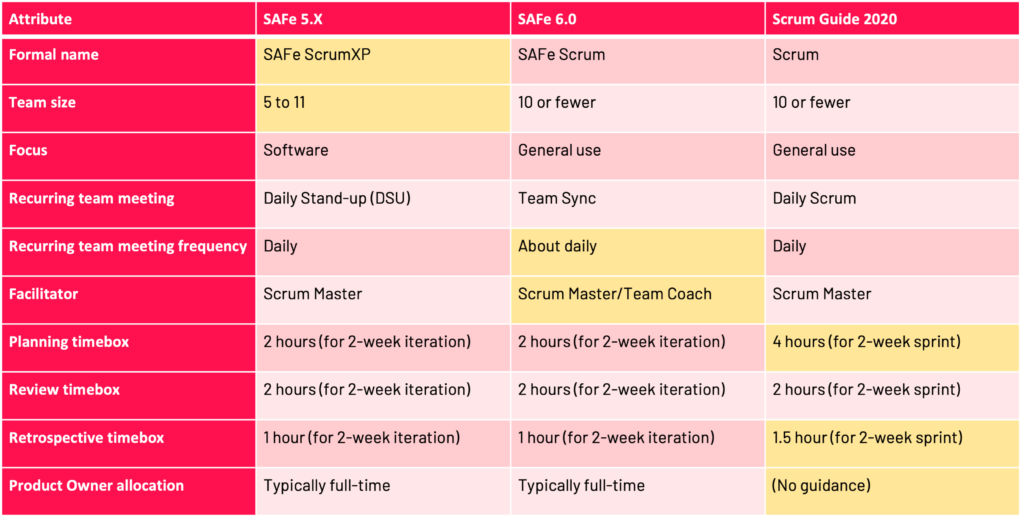
SAFe 6.0 provides a few minor modifications to the construct of what was formerly “ScrumXP”, a merger of the Scrum framework and XP (Extreme Programming). I have highlighted a few key differences below to call out specific changes. Let’s explore these more closely and see if they truly matter to you and your teams.

Changes to SAFe Scrum

What are the key differences?

Terminology aside, the conceptual change from “ScrumXP” to “SAFe Scrum” is not materially significant. But, there are a few differences to be aware of.

Removing “XP”

SAFe indicates the XP practices (such as pair work, continuous integration, etc.) are now integrated into other areas of the framework, which is why they removed the “XP” moniker. I believe that this simplification makes sense and will probably reduce confusion, but not much value beyond that.

How big should a team be?

The next change is related to the recommended team size. SAFe 6.0 is now aligned with the most current version of the Scrum Guide (2020) in terms of ideal team size (no more than 10). While “5 to 11” from SAFe 5.X does not appear to be much different, this change increases the flexibility somewhat by eliminating the lower limit of five, implying you could have a team with fewer than five people if you choose.

Daily Stand-up is not daily!?

Next, we see a change regarding the frequency of the daily team meeting, formerly known as the Daily Stand-up. Instead of mandating a daily occurrence, 6.0 provides a more general recommendation of “about daily”, which means the teams may choose to NOT meet daily. While this may provide more freedom for teams to decide how often they wish to revisit their plan towards sprint/iteration goals, I am concerned that some teams will use this wording to justify a weekly meeting, which would follow a more traditional status meeting mentality. I believe teams should remain vigilant and have the discipline to meet daily until they have reached a state of maturity and understanding of how to collaborate effectively within the Agile/SAFe paradigm.

Master or Coach?

The next change is related to the title of the Scrum Master role. By adding the “Team Coach” moniker, they place more emphasis on the Scrum Master’s focus area, which is to provide coaching and guidance to teams rather than serving as an administrator of tools. I believe this is a good enhancement that highlights the key duties of the Scrum Master and helps to clarify the value of this role.

Clarifications of differences between SAFe and Scrum

The remaining items highlighted in the table are not specifically tied to the SAFe 6.0 update, but a clarification of the difference between SAFe and “classic” Scrum (e.g. the Scrum Guide). As you see, the time boxes for some events are different between SAFe and the Scrum Guide, which may not be significant, but they’re noteworthy. If you have a large train with several teams, these may make a difference in terms of the overall investment made in the various events.

Which changes should you care about?

Depending on where your organization is in your SAFe journey, some of these modifications may not be meaningful. If you have existing trains that have been operating for several months or years, making these adjustments may require more effort and time than you expect.
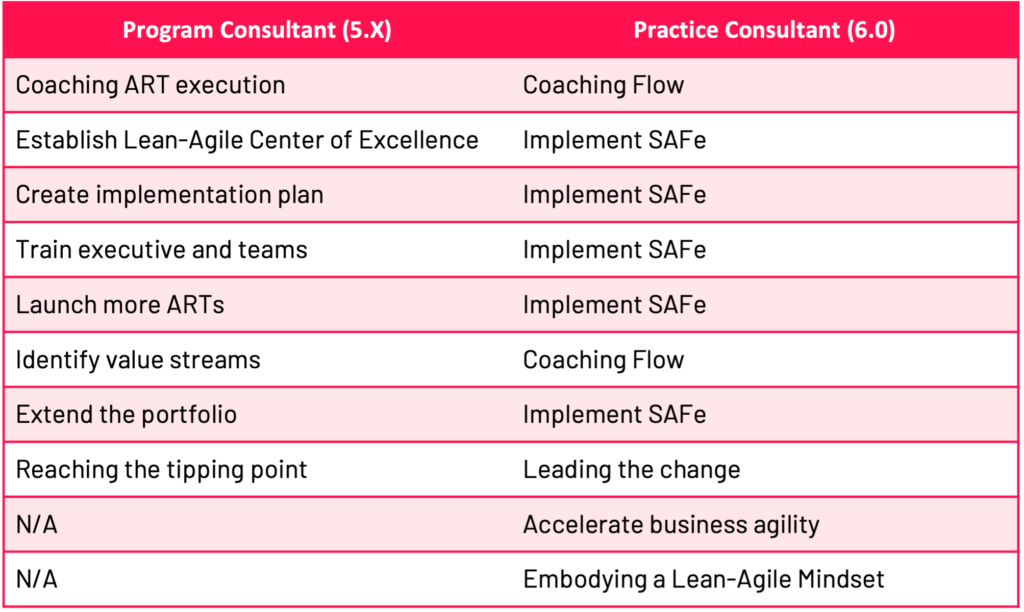

If you are just starting your journey and preparing to launch your first train, adopting SAFe 6.0 terminology and practices may be simpler for you because you will probably avoid the barriers of preconceived notions or mindsets that have been established already.

Closing thoughts

The important thing to keep in mind is that SAFe is a framework, and it should be customized to fit your context. The risk here is not knowing what to customize and unknowingly taking away practices or constructs that reduce your overall agility and/or quality.

To avoid this, it is usually a good idea to engage experienced SAFe practitioners and consultants to assist you with this process. SAFe can be a highly effective approach to building great products and solutions, but there will always be a learning curve with any framework, and seeking help can accelerate your adoption significantly.

SAFe and Scaled Agile Framework are registered trademarks of Scaled Agile, Inc.