

Author: Elizabeth Walsh

Modern Service Management for a Deskless World

Most service strategies are optimized for employees who sit at desks. But 80% of the global workforce doesn’t.

In industries like transportation, manufacturing, healthcare, and construction, the people driving daily value are on the move. Modern service management must be reimagined for those who don’t have the luxury of time, training, or a laptop.

Where Traditional Service Models Break Down

Legacy service models were never designed with deskless workers in mind, and that misalignment continues to erode productivity and engagement. These models rely on consistent connectivity, dedicated time, and digital literacy, all of which are luxuries for frontline employees.

According to a recent Microsoft survey, only 23% of frontline workers have access to digital tools. When support systems lag, workers disengage. When resolution takes hours, burnout spreads. And when basic services require navigating outdated portals, productivity suffers at scale.

Designing for Flow, Not Just Function

The right design doesn’t just make systems easier. It makes them invisible. Mobile-first access, badge-authenticated logins, QR-triggered requests, and multilingual interfaces reduce friction to near zero. Support becomes something workers can access in seconds, without breaking stride.

That matters, because 61% of deskless workers rely on personal devices, and over half have no access to email at all, according to Infeedo. Simplicity is how service delivery becomes instant, intuitive, and invisible.

What Embedded Service Looks Like

A modern frontline experience removes the guesswork:

  • Check schedules or pay in under a minute.
  • Report a safety incident on the spot.
  • Submit equipment requests or time-off via mobile.
  • Get real-time updates through virtual agents.
  • Surface knowledge without keyword searches.

Smart interfaces adapt to how and when people work. AI agents streamline support by anticipating needs, resolving issues, and routing requests instantly.

Service That Moves at Speed

When support systems operate in the flow of work, productivity compounds. Requests don’t stall. Workarounds disappear. And feedback loops tighten.

As detailed in this BCG report, companies that invest in frontline-specific tools see dramatic improvements: up to 69% higher retention and 43% less turnover. Embedded AI also reduces manual tasks, saving frontline workers up to five hours a week, according to BCG 2025 AI at Work.

Lead with Empathy, Not Software

The Rippl Deskless Workforce Report found that over half of frontline employees feel disconnected from decision-makers. No system can fix what leadership hasn’t observed firsthand. 

Far from just deploying tech, high-performing organizations shadow shift changes, conduct ride-alongs, and co-design solutions with the people doing the work. Real progress starts by closing that gap with empathy, pilot testing, and continuous iteration. Build for the workflow, not the workshop. Design for real-world speed, not theoretical use cases.

See It in Action

Discover how leading enterprises are elevating frontline performance by rethinking service delivery. Watch the full webinar for a behind-the-scenes look at the platform, adoption strategies, and real-world outcomes.

Financial Intelligence in Motion: Where TBM Meets FinOps in AI-First Enterprises

Modern enterprises are no longer static structures. They operate as living systems that shift, scale, and recalibrate in real time. Yet financial governance remains bound to outdated cycles and rigid controls where budgets are typically set once a year, forecasts lag behind current conditions and strategic investments and platform decisions are made without real-time visibility into performance and impact..

In AI-enabled and cloud-first environments, this static approach breaks the flow of value. Cost signals fail to reflect real-time activity causing funding to be out of sync with performance shifts and opportunities for optimization to get lost between product, platform, and finance teams.

Enterprise leaders recognize this friction and act, setting agile teams in place, with cloud platforms operating at scale, and AI pilots underway. But held back by a financial architecture that still follows outdated rhythms, slowing innovation and clouding impact.

To stay competitive, enterprises need a financial model that adapts in real time. Strategy must be integrated with execution, so decisions and actions advance together without delay or disconnect.

The Convergence: Strategy and Execution, Joined at the Ledger

Technology Business Management (TBM) and FinOps were born from different needs. TBM brings a strategic lens to enterprise planning, offering leaders the ability to connect technology spend to business outcomes. It enables tradeoff decisions, prioritization, and portfolio-level governance. 

FinOps, by contrast, delivers immediacy. It tracks cloud consumption, monitors efficiency, and promotes accountability in real time.

Together, they create a financial system built for orchestration and velocity. TBM sets direction as FinOps keeps the system responsive. The result is an adaptive financial model that aligns funding decisions with real impact and connects usage data with forecasts and budgets.

In digital-native enterprises, this pairing enhances efficiency. In AI-native enterprises, it becomes foundational infrastructure for intelligent execution.

Closed-Loop Execution: How Intelligent Financial Systems Learn

In AI-native organizations, intelligence operates from within. It’s embedded in decisions, not layered on top. TBM and FinOps function as the instrumentation of that internal system, creating a continuous financial rhythm based on live signals rather than delayed reporting.

Here’s what that loop looks like in practice:

  • A spike in cloud consumption is detected in a key product area.
  • FinOps identifies the deviation, maps it to value metrics, and suggests an immediate corrective action.
  • TBM surfaces tradeoffs across the portfolio and pinpoints underperforming initiatives that can be paused to release capacity.
  • AI models simulate reinvestment scenarios and recommend the most valuable redirection of funds.
  • That decision routes instantly to product, platform, and finance leaders, triggering coordinated action across execution teams.

Financial orchestration must be embedded directly into the operating model, activating decision speed and enterprise alignment.

And it doesn’t require a fully autonomous system to work. 

The process starts by connecting cloud data, financial tools, and telemetry into shared workflows. As agentic AI matures, this loop accelerates learning and sharpens enterprise responsiveness. But the business impact begins as soon as the connections are made.

Aligning Budget, Forecast, and Real-Time Usage to Value

Convergence delivers more than visibility. It activates real outcomes across budgeting, forecasting, and value realization.

Budgets become dynamic instruments that adjust in real time to performance signals and respond to evolving priorities.

Forecasts evolve with real-time behaviors, consumption trends, and platform telemetry, providing leaders with a continuously updated view of future performance.

Usage data becomes a live signal of enterprise value, fueling rapid optimization, real-time adjustments, and confident funding decisions.

Once this alignment is in place, platform investments gain financial clarity. They function as value-generating assets, governed and optimized with speed and precision. This transformation enables enterprises to manage intelligently and respond with confidence.

Build a Financial Architecture That Responds in Real Time

A modern financial architecture connects strategic planning with execution, embedding TBM and FinOps into how capital moves, performance is measured, and outcomes are optimized. 

This system includes:

  • Data flow between product, cloud, and financial systems
  • Embedded decision points with intelligence and triggers for action
  • Adaptive planning and funding based on live performance
  • Feedback loops that drive continuous value realization

This model creates orchestration across the enterprise where strategy moves with the business and funding follows performance.

Don’t rebuild your finance function. Rewire it to move with the business. Begin by linking forecasts to usage data, connect investment decisions to value delivery metrics, introduce triggers that help governance respond to change, then, scale what works.

The result is a financial system that adapts alongside the organization, moving capital with opportunity, reinforcing execution with real-time performance, and creating alignment across strategy, delivery, and measurement.

The Path Forward

The pace of enterprise change requires responsiveness built into the system. TBM and FinOps enable that responsiveness and ensure that financial governance supports momentum rather than slowing it down.

This is how enterprises orchestrate financial intelligence at scale. Strategy flows into execution. Performance loops back into planning. Decisions translate into measurable business value.

Together, TBM and FinOps create an adaptive financial system where strategy flows, execution learns, and funding delivers impact.

This is financial orchestration: scaled, adaptive, and built for the AI-first enterprise.

How to Align Strategy and Execution Across the Enterprise

Operational alignment means strategic priorities are reflected in the work teams actually deliver. Too often, vision is captured in planning decks while delivery teams work from isolated backlogs. This gap creates risk and undermines momentum.

When strategic decisions don’t inform daily execution, value is lost. And when delivery progress doesn’t inform strategy, organizations repeat mistakes or continue investing in work that no longer matters.

Operational alignment is achieved by orchestrating priorities, funding, and execution into one system of performance. Teams work on initiatives that directly support strategic outcomes and progress is visible to leadership. Delivery data informs the next round of planning, resulting in a system where decisions, investments, and output stay connected.

Breaking Down the Barriers Between Planning and Delivery

Enterprise planning and execution often operate on different rhythms. Planning focuses on vision and outcomes, while delivery focuses on sequencing and execution. Without a shared foundation, these two sides pull against each other.

Bridging the planning-delivery divide requires three systemic shifts:

  • Intake processes must connect demand to enterprise strategy 
  • Work must be evaluated based on feasibility and value before being funded 
  • Progress and impact must be tracked as part of the same flow 

This approach allows strategic decisions to reach delivery teams without delay or distortion, and it gives leadership the visibility to evaluate whether execution is keeping pace with intention.

The Role of Strategic Portfolio Management in Alignment

Strategic Portfolio Management (SPM) orchestrates decision-making across planning, funding, and performance, surfacing tradeoffs, enabling prioritization, and keeping portfolios aligned to enterprise value.

SPM links business priorities to investment, as it supports scenario planning, funding decisions, and performance evaluation. When implemented effectively, it allows leaders to allocate resources based on business impact, instead of internal lobbying or habit. It creates transparency, ensures alignment, and enables faster decisions.

Most importantly, SPM closes the loop, providing insight into how current initiatives are performing and what needs to change. This keeps the portfolio responsive and aligned with enterprise goals.

The Framework for Enterprise Execution that Actually Works

Enterprises need a structured model to connect strategic direction to operational delivery. The Enterprise Product/Portfolio Operating Model connects strategy, funding, execution, and feedback across five core components to achieve this purpose:

  1. Strategic Planning: Aligns enterprise priorities with desired outcomes
  2. Investment and Portfolio Governance: Funds work based on feasibility, value, and readiness
  3. Delivery and Architecture: Executes and scales initiatives aligned to value flow
  4. Dynamic Funding Models: Reallocate resources based on performance and demand
  5. Real-Time Feedback and Measurement: Guide decisions with continuous performance insight

This model rewires fragmented processes into an intelligent system of value creation, where strategy flows into execution and real-time feedback drives reinvestment.

Rewiring Your Operating Model to Scale What Works

Legacy operating models slow down progress since they were built for stability, not speed. They assume that strategy is episodic and that execution can be planned in fixed increments.

That approach no longer works.

A modern operating model is designed for continuous flow to allow the enterprise to shift direction, reallocate investment, and accelerate value delivery without restarting from zero.

Modernizing the operating model requires change in several areas:

  • Structure: Teams are organized around value delivery, creating fewer handoffs and more ownership.
  • Funding: Investment decisions flow with demand signals and real-time feasibility, not fixed budget cycles.
  • Architecture: Platforms and systems are designed for flexibility and scale
  • Governance: Data-informed controls accelerate decisions and reduce organizational drag.
  • Measurement: Real-time performance feedback enables faster optimization and smarter reinvestment.

When these components work together, enterprises move faster and smarter because teams understand what matters and why. 

Leaders gain continuous visibility into value flow, making confident, data-backed decisions and accelerating results at scale.

Investments are guided by live data, feasibility signals, and real-world results, empowering the enterprise to double down on what works and reallocate from what doesn’t.

Execution becomes a system of flow, amplifying strategy, compounding value, and accelerating outcomes.


Stop Context Switching, Start Shipping: How Rovo Gives Devs Back Their Focus

Developers know the drill: time often slips away in the small moments. Searching for the right information. Jumping between Slack and Confluence. Digging through logs. Each piece of busywork pulls focus away from real priorities like coding, building, and shipping great products.

For years, Atlassian has given development teams a better way to collaborate and reduce friction through a central platform. Now, with Atlassian Rovo, an AI teammate powered by your organization’s knowledge, those capabilities go even further. 

Powered by Atlassian’s Teamwork Graph, Rovo adds a connected layer of context with built-in AI across developer workflows. Rovo Search, Chat, and Agents help teams improve productivity, streamline workflows, and eliminate repetitive tasks.

In this blog, we’ll break down exactly how Rovo benefits DevOps teams, including more real-world examples of how teams are using it today.

Disrupting Focus: The Real Cost of Developer Busywork

While developers are under pressure to innovate faster, they’re spending 84% of their valuable time on tasks outside of coding. That time is lost across four key friction points: 

  • Constant context switching. Developers jump between tasks, tools, and conversations. These interruptions can cause up to 40% in productivity loss.
  • Manual, repetitive tasks. From searching for information to organizing Jira tickets, Atlassian research shows automating this type of work can save developers up to 1.5 hours/day.
  • Lack of visibility. Tool sprawl and complex, disconnected workflows force development teams to manually piece together the full picture. Up to 23 hours a week of employee time is spent on excessive documentation, meetings, and overhead tasks.

Collaboration breakdowns. Without shared context or a single source of truth, it’s hard to move fast. One-fourth of executives and teams spend a quarter of the workweek just searching for information.

How Rovo Reduces Developer Time Drains

Rovo is easily customizable and built directly into developers’ favorite tools, absorbing Confluence intelligence, Jira intelligence, and relevant data from Compass and Bitbucket, making it a seamless way to adopt AI and reduce friction.   

Rovo AI Search: Context That Spans Your Stack

Developers work best when they have uninterrupted focus. A simple process, like attempting to debug an API issue, could take hours without a central system. It also means jumping across five tools. With 23 minutes lost on every switch of context, developers could lose almost two hours in this case.

By using Rovo Search, developers can see everything in one place instead of manually switching context across tools like Jira, Slack, and Datadog. Ask Rovo, “Why is the API timing out?” and get related tickets, docs, and threads with context provided, instantly.

Rovo Chat: Ask and Get Instant Answers

Without connected data and systems, engineers spend their day acting as human search engines, asking and answering the same questions repeatedly: 

  • “Where’s the deployment runbook?” 
  • “Who changed the database schema?” 
  • “Why did we choose Redis here?” 

Using Rovo Chat, developers can simply ask Rovo for what they need. For example, by turning on Rovo in Confluence and Bitbucket and connecting it to Slack, a developer can chat with Rovo to ask questions like, “Why do we use Redis for session storage?” Rovo will pull any related information, from the original architecture decision and performance benchmarks to the team discussion that led to the choice. No meetings, pings, or emails required.   

Rovo Agents: Automate the Work That Slows You Down 

A 3am incident means starting the day by reviewing error logs in Splunk, finding recent changes in GitHub, and searching for similar incidents in Jira. It can take an entire team of engineers hours to piece together what happened. 

Instead, developers can set up Rovo Agents to automate this work and save time. Agents can summarize deploymentsreview code, surface similar past incidents, and identify code owners automatically, delivering the incident context to the right engineer, reducing bottlenecks and getting the team back to work faster.

Building Your Intelligent Development Ecosystem

While many teams thrive on Rovo’s out-of-the-box capabilities, the biggest gains can come from tailoring agents to your unique workflows. With our Rovo-augmented product development solution, we can build specialized agents with or without coding to automate the friction points impacting your organization most.

Some of the custom agent patterns engineering teams are building today are:

  • Code Quality Agents that learn your team’s standards and flag potential issues before a merge. 
  • Deployment Orchestration Agents that coordinate releases across your specific infrastructure stack. 
  • Knowledge Capture Agents that automatically document tribal knowledge from Slack discussions and code reviews. 
  • Onboarding Pathway Agents that create personalized learning journeys based on your actual codebase. 
  • Extended integrations beyond the Atlassian ecosystem—GitHub Enterprise, internal APIs, monitoring tools, and custom databases—turn Rovo into your engineering team’s central nervous system.

The key to starting is identifying your team’s biggest pain point and building from there. Teams getting the most out of Rovo aren’t trying to automate everything at once. They’re addressing pain points and perfecting workflows before moving on to the next stage. 

At Cprime, we design and implement these intelligent development ecosystems, from custom agent development to complex integrations, ensuring your AI transformation actually moves the needle on engineering velocity. The most successful Rovo implementations combine a deep understanding of engineering workflows with thoughtful agent design and integration strategy. 

Rovo AI Search: End the Hunt for Hidden Information and Unify Knowledge Silos

Every day, teams burn hours digging through tools or pinging co-workers to track down the information they need to do their jobs. In fact, knowledge workers waste up to 25% of their time looking for answers, according to Atlassian’s 2025 State of Teams report.

Rovo Search, Atlassian’s AI-powered search feature, changes the equation by helping employees find what they need, instantly. It connects tools like Jira intelligence, Confluence intelligence, Bitbucket, Compass, Google Drive, and SharePoint into a single, unified interface. At its center is the Teamwork Graph, a dynamic knowledge layer that understands how your people, projects, goals, and tools are connected. 

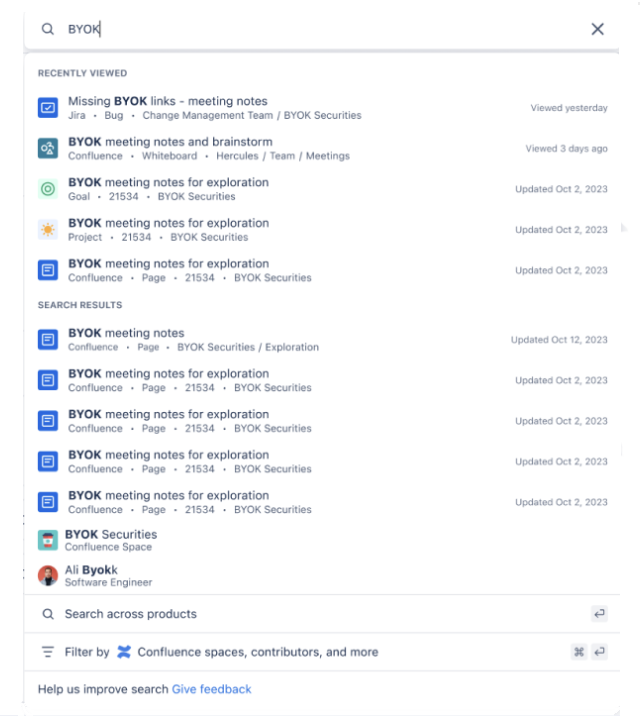
Unlike basic enterprise search that returns keyword matches, Rovo AI search interprets intent, respects permissions, and connects related information across your tools. This includes AI-driven results synthesis that prioritizes the most relevant information and suggests next steps.

For example, if you search for “payment service outage,” instead of links to scattered docs, you’ll get:

  • Summarized findings from recent incidents in Jira
  • Troubleshooting steps from Confluence runbooks
  • Related commits from Bitbucket
  • Google Drive and SharePoint documents outlining past resolutions
  • Slack discussions where the issue was debugged

For more complex queries like, “Why did we move to microservices for user management?” Rovo can reconstruct the full decision trail by connecting architectural notes, performance benchmarks, team conversations, and historical requirements. 

This is intelligent knowledge orchestration in action: Rovo Search helps teams quickly understand data, act on it with confidence, and scale decisions across the business. In this post, we’ll show how Rovo AI search turns fragmented data into faster decisions and coordinated execution.

The Problems With Traditional Search (and How Rovo Search Solves Them) 

Traditional search relies primarily on scanning content for keywords. This results in a flood of semi-relevant hits that force teams to piece together an answer. It often forces teams to sift through irrelevant results, slowing decisions and increasing rework.

What Makes Rovo AI search Different 

If traditional search is like navigating a dark maze by the light of a birthday candle, Rovo Search is like switching on a spotlight that instantly reveals the quickest path to success.  

Rovo Search goes beyond simple keyword matching by leveraging Atlassian’s Teamwork Graph, a rich knowledge layer that maps relationships between people, projects, and tools across your organization. This allows Rovo to understand context, not just text, and deliver insights that reflect how your teams actually work. And because Rovo lives inside the tools your employees already use, it feels like a natural extension of their workflows, not an added step

Here’s an Example:
Traditional SearchRovo Search
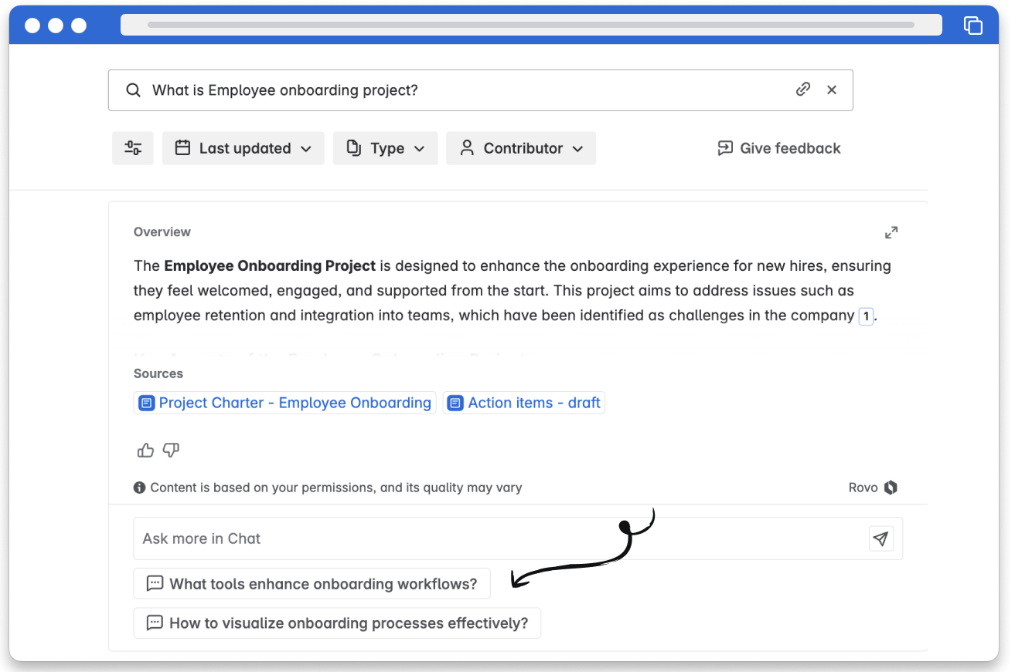
 A user types “employee onboarding” into Confluence to get a long list of pages containing those exact words. They would also have to repeat the search across every other tool they want to query.A user types “employee onboarding” into Rovo Search, which automatically understands the context to surface the most relevant resources (including training guides, HR checklists, and other materials that don’t explicitly have the “employee onboarding” keyword) and summarizes them for fast comprehension.

Rovo Search actively suggests follow-up prompts to dive deeper on a topic (Source)

How Teams are Using Rovo Search Today

Rovo Search tackles the challenges that leave nearly half of all digital workers struggling to find the information needed to do their jobs effectively.

Rovo Search is helping our teams find information much faster, reduce cognitive load, and stay in the flow. It’s really promising so far. I don’t foresee a future where we don’t have it.” – Ronny Katzenberger, Director of Engineering Enablement at Procore Technologies


“We constantly see new opportunities to optimize our work with Rovo. For example, we have the potential to kickstart our requirements and design in minutes with Rovo, turning the overall discovery process into days, not months!” – Fred Frenzel, Project Management Office Director at HarperCollins

Best Practices for Getting the Most Out of Rovo Search 

Like many sophisticated AI tools, Rovo Search’s value depends on the quality of the data you feed it and how your teams engage. Here are some tips for keeping Rovo Search sharp, relevant, and secure: 

  • Keep your data clean: Regularly update, consolidate, and remove outdated content across Atlassian and third-party systems. 
  • Train teams to ask better questions: Encourage intent-driven queries like “What were the key decisions from last quarter’s strategy meeting?” instead of vague keywords. 
  • Create a feedback loop: Monitor usage, gather feedback, and refine content and settings over time. 
  • Stay secure and compliant: Rovo respects your business’s permissions and supports audit trails and data residency, so review policies regularly to maintain control.

Taking Rovo Search to the Next Level  

Getting started with Rovo Search is straightforward, but realizing its full impact requires strategic thinking about knowledge architecture and workflows. That takes a clear plan and thoughtful integration into how your teams actually work. Successful, forward-looking implementations typically focus on: 

  • Pinpointing high-impact use cases where Rovo Search can provide the most value. 
  • Cleaning up and structuring data sources to ensure Rovo Search has the right foundation for success. 
  • Extending Rovo Search beyond Atlassian by connecting your full tech stack, including third-party apps, to unify knowledge discovery across internal systems and external tools.
  • Customizing Rovo Search to your needs with tailored configurations, purpose-built connectors, and custom solutions built on Forge or other platforms. 
  • Maintain trust and control by setting up secure access, auditability, and compliance in accordance with internal data policies and regulatory standards. 
  • Going beyond Rovo AI search by using Rovo to augment the entire produce development lifecycle.

The organizations seeing transformational results from AI are putting in the effort to rewire how knowledge moves throughout the business. As an Atlassian Platinum Solution Partner with 15+ years of experience and a deep heritage in enterprise transformation, Cprime helps organizations go beyond basic Rovo deployment to drive real and lasting change. We bring proven expertise in establishing Atlassian Cloud as a strategic foundation for AI transformation, delivering solutions that help teams unlock efficiency, agility, and measurable business impact.

Orchestrating Enterprise AI Adoption with Atlassian at the Helm

Enterprise AI adoption is reshaping how companies work, decide, and scale. By 2030, the global AI market is projected to reach $1.8 trillion (Bloomberg Intelligence), yet fewer than 10% of companies are deploying AI at scale (McKinsey). The opportunity is clear. 

So is the urgency.

What separates organizations running pilots from those generating real returns? It’s not just technical skill or executive sponsorship. The differentiator is seamless AI implementation into the systems where work already happens, and increasingly, that means the Atlassian AI ecosystem.

Here are the essential shifts that turn experimentation into execution. 

For a deeper dive featuring platform experts from Atlassian, Forrester, and Cprime’s AI-First center of excellence, watch the full panel webinar on demand.

Start with the Business, Not the Bot

Enterprises often begin their AI journey with a list of interesting use cases. But success doesn’t come from novelty. It comes from purpose. What is the business trying to achieve? Which goals matter most to leadership, customers, or the market?

The strongest AI use cases emerge from aligning AI capabilities with those high-priority objectives. That means identifying measurable outcomes, mapping relevant processes, and filtering ideas through a value-versus-feasibility lens. When you prioritize initiatives that offer real impact and can be implemented with minimal drag, you build credibility fast and gain momentum for broader adoption.

Your SDLC Is the Launchpad

AI amplifies your software delivery lifecycle. But when that lifecycle is chaotic, AI will surface the chaos.

Standardization and clean development hygiene are prerequisites for scaling AI. Whether you’re leveraging AI to streamline pull requests, automate code reviews, or accelerate CI/CD, the foundation must be solid. Teams working across inconsistent toolchains or with unmanaged tech debt are likely to see clutter, not clarity.

Atlassian users already operate in structured, traceable environments (like Jira, Confluence, Bitbucket, or Compass) which provides a head start. By embedding intelligence directly into the Atlassian toolchain, enterprises achieve low-friction gains in velocity and quality, creating AI-powered workflows with no disruption.

Integration > Replacement

Most organizations benefit from augmenting their workflows with AI, rather than replacing them entirely.

Whether it’s an AI agent summarizing a Confluence page, surfacing critical issues in Jira, or nudging developers with context-aware insights, the real power of AI lies in meeting users where they already work. Atlassian’s Rovo, integrated with third-party tools and cloud-native platforms like AWS Bedrock, enables intelligent orchestration without additional overhead.

In modern hybrid environments, AI needs to be interoperable. It should pull from APIs, recognize your enterprise architecture, and act as an invisible accelerator that enhances productivity without adding friction.

From Human Burden to Human Leverage

AI removes repeatable tasks and elevates human contribution.

The organizations seeing the most impact from their AI strategy are increasing the value of their workforce. Agents summarize updates, prepare documentation, route requests, and analyze performance. That frees developers, product owners, and operations teams to focus on the decisions, relationships, and innovations that drive growth.

This shift requires deliberate change management. Teams need training, support, and room to adapt. The best AI strategies treat people as leverage.

Intelligent Orchestration Is Already Underway

Orchestration is happening now across core workflows, decision layers, and user-facing processes.

AI agents in the Atlassian ecosystem already interact with Confluence, Jira, Bitbucket, Compass, and third-party tools, making work visible, actionable, and automatically aligned with execution standards. With access to the right data and structure, AI moves information faster and smarter.

This shift delivers more than automation. It creates intelligent flow. Work moves with fewer obstacles. Knowledge gets where it’s needed. Redundancy drops. Quality rises. Time-to-value shrinks.

Don’t Tinker. Orchestrate.

AI-first transformation goes beyond testing technology. It turns AI into a core operational capability.

The enterprises making the leap are building AI into the fabric of their operating model. They embed agents in workflows, activate cross-platform intelligence, and accelerate value across development, delivery, and decision-making.

This shift is active. And in the Atlassian ecosystem, it’s gaining momentum.

Watch the full webinar on demand to learn from the architects behind these strategies, including Atlassian, Forrester, and the enterprise AI leaders at Cprime’s AI-First center of excellence. See how real organizations are scaling AI across development, delivery, and operations, and how you can too.

Agile Practitioners Embracing AI: From Scrum Master to AI Enabler

Artificial Intelligence (AI) has evolved from speculation to enterprise reality, reshaping how work is orchestrated. This is especially true in dynamic, technology-centric environments that have long embraced Agile practices. The current wave of AI advancement is a force to harness for outsized impact. For Agile practitioners, and particularly for Scrum Masters / Agile Coaches, this signals an exciting evolution: a transition from facilitating Agile practices to becoming pivotal “AI enablers” who empower their teams to reach unprecedented levels of performance and innovation. 

This journey involves understanding how AI can amplify Agile practices and actively guiding teams to integrate these powerful new capabilities into their daily work. The integration of AI with Agile practices is a pivotal evolution, one that promises to redefine efficiency and creativity in product/service development.

The pervasiveness of AI discussions naturally creates a mix of anticipation and apprehension. 

Therefore, it is crucial to frame AI’s role constructively within the Agile context, highlighting it as an opportunity for growth and enhancement, rather than a threat to existing roles or practices. The shift for Scrum Master to become an AI enabler is a transformative journey, and understanding this new dimension to the role can provide a compelling roadmap for development professionals.

Understanding the Scrum Master’s Core Mission

Before exploring the fusion of AI with Agile practices, it is essential to re-establish the foundational role and mission of the Scrum Master. The introduction of AI does not seek to replace these core duties but rather to augment and enhance the Scrum Master’s ability to fulfill them. According to the Scrum Guide, “The Scrum Master is responsible for promoting and supporting Scrum as defined in the Scrum Guide. Scrum Masters do this by helping everyone understand Scrum theory, practices, rules, and values”. They are strategic enablers for the Scrum Team. Furthermore, the Scrum Master is accountable for “establishing Scrum” and for the “Scrum Team’s effectiveness”.

This definition is critical because it provides the inherent “why” behind a Scrum Master’s engagement with AI. If a Scrum Master is accountable for team effectiveness and the successful implementation of Scrum, then exploring and facilitating the use of tools and technologies that enhance these aspects falls squarely within their purview. 

The “true leader” characteristic is particularly pertinent when considering AI enablement. It implies adopting the use of AI themselves, then guiding and supporting the team’s exploration and use of AI, fostering a collaborative approach rather than imposing solutions. 

This aligns with the principle that AI adoption should be team-driven to ensure genuine buy-in and maximize effectiveness. A true leader facilitates this by providing necessary resources, removing obstacles to learning and adoption, and cultivating an environment where it is safe to experiment and learn from both successes and failures. 

Moreover, the Scrum Master’s responsibility to help everyone understand Scrum theory and practice can be extended to understanding how AI aligns with or can amplify Scrum values, such as using AI-generated reports to improve transparency or leveraging AI tools to help the team maintain focus on sprint goals.

AI Meets Agile

AI and Agile amplify each other. Fast, iterative practices meet intelligent acceleration. Agile provides a robust framework for iterative development, rapid response to change, fast learning, and continuous value delivery. AI, in turn, offers a suite of powerful tools and capabilities that can accelerate, automate, and enrich these Agile practices.

AI technologies can propel this agility to new heights, offering tools that automate tasks, predict trends, and facilitate decision-making. 

This powerful combination allows AI to amplify core Agile principles:

  • Transparency: AI-driven dashboards, automated reporting, and real-time data analytics can provide unprecedented visibility into project progress, impediments, and team performance.
  • Inspection: AI tools can analyze sprint data, identify patterns in team velocity or defect rates, and provide objective insights for more effective Sprint Retrospectives.This allows teams to inspect their processes with greater depth and accuracy.
  • Adaptation: By offering predictive insights, AI enables teams to anticipate potential roadblocks, forecast delivery timelines more accurately, and make quicker, more informed adjustments to their plans and priorities.

The integration of AI into Agile can also help address common challenges that teams face in their Agile journey. For instance, many teams struggle with estimation and maintaining a predictable delivery. AI tools, by analyzing historical team data, can significantly improve forecasting accuracy and help teams develop more realistic sprint plans.

In this way, AI can act as a supportive mechanism, bolstering Agile maturity. 

While AI can help to accelerate processes and enhance efficiency, Agile frameworks  like Scrum with their defined events, accountabilities, and artifacts provide the essential structure to ensure this acceleration is directed towards valuable outcomes. 

This structure prevents AI-driven speed from devolving into “faster chaos,” ensuring that efforts are channeled effectively, reviewed regularly through feedback loops, and adapted as necessary to meet evolving requirements.

AI as Your Team’s Superpower: Supporting Humans, Not Replacing Them

A prevalent concern surrounding the rise of AI is the potential for job displacement. However, within the context of Agile and knowledge work, the narrative is shifting towards AI as an augmentation force—one that enhances human capabilities rather than rendering them obsolete. This shift empowers teams by allowing individuals to focus on tasks that uniquely leverage human intellect and creativity. 

MIT economics professor David Autor articulates this perspective clearly: “AI will end up generally augmenting workers instead of replacing them,” and “Tools often augment the value of human expertise…They enable us to do things we could not otherwise do without them”.

This sentiment is echoed by MAPFRE, which states, “AI will never replace people, and human oversight will always be necessary”.

AI excels at handling repetitive, mundane, or data-intensive tasks, thereby liberating human workers to concentrate on:

  • Strategic thinking and complex problem-solving: AI can process vast datasets and identify patterns, but humans are needed to interpret these findings within a broader strategic context and devise innovative solutions to complex challenges.
  • Creativity and innovation: By automating routine aspects of work, AI frees up cognitive bandwidth for creative exploration, ideation, and the development of novel products and services.
  • Ethical considerations and nuanced decision-making: Many knowledge work tasks require human judgment, empathy, and ethical reasoning—qualities that current AI systems largely lack.

Benefits of AI Augmentation in Agile Contexts

The augmentation capabilities of AI translate into tangible benefits for Agile teams across various aspects of their work:

  • Accelerating Ideation and Innovation: AI accelerates innovation cycles and time-to-value. It can analyze vast amounts of market data, customer feedback, and emerging trends to help teams identify unmet needs and opportunities.  AI tools can assist in brainstorming sessions, help synthesize research findings, and enable the rapid creation of prototypes to test new ideas quickly.
  • Boosting Productivity and Velocity: In software development, AI tools are already demonstrating significant productivity gains. Developers can complete coding tasks up to twice as efficiently using AI assistants. AI can automate aspects of code generation, conduct preliminary code reviews, generate unit tests, and even assist in creating and maintaining documentation. For instance, AI testing tools have enabled teams to reduce test execution time by as much as 75% and decrease manual testing hours by 80%.
  • Unlocking Data-Driven Insights: Agile teams thrive on data, and AI can supercharge their ability to extract meaningful insights. AI algorithms can process large volumes of project data to deliver actionable intelligence, helping project managers and teams make faster, more informed decisions. For example, AI can look at data from previous projects and spot patterns that could affect current or future projects, leading to better planning, risk mitigation, and resource utilization. This capability extends to predictive analytics for better forecasting, early risk identification, and optimized resource allocation.

The “augmentation” narrative effectively shifts the focus from a fear of job loss to an opportunity for skill evolution. As teams begin to work more closely with AI, new skills will become necessary—such as effective prompt engineering for generative AI, the ability to critically evaluate AI-generated outputs, and an understanding of AI ethics. 

Scrum Masters, in their coaching capacity , can play a vital role in facilitating the development of these new competencies within their teams. The true value of AI is unlocked when human expertise guides its application and interprets its outputs. AI can provide the “what”—the data, the patterns, the initial drafts—but humans provide the crucial “so what”: the context, the strategic implications, and the final decisions. This symbiotic relationship, where AI processes information at scale and humans apply wisdom and contextual understanding, is central to successful AI integration. The Scrum Master can help the team understand and cultivate this productive balance.

The Scrum Master as an AI enabler

The core responsibilities of a Scrum Master—ensuring team effectiveness, fostering continuous improvement, and upholding Scrum principles—align perfectly with the opportunity presented by AI. Guiding the adoption and effective use of AI is not an additional burden but a natural extension of the Scrum Master’s existing role, enabling them to serve their teams even more powerfully in an increasingly AI-driven landscape.

Key Responsibilities of an AI-Enabling Scrum Master

The transition to an AI enabler involves embracing several key responsibilities:

  • Educating and Evangelizing: This involves actively advocating for AI’s strategic value and practical applications relevant to the team’s work. The Scrum Master can demystify AI, address concerns, and showcase success stories or specific use cases to inspire the team and stakeholders. This aligns with the Scrum Master’s established role of “helping everyone understand Scrum theory and practice, both within the Scrum Team and the organization”, now broadened to include AI’s role within that practice.
  • Facilitating Exploration and Experimentation: An AI-enabling Scrum Master creates the space and a culture of experimentation and safety for the team to explore AI tools and techniques. This might involve allocating time during Sprints for experimentation, organizing innovation spikes, or guiding the team in identifying small, low-risk experiments to test AI tools for specific problems. 
  • Coaching for Human-AI Collaboration: Effective use of AI is a skill. The Scrum Master coaches team members on how to work with AI tools. This includes practical guidance on tasks like writing effective prompts for generative AI, critically evaluating AI-generated outputs, and seamlessly integrating AI into existing workflows. 
  • Removing Impediments to AI Adoption: As with any new initiative, AI adoption can face obstacles. The Scrum Master, in their capacity as an “Impediment Remover”, works to identify and address these barriers. Impediments might include lack of access to appropriate AI tools, skill gaps requiring targeted training, resistance to change, or unclear organizational policies regarding AI usage and data security.
  • Championing Ethical and Responsible AI Use: With the power of AI comes the responsibility to use it ethically. The Scrum Master facilitates crucial discussions within the team about data privacy, potential biases in AI algorithms, the transparency of AI-driven decisions, and the overall ethical implications of their AI applications. This proactive approach helps ensure the team uses AI tools responsibly and in alignment with organizational values and regulatory requirements.

Categories of AI Tools for Agile Teams

We are now awash with AI tools, here are some categories you may wish to consider.

  • AI-Powered Delivery Management & Collaboration: A new generation of delivery management and collaboration platforms is embedding AI to streamline workflows.
    • These tools can automate task creation and assignment, summarize progress for stakeholders, generate reports, facilitate virtual brainstorming, transcribe meeting minutes, and generally improve team communication and coordination.
  • AI for Developers (Coding, Review, Testing): This is perhaps one of the most mature areas for AI application in Agile.
    • These tools assist with code completion, automated unit and integration test generation, intelligent vulnerability scanning, AI-assisted code reviews, and code refactoring suggestions, all contributing to faster development cycles and higher quality code.
  • AI for Backlog Refinement & User Story Generation: While still an emerging area, AI shows promise in assisting Product Owners and teams with the crucial task of managing and refining the Product Backlog.
    • This can help in drafting initial user stories, suggesting acceptance criteria, identifying dependencies, or even flagging conflicting requirements, allowing the Product Owner and team to focus on higher-level strategic refinement.

Of course remember, AI is augmenting how we do work, not replacing us, and certainly not replacing the knowledge work we humans do.  For example using AI to help ideate requirements / user stories is great for idea generation, it might be great to help explore requirements and help the team understand them.  But the actual decision of what the requirement is and what to do is the decision of a human.

The Future is Human-AI Collaboration in Agile

The trajectory of AI in the workplace points not towards an AI-dominated future, but one characterized by a synergistic partnership between humans and intelligent machines. 

This human-AI collaboration holds the key to unlocking new potentials for Agile teams, enabling them to achieve levels of creativity, efficiency, and value delivery previously unimaginable. 

McKinsey envisions a future where AI empowers teams to “spend more time on higher-value work and less on routine tasks”. 

This evolving landscape underscores the critical importance of a continuous learning mindset. The field of AI is exceptionally dynamic, with new tools, techniques, and capabilities emerging at a rapid pace. Agile teams, with their inherent emphasis on adaptation and improvement, are well-positioned to thrive in this environment. Guided by their Scrum Masters, they will need to continuously learn, experiment, and adapt their practices to harness the latest AI advancements effectively. 

Scrum Masters, by cultivating an environment of psychological safety, play a crucial role in enabling team members to openly discuss concerns, share learnings, and collectively build trust in new processes involving AI. As AI systems become increasingly adept at handling analytical and executional tasks, the uniquely human skills of empathy, complex communication, nuanced judgment, and strategic oversight will become even more valuable differentiators for Agile teams and their leaders. The future value proposition for human knowledge workers, including Scrum Masters, will increasingly lie in these higher-order cognitive and emotional capabilities.

Step Up, Scrum Masters – Become the AI enablers Your Teams Need

The integration of artificial intelligence into Agile ways of working presents a transformative opportunity, and Scrum Masters are uniquely positioned to lead their teams into this new era. The call is clear: embrace the challenge and the opportunity to evolve from Scrum facilitators to indispensable AI enablers. This evolution is not about adding an overwhelming new set of responsibilities, but about enhancing existing skills and leveraging powerful new tools to better serve teams and organizations in an increasingly AI-driven world.

The journey to becoming an AI enabler is, fittingly, an iterative one. Scrum Masters should approach AI adoption the same way they approach Agile itself: iteratively, incrementally, and with a clear focus on outcomes. Scrum Masters can encourage their teams to start small, experiment, learn from those experiments, and adapt their strategies accordingly. This iterative approach makes the prospect of AI integration less daunting and aligns perfectly with the Scrum Master’s existing mindset and the core principles of Agile.

By proactively engaging with AI, Scrum Masters not only drive measurable outcomes for their current teams—driving efficiency, innovation, and value—but also enhance their own career relevance and marketability in a rapidly changing technological landscape. 

Agile teams empowered by AI and guided by strategic leaders will define the future of work.

Your AI Teammate: How Atlassian Rovo Agents Are Revolutionizing the Way Work Gets Done

AI is everywhere these days. But your average workday still feels stuck in manual updates, endless meetings, and constant context-switching. It’s time for something better.

So why hasn’t AI yet made a real difference for most teams? One reason is the assumption that doing so requires a complete system overhaul. While that may have been true just a few years ago, that’s no longer the case. Those working in Atlassian can start seeing real results almost immediately. More flow, less friction. 

Rovo Agents are a new AI teammate providing generative AI capabilities within Atlassian tools like Jira, Confluence, and Bitbucket. These AI-powered teammates are designed to help teams across every department, from HR to IT to engineering, automate repetitive tasks (e.g., answering common employee questions, triaging support tickets, summarizing meetings) to keep things flowing so teams can dive deeper into strategic work.

“If you’re already working in Jira or Confluence, Rovo Agents are a no-brainer. They’re built into the Atlassian stack and immediately start delivering value where your work already happens.”
— Drew Garvey, Agile Tooling Solutions Practice Director at Cprime

In this post, we’ll cover how Rovo Agents work, how teams are using them today, and what steps to take to start seeing results quickly.

What Are Atlassian Rovo Agents, and Why Are They Valuable? 

Rovo Agents are enterprise AI-powered assistants that uses workflow automation to reduce the “work about work,” by automating tedious tasks. This allows teams to focus on more complex problems, with the average user saving one to two hours weekly Through this no-code workflow automation, you can launch prebuilt agents or build your own to match specific team needs and workflows. Even better, Rovo Agents also integrate with third-party tools like Slack, Asana, GitHub, and Dropbox.

Some ways Rovo Agents help out teams:

  • Automate the busywork like ticket triage, meeting summaries, and password resets. 
  • Function as an enterprise search platform, pulling answers instantly from a unified knowledge base across all your connected tools. 
  • Keep teams in sync by streamlining handoffs and avoiding duplicate work. 
  • Customize easily with a low-code setup, allowing for the creation of custom AI agents for business that fit each team’s unique needs.
  • Accelerate impact with out-of-the-box use cases for every team. 

How Cprime Used Rovo Agents to Transform a Company’s HR Operations   

A business services company came to Cprime with an overburdened HR team. Between onboarding, benefits, and policy questions, HR employees were spending 30-40% of their time fielding repetitive requests and tracking down information across scattered systems. 

Cprime worked closely with the client to design and launch custom Rovo Virtual Agents trained to handle routine HR service management inquiries. Using Rovo Studio, we shaped each agent’s persona, fine-tuned their scope, and built smart handoff logic to ensure employees always got the right support.

The results were immediate: HR’s workload dropped sharply. Employees quickly noticed faster answers and fewer hassles. The HR team finally had breathing room for strategic projects, demonstrating how rewiring just a few workflows can accelerate productivity across the whole organization.

Tips for Getting Started with Rovo Agents 

Rovo Agents are ready to work. Here’s how to help them start delivering value on day one.

  • Start with high-impact automations: Target high-volume tasks like automated ticket routing or natural language search queries to quickly demonstrate value and build momentum.
  • Build a reliable knowledge base: Rovo pulls from your internal knowledge and tools, so make sure Confluence pages, Jira fields, and other sources are accurate and clearly organized.
  • Rally your champions: Tap early adopters to drive usage and reassure teams that agents support, not replace, human work. 
  • Measure impact: Track key success metrics, like time saved or resolution speed, and use the insights to drive excitement among teams and refine how agents operate. 

Bring in experts: A trusted partner like Cprime can help identify the most valuable use cases, tailor custom agents, and scale across teams.

Why Cprime? A Smarter Path to Scalable AI 

We’re here to help you launch Rovo Agents quickly, so your team can immediately benefit. And we’ll keep working together to scale that success into broader AI-powered orchestration across your business. Every deployment is tailored to your goals, tools, and ways of working.

With deep experience across industries and functions, we guide you from setup through optimization, ultimately helping your business become truly AI-first

“Cprime doesn’t just flip a switch and walk away. We get to know the company’s core strategy and priorities to make sure agents are trained, scoped, and continuously improved to support how the business actually runs.” 

Drew Garvey, Agile Tooling Solutions Practice Director at Cprime

With Rovo Agents, Cprime helps companies: 

  • Identify where to start with workshops that connect agent use cases to your team’s biggest needs. 
  • Design custom agents with hands-on Rovo Studio experience. 
  • Orchestrate full Rovo-augmented product development workflows.
  • Ensure security and compliance by configuring access, audit trails, and data policies that meet your standards. 
  • Drive adoption with training and change management that’s tailored to specific roles. 
  • Keep improving over time by using feedback to fine-tune agents, expand use cases, and boost impact. 

What a Modern Operating Model Really Looks Like, and Why It Delivers

A modern operating model is a connected execution system that aligns strategy, funding, and delivery into a seamless flow of value. Built across three interdependent layers—strategy, optimization, and enabling infrastructure—it replaces fragmented execution with measurable momentum.

Reorgs alone can’t achieve that. 

“But we’ve tried that!”Most CEOs, at one time or another.

Enterprise ambition is high. But execution often gets stuck as legacy systems slow everything down: strategic priorities get lost in planning cycles, product teams are disempowered, funding doesn’t usually follow value, and delivery is disconnected from measurement.

Even with the latest tools, such as AI, agile teams and platform investment, the promised impact rarely materializes. 

This is a system problem and the solution lies in how your organization operates. 

A modern operating model replaces friction with flow, connecting strategic intent into delivery execution, continuously turning enterprise decisions into outcomes. 

Static plans or top-down controls get replaced by intelligently orchestrated systems of work, investment, and measurement. This is how organizations fund what matters, deliver faster, and measure what works.

Legacy operating models are slowing everything down

Legacy enterprise operating models were designed for predictability and control, fragmenting strategy, funding, and delivery across disconnected silos, which rewards activity over outcomes and slows everything down.

The result? Innovation stalls, teams burn out and ultimately, business value disappears into complexity.

According to McKinsey, only about 30% of digital transformations fully succeed. Nearly 70% of initiatives underperform against original goals due to unclear strategy, fragmented execution, and misaligned incentives.

Adopting an agile approach, investing in the latest platforms or even getting into AI won’t fix this. None of them addresses the root issue: your operating model is designed for a world that no longer exists.

What a modern operating model looks like

A modern operating model connects decisions, teams, and technology into a unified system of execution by orchestrating three layers:

  • Strategic Layer: Product-led teams, dynamic funding, real-time prioritization
  • Optimization Layer: Architecture that enables agility; portfolio decisions based on impact
  • Foundation Layer: Embedded data, AI, and change management powering flow and adaptability

It’s built to continuously align strategic intent with real-time delivery through product-led structures, adaptive funding, outcome tracking, and intelligent orchestration. They turn planning, funding, delivery, and measurement into a single, continuous flow.

Here’s how:

  • Product-led organizational design: Teams are structured around value delivery, with ownership over outcomes.
  • Dynamic funding and portfolio governance: Investment flows toward outcomes, not static projects.
  • Adaptive architecture: Systems are built for change, not just stability.
  • Embedded data and AI: Decisions are informed by real-time intelligence, not lagging reports.
  • Continuous enablement: Change, adoption, and learning are built into the operating rhythm.
  • Real-time value realization: Investment performance is tracked continuously and used to guide future priorities.

Why Functional Hierarchies Stall Value, and How to Fix It

In a traditional enterprise, work moves slowly through handoffs, approvals, and departmental friction. A modern operating model removes those barriers by organizing around consistently delivering value, fostering end-to-end pathways where value flows to customer and the business via:

  • Empowered, cross-functional product teams.
  • Decisions tied to outcomes, not roles.
  • Rapid feedback loops from execution to planning.

Teams operate with clarity, ownership, and momentum, delivering measurable value without bureaucratic drag. Organizations reduce endless planning, and focus on investing and adjusting. And, instead of hoping for results, your organization can measure them in real time.

This is what the enterprise operating model delivers: a dynamic, orchestrated system that connects strategy to execution and outcomes to impact. At scale.

Why Product-led Models win

Product-led operating models turn strategy into action by giving teams clear ownership over what matters: prioritizing, funding, delivering, and measuring value.

This model operationalizes change, turning strategy into sustained, measurable action.

Product-led enterprises:

  • Collapse the gap between business and technology.
  • Align investments with customer outcomes.
  • Accelerate time-to-value without sacrificing control.

According to Planview, elite organizations now rely on product-prioritized work for more than 50% of their delivery portfolio. A CIO report by Gartner also found that these organizations expect 70% of work to shift toward a product-operating model in the coming years. Leading companies like Amazon, Spotify, and Salesforce have already adopted this approach to stay ahead.

This is how enterprise agility becomes scalable and sustainable.

Linking strategy, funding and delivery in real time

Disconnected decision-making creates waste. By the time work gets funded, priorities have changed, teams are left guessing, and CFOs are left questioning why the promised ROI is nowhere to be found.

Modern models integrate funding and execution into a single loop where dynamic investment strategies replace static budgets, economic modeling ties funding to impact, and value tracking informs future prioritization.

Deloitte found that only 32% of leaders say their digital programs delivered significant enterprise value, despite large-scale investment . This underscores the urgency of linking strategy and delivery in real time to accelerate enterprise ROI.

Financial orchestration unlocks agility and accountability by funding the right bets and proving ROI in real time.

How to Rewire for Real-Time Value Flow

You don’t need a total overhaul. You need to identify where value flow breaks down, and start fixing it with precision. Here’s how you can do it:

  • Map where value stalls: Visualize your enterprise value flow to pinpoint friction.
  • Reorient around value delivery: Stand up product-led teams with clear outcome ownership.
  • Fund for outcomes: Shift from project-based planning to value-based prioritization.
  • Make progress visible: Track delivery, adoption, and impact in real time.
  • Start where the system is breaking down, fix the friction, and then scale what works.

When strategic ambition outpaces execution, it’s time to rewire the system for flow, resilience, and measurable results.

Let’s architect a system that moves at the speed of business.

Strategic Portfolio Management: Your Operating Model’s Missing Link

Despite years of transformation investment, too many enterprises are still falling short of measurable outcomes. Why? Because their operating models are missing the connective tissue between strategic intent and real-world execution. That missing link is strategic portfolio management (SPM).

SPM functions as the mechanism that aligns enterprise-wide priorities with capacity, funding, and measurable value, turning static strategies into compounding results.

What Is Strategic Portfolio Management?

Strategic portfolio management is a value optimization discipline that dynamically connects what the business wants to achieve with how it gets done. It links strategic intent to execution reality, enabling leaders to govern investment, reprioritize based on market shifts, and ensure resources flow to what creates the greatest impact.

Far from traditional project oversight, SPM governs decision-making across initiatives. It unifies strategy, funding, and delivery into one system of value creation—an essential component of any modern enterprise operating model.

And as enterprises face increasing pressure to move faster with fewer resources, the need for this system has never been more urgent. According to Deloitte, 51% of global leaders say their digital initiatives target fundamental change, yet only 32% report significant enterprise value. That gap is where portfolio discipline makes the difference.

Why Traditional Planning Fails to Deliver Outcomes

Most enterprises still treat strategy, investment, and execution as separate conversations. Budgets are locked months before delivery teams can weigh in. Capacity constraints derail even the best-laid plans. And market shifts often expose how out of sync the roadmap is with what actually creates value.

Outcomes stall, not because teams fail to deliver but because priorities were never aligned to begin with.

Common Signs of Misalignment:

  • Multiple “priority” initiatives competing for the same resources
  • Delays caused by unclear ownership or overlapping scopes
  • Value metrics defined after the fact (if at all)
  • Static roadmaps that can’t adjust to real-time market signals

These symptoms point to a structural issue: the absence of enterprise-wide orchestration. Strategic portfolio management rewires the system so strategy and execution move in concert.

How Portfolio Management Strengthens Your Operating Model

A modern operating model is a dynamic system that integrates strategy, funding, and execution. SPM is the control center of that system. It gives leaders visibility into how value flows and where it gets blocked. It also provides the mechanisms to adapt in real time, reallocating investments, shifting resources, and reinforcing enterprise priorities across every domain.

Connecting Funding, Execution, and Measurable Value

Strategic portfolio management:

  • Ties funding directly to business objectives, enabling investment to follow value
  • Matches work intake with actual capacity, avoiding burnout and delays
  • Makes trade-offs explicit through scenario modeling and performance insights
  • Surfaces opportunities to reduce redundancy, align dependencies, and accelerate time to value

Through 2024, this shift has gained momentum. As Broadcom notes, leading organizations are moving away from turnkey toolsets toward tailored approaches, blending agile, traditional, and SAFe-based frameworks to prioritize investment performance over engineering efficiency.

KPIs That Matter: Measuring What Your Transformation Actually Delivers

SPM elevates performance measurement from status reporting to strategic feedback. It builds a discipline around the KPIs that matter most to business stakeholders:

  • Customer retention and net revenue retention
  • Time-to-value acceleration
  • Margin expansion or cost avoidance
  • Reinvestment yield and strategic agility

And as AI begins to infuse portfolio operations, measurement is getting sharper. The Forbes Tech Council dubbed this evolution “Strategic Portfolio Management 2.0”, where generative AI enhances scenario planning, demand management, and real-time KPI optimization.

Getting Started: Aligning Priorities with Real-World Capacity

Organizations can start by building on what they already know and clarifying how those insights align with their most critical goals.

To embed SPM into the operating model:

  • Map how strategy flows through funding to delivery, and pinpoint where it breaks.
  • Establish a cross-functional governance rhythm to review and adjust portfolio priorities regularly.
  • Align prioritization criteria to business value, not just internal politics or sunk cost.
  • Equip leaders with visibility into resource constraints, interdependencies, and outcomes in motion.

Strategic portfolio management serves as a core operating capability, a way to orchestrate the enterprise around the outcomes that matter most, going beyond dashboards and meetings. Once in place, it becomes the link that turns ambition into advantage.